Source: US Citizenship and Immigration Services, State Department, Labor Department
Tools: Designed in Figma, hand-coded in chart software, touched up in Illustrator
Notes: Citizens from countries highlighted separately in these charts experience longer waits due to the per-country visa cap.
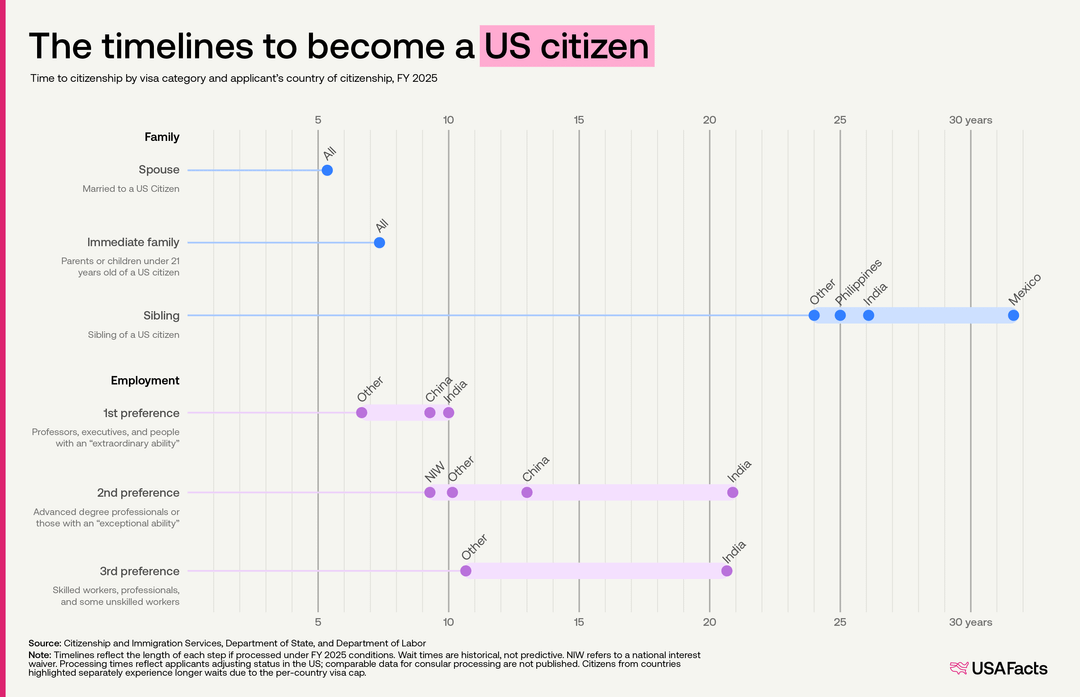
* **Chart 1:** Timelines reflect the length of each step if processed under FY 2025 conditions. Wait times are historical, not predictive. NIW refers to a national interest waiver. Processing times reflect applicants adjusting status in the US; comparable data for consular processing are not published. Citizens from countries highlighted separately experience longer waits due to the per-country visa cap.
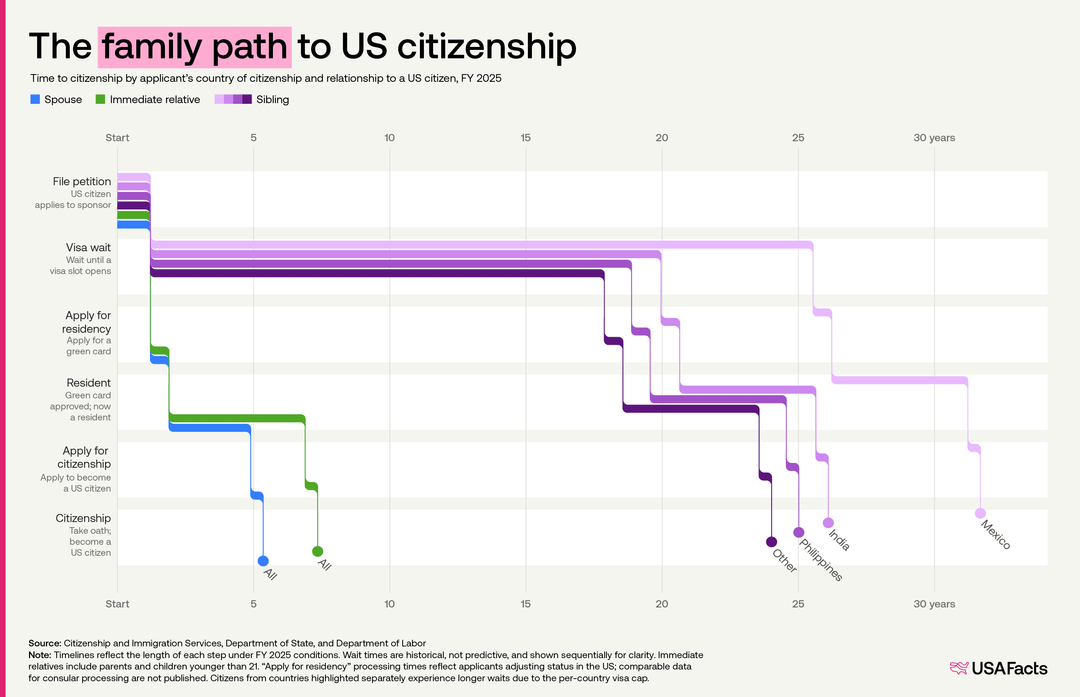
* **Chart 2:** Timelines reflect the length of each step under FY 2025 conditions. Wait times are historical, not predictive, and shown sequentially for clarity. Immediate relatives include parents and children younger than 21. Citizens from countries highlighted separately experience longer waits due to the per-country visa cap. “Apply for residency” processing times reflect adjusting status in the US; comparable data for consular processing are not published.
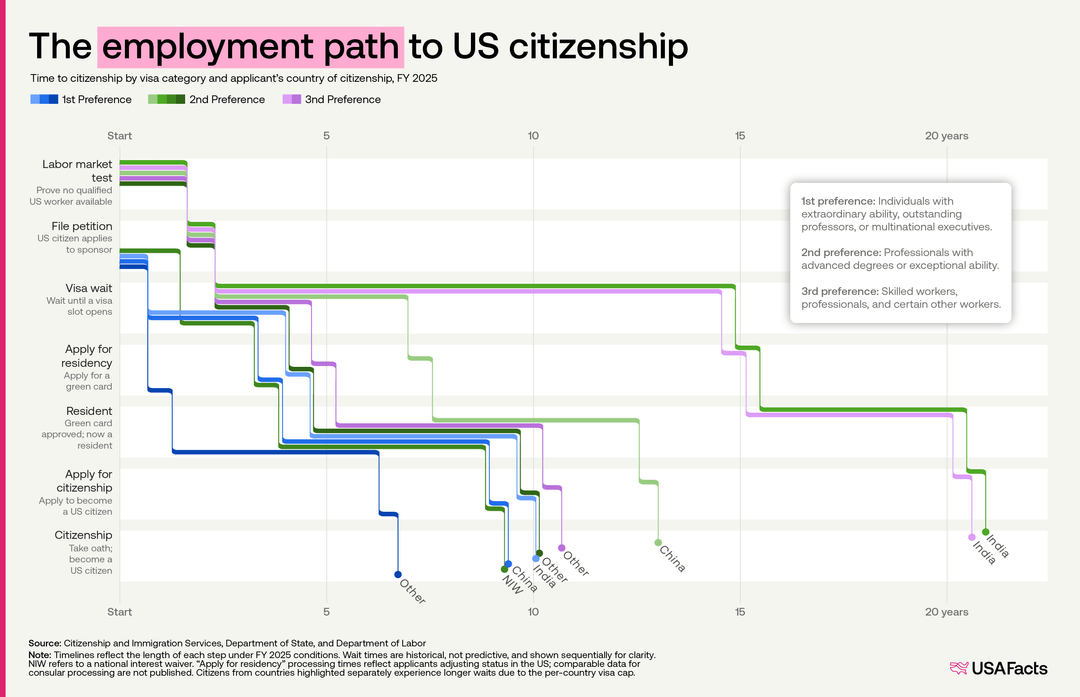
* **Chart 3:** Timelines reflect the length of each step under FY 2025 conditions. Wait times are historical, not predictive, and shown sequentially for clarity. NIW refers to a national interest waiver. Citizens from countries highlighted separately experience longer waits due to the per-country visa cap. “Apply for residency” processing times reflect adjusting status in the US; comparable data for consular processing are not published.
DrProfSrRyan on
I’m surprised just being a sibling of a US citizen is a valid path to citizenship. Pretty sure that’s not the case here in Germany.
USAFacts on
These charts show how long it can take to become a US citizen depending on your visa category and country of origin. Part of why we built this is because we couldn’t find a holistic viz anywhere. There are calculators and individual time-frame tables, but nothing that ties the entire journey (from petition to visa wait to green card to naturalization) into one view.
We made these using data from US Citizenship and Immigration Services, the State Department, and the Department of Labor. Every timeline reflects how long each step takes *under FY 2025 processing conditions*. Wait times are *historical*, not predictive — especially the visa-wait portions, which represent how long the people *currently* at the front of the line have been waiting.
The tricky bit was mapping out the exact sequence of steps for each pathway (family, employment, humanitarian aid) and figuring out how to visualize them together. The “ribbon” charts started as a completely different layout (the ribbons flowed upward at one point).
Here’s some context for the data:
* The process to become a US citizen requires someone to first obtain an immigrant visa before applying for residency (green card) and later (up to 5 years) applying for citizenship.
* The biggest factor in this timeline is visa availability. Visas for immediate relatives (parents or kids under 21) and spouses of US citizens aren’t capped, but most other categories are — and no more than 7% of certain visas can go to one country per year. That’s why applicants from India, China, Mexico, and the Philippines often face the longest waits.
* Family ties are the most common path to a green card. In FY 2023, nearly 65% of new green card holders qualified through a US citizen or lawful permanent resident relative. But how long the process takes depends entirely on who that relative is.
* Mexican siblings of US citizens who applied in 2001 – the year that George W. Bush entered the White House – started to become eligible for green cards in September 2025.
* Employment is the second most common path to a green card. In FY 2023, 16.7% of new green cards were issued through jobs or job offers in the US, though roughly half of those went to the workers’ spouses and children rather than the employees themselves.
* Humanitarian paths are the least predictable, which is why they’re not charted here. Refugee/asylum timelines aren’t fully published, so those waits vary widely and can’t be shown the same way.
* Green card holders still have to wait before naturalizing. Based on FY 2025 processing times, the full journey from receiving a green card to becoming a US citizen can take 3 to 6 years.
* There’s no limit on how many people can join the line awaiting a capped visa each year, so those applying now may be entering a much longer queue than those who applied years ago.
* Yes, being born in the US is the fastest timeline to become a citizen.
In contrast it took me 2.5yrs (via employment) to become a naturalized Canadian citizen.
lodestar72 on
Did we leave out Trump’s $5 million bribery vector?
genuine-clover199 on
Okay so visa classes for siblings, parents, extended family, unskilled labor should be eliminated ASAP
z0diark88 on
Is this path to citizenship or path to permanent residency (green card)?
[deleted] on
[deleted]
engin__r on
I know that this is controversial but five years is an insanely long time to wait for citizenship, let alone thirty years.
Rizak on
Love this chart. What tool did you use?
brotha_eric on
Shouldn’t be a pathway for parents, especially older parents who will end up on medicaid/medicare.
AwesomeAndy on
This doesn’t even include cost. My friend spent several thousand dollars for his Vietnamese wife to get citizenship, not even including trips to visit her, and they wouldn’t even give her a visa until after they were married, since assumed she would enter and stay.
Jaszuni on
Where screenshots from, these are nice visuals. I mean the software that creates it.
geraffes-are-so-dumb on
I adopted two children from Colombia and learned it was the absolute fastest path to citizenship. It still took two years.
Throughout the process, people kept telling them they were “lucky” which is my second least favorite thing that people say to adopted kids, but I let it slide in the context of immigration. We spent a lot of time in offices, but it’s nothing compared to what other folks do for citizenship.
The annoying part is that when my family came over in the early 1900s from Finland, they literally just showed up. How did we go from centuries of just show up to a 30 year wait in some cases?
jemenake on
This is what’s infuriating about the “illegals are cutting the line” notion. It comes from people who can’t tell you how long the lines are nor how many different ones there are nor how one is supposed to navigate them. Granted, these charts are about citizenship, but the ones for visas are similar. Back during his first term, I remember reading that Trump reduced the allowed number of admissions for asylum at our southern border to something like 1,500/yr (that’s right, a whopping 5 per day) and that the _waiting list_ was something like 60k people. So, you could expect to be on the list for 40 years. If you applied when you were 20, you could get admitted just about when your productive working years were coming to a close. Suuuuper.
soundlinked on
This doesn’t seem right. The green card application process for “other” shouldn’t take 6 years total.
OSUfirebird18 on
There was some law passed in the early 90s, forgot what, that allowed my family to be expedited like crazy. I came here when I was 5 and I think I was a citizen by 11/12 or something when my parents became citizens.
HoldingTheFire on
Should significantly shorten an add more legitimate paths. Anyone who wants to come to this country should be allowed to, like most people’s ancestors did.
onusofstrife on
Spouses of US Citizens can apply for Citizenship after three years. Assuming they came in on cr2 and not adjusting status which likely adds time to the estimate.
1isOneshot1 on
“Just wait your turn in line”
The line in question:
K04free on
How’s this compare to other places in the world? I heard that Switzerland and Japan are extremely difficult to become a citizen in.
najumobi on
For myself, parents, grandparents, and others of my extended family it took 13-25 years from the initial US visa application to naturalization.
thegiantgummybear on
Wild that Indians have to wait longer than Chinese. I’m assuming there are more Indians who want to come to the US so the queue is longer?
forkedquality on
Nice visualization. The only comments I have is that there is one more common family based path to citizenship – the fiancee, or K-1 visa. And there’s the diversity lottery.
philatio11 on
My father found the fastest path to citizenship available in his era. After medical school in the Philippines, he emigrated to do his residencies as part of a foreign doctor recruitment program. He was stuck in residency for years, which had the unintended consequence of him becoming a more specialized physician since he had to spend an extra two years waiting it out on a student visa. In the meanwhile he married a native-born American citizen. All of this (being a doctor with a professional degree, passing US boards, marrying an American) moved him along to where he finally was eligible for a green card AKA Permanent Resident Status. This also forces you to register for Selective Service. The second the government received his Selective Service registration, he was immediately drafted into the US Army and sent to Vietnam. He received a blue American passport at his army induction ceremony, and never even received the green card he was eligible for.
This pathway no longer exists. There is now an expedited process for honorably discharged vets serving in wartime (which covers all service since Sep 2001), which is about 77% of vets. The US does regularly deport veterans with green cards if they commit any crimes, most commonly DUIs, drug charges and domestic violence. Approximately 1/3rd of veterans have been arrested, markedly higher than the genpop rate of 20%. So simple math says that at least 51% of vets will get some accelerated path to citizenship, without controlling for correlations between misconduct and arrests. But definitely no guarantees.
iKidA on
Amazing. One of the best charts I’ve seen on here
CobblerYm on
My coworker, almost 40, got brought over by his parents from Mexico who overstayed their Visa when he was just two years old. They had two more kids in the states who are US Citizens. Coworker didn’t know he wasn’t a legal US Citizen until he was 16 and had to get his drivers license. His parents actually applied for US Citizenship and got it because they have two citizen children. Now his parents and both of his siblings and all his nieces and nephews are legal citizens, but he has no real path to citizenship. He’s never been to Mexico after the age of 2, doesn’t speak any Spanish, and has been gainfully employed in the states with a high paying job (6 figures). No way to get citizenship. He’s DACA, but that’s been a temporary relief if anything since it’s like the DACA crowd has been a pawn in politics lately. He’s terrified to leave his house because of ICE raids, even though he’s supposed to be “protected”, we all know how that goes.
Anyways, not sure why I’m posting this. The chart just made me think of it. People say “Come into the country the right way”, but what is he supposed to do? He’s no less American than me, and I’d be in a bad way if I got deported to Mexico. I’ve never been, I don’t speak the language, I’ve lived here my whole life and he’s lived here as long as he can remember.
Mr-Blah on
Fina-fuck8ng-ly a submission that understand the point of this sub.
Congratulations.
BlacksmithThink9494 on
Thirty years if you have a sibling thats a US citizen. Insane.
BlackWindBears on
So there is no path to citizenship if you just want to become an American? That’s a shame
Bear_necessities96 on
This is for the “come legally”, it’s a lengthy process and can takes decades
Canadian_Invader on
Service does in fact, NOT, guarantee citizenship.
daveescaped on
It only takes 5! That’s not bad. So you get in line and they say, “Hey! Take 5 and your citizenship will be done!”.

![The timelines to become a US citizen [OC]](https://www.byteseu.com/wp-content/uploads/2025/11/p3r79jl1p11g1-1024x661.png "The timelines to become a US citizen [OC]")
33 Comments
Source: US Citizenship and Immigration Services, State Department, Labor Department
Tools: Designed in Figma, hand-coded in chart software, touched up in Illustrator
Notes: Citizens from countries highlighted separately in these charts experience longer waits due to the per-country visa cap.
* **Chart 1:** Timelines reflect the length of each step if processed under FY 2025 conditions. Wait times are historical, not predictive. NIW refers to a national interest waiver. Processing times reflect applicants adjusting status in the US; comparable data for consular processing are not published. Citizens from countries highlighted separately experience longer waits due to the per-country visa cap.
* **Chart 2:** Timelines reflect the length of each step under FY 2025 conditions. Wait times are historical, not predictive, and shown sequentially for clarity. Immediate relatives include parents and children younger than 21. Citizens from countries highlighted separately experience longer waits due to the per-country visa cap. “Apply for residency” processing times reflect adjusting status in the US; comparable data for consular processing are not published.
* **Chart 3:** Timelines reflect the length of each step under FY 2025 conditions. Wait times are historical, not predictive, and shown sequentially for clarity. NIW refers to a national interest waiver. Citizens from countries highlighted separately experience longer waits due to the per-country visa cap. “Apply for residency” processing times reflect adjusting status in the US; comparable data for consular processing are not published.
I’m surprised just being a sibling of a US citizen is a valid path to citizenship. Pretty sure that’s not the case here in Germany.
These charts show how long it can take to become a US citizen depending on your visa category and country of origin. Part of why we built this is because we couldn’t find a holistic viz anywhere. There are calculators and individual time-frame tables, but nothing that ties the entire journey (from petition to visa wait to green card to naturalization) into one view.
We made these using data from US Citizenship and Immigration Services, the State Department, and the Department of Labor. Every timeline reflects how long each step takes *under FY 2025 processing conditions*. Wait times are *historical*, not predictive — especially the visa-wait portions, which represent how long the people *currently* at the front of the line have been waiting.
The tricky bit was mapping out the exact sequence of steps for each pathway (family, employment, humanitarian aid) and figuring out how to visualize them together. The “ribbon” charts started as a completely different layout (the ribbons flowed upward at one point).
Here’s some context for the data:
* The process to become a US citizen requires someone to first obtain an immigrant visa before applying for residency (green card) and later (up to 5 years) applying for citizenship.
* The biggest factor in this timeline is visa availability. Visas for immediate relatives (parents or kids under 21) and spouses of US citizens aren’t capped, but most other categories are — and no more than 7% of certain visas can go to one country per year. That’s why applicants from India, China, Mexico, and the Philippines often face the longest waits.
* Family ties are the most common path to a green card. In FY 2023, nearly 65% of new green card holders qualified through a US citizen or lawful permanent resident relative. But how long the process takes depends entirely on who that relative is.
* Mexican siblings of US citizens who applied in 2001 – the year that George W. Bush entered the White House – started to become eligible for green cards in September 2025.
* Employment is the second most common path to a green card. In FY 2023, 16.7% of new green cards were issued through jobs or job offers in the US, though roughly half of those went to the workers’ spouses and children rather than the employees themselves.
* Humanitarian paths are the least predictable, which is why they’re not charted here. Refugee/asylum timelines aren’t fully published, so those waits vary widely and can’t be shown the same way.
* Green card holders still have to wait before naturalizing. Based on FY 2025 processing times, the full journey from receiving a green card to becoming a US citizen can take 3 to 6 years.
* There’s no limit on how many people can join the line awaiting a capped visa each year, so those applying now may be entering a much longer queue than those who applied years ago.
* Yes, being born in the US is the fastest timeline to become a citizen.
A bit more context and interactive versions of the family and employment charts [here](https://usafacts.org/articles/how-long-can-it-take-to-become-a-us-citizen/).
In contrast it took me 2.5yrs (via employment) to become a naturalized Canadian citizen.
Did we leave out Trump’s $5 million bribery vector?
Okay so visa classes for siblings, parents, extended family, unskilled labor should be eliminated ASAP
Is this path to citizenship or path to permanent residency (green card)?
[deleted]
I know that this is controversial but five years is an insanely long time to wait for citizenship, let alone thirty years.
Love this chart. What tool did you use?
Shouldn’t be a pathway for parents, especially older parents who will end up on medicaid/medicare.
This doesn’t even include cost. My friend spent several thousand dollars for his Vietnamese wife to get citizenship, not even including trips to visit her, and they wouldn’t even give her a visa until after they were married, since assumed she would enter and stay.
Where screenshots from, these are nice visuals. I mean the software that creates it.
I adopted two children from Colombia and learned it was the absolute fastest path to citizenship. It still took two years.
Throughout the process, people kept telling them they were “lucky” which is my second least favorite thing that people say to adopted kids, but I let it slide in the context of immigration. We spent a lot of time in offices, but it’s nothing compared to what other folks do for citizenship.
The annoying part is that when my family came over in the early 1900s from Finland, they literally just showed up. How did we go from centuries of just show up to a 30 year wait in some cases?
This is what’s infuriating about the “illegals are cutting the line” notion. It comes from people who can’t tell you how long the lines are nor how many different ones there are nor how one is supposed to navigate them. Granted, these charts are about citizenship, but the ones for visas are similar. Back during his first term, I remember reading that Trump reduced the allowed number of admissions for asylum at our southern border to something like 1,500/yr (that’s right, a whopping 5 per day) and that the _waiting list_ was something like 60k people. So, you could expect to be on the list for 40 years. If you applied when you were 20, you could get admitted just about when your productive working years were coming to a close. Suuuuper.
This doesn’t seem right. The green card application process for “other” shouldn’t take 6 years total.
There was some law passed in the early 90s, forgot what, that allowed my family to be expedited like crazy. I came here when I was 5 and I think I was a citizen by 11/12 or something when my parents became citizens.
Should significantly shorten an add more legitimate paths. Anyone who wants to come to this country should be allowed to, like most people’s ancestors did.
Spouses of US Citizens can apply for Citizenship after three years. Assuming they came in on cr2 and not adjusting status which likely adds time to the estimate.
“Just wait your turn in line”
The line in question:
How’s this compare to other places in the world? I heard that Switzerland and Japan are extremely difficult to become a citizen in.
For myself, parents, grandparents, and others of my extended family it took 13-25 years from the initial US visa application to naturalization.
Wild that Indians have to wait longer than Chinese. I’m assuming there are more Indians who want to come to the US so the queue is longer?
Nice visualization. The only comments I have is that there is one more common family based path to citizenship – the fiancee, or K-1 visa. And there’s the diversity lottery.
My father found the fastest path to citizenship available in his era. After medical school in the Philippines, he emigrated to do his residencies as part of a foreign doctor recruitment program. He was stuck in residency for years, which had the unintended consequence of him becoming a more specialized physician since he had to spend an extra two years waiting it out on a student visa. In the meanwhile he married a native-born American citizen. All of this (being a doctor with a professional degree, passing US boards, marrying an American) moved him along to where he finally was eligible for a green card AKA Permanent Resident Status. This also forces you to register for Selective Service. The second the government received his Selective Service registration, he was immediately drafted into the US Army and sent to Vietnam. He received a blue American passport at his army induction ceremony, and never even received the green card he was eligible for.
This pathway no longer exists. There is now an expedited process for honorably discharged vets serving in wartime (which covers all service since Sep 2001), which is about 77% of vets. The US does regularly deport veterans with green cards if they commit any crimes, most commonly DUIs, drug charges and domestic violence. Approximately 1/3rd of veterans have been arrested, markedly higher than the genpop rate of 20%. So simple math says that at least 51% of vets will get some accelerated path to citizenship, without controlling for correlations between misconduct and arrests. But definitely no guarantees.
Amazing. One of the best charts I’ve seen on here
My coworker, almost 40, got brought over by his parents from Mexico who overstayed their Visa when he was just two years old. They had two more kids in the states who are US Citizens. Coworker didn’t know he wasn’t a legal US Citizen until he was 16 and had to get his drivers license. His parents actually applied for US Citizenship and got it because they have two citizen children. Now his parents and both of his siblings and all his nieces and nephews are legal citizens, but he has no real path to citizenship. He’s never been to Mexico after the age of 2, doesn’t speak any Spanish, and has been gainfully employed in the states with a high paying job (6 figures). No way to get citizenship. He’s DACA, but that’s been a temporary relief if anything since it’s like the DACA crowd has been a pawn in politics lately. He’s terrified to leave his house because of ICE raids, even though he’s supposed to be “protected”, we all know how that goes.
Anyways, not sure why I’m posting this. The chart just made me think of it. People say “Come into the country the right way”, but what is he supposed to do? He’s no less American than me, and I’d be in a bad way if I got deported to Mexico. I’ve never been, I don’t speak the language, I’ve lived here my whole life and he’s lived here as long as he can remember.
Fina-fuck8ng-ly a submission that understand the point of this sub.
Congratulations.
Thirty years if you have a sibling thats a US citizen. Insane.
So there is no path to citizenship if you just want to become an American? That’s a shame
This is for the “come legally”, it’s a lengthy process and can takes decades
Service does in fact, NOT, guarantee citizenship.
It only takes 5! That’s not bad. So you get in line and they say, “Hey! Take 5 and your citizenship will be done!”.
Oh that’s years?! 🙂