
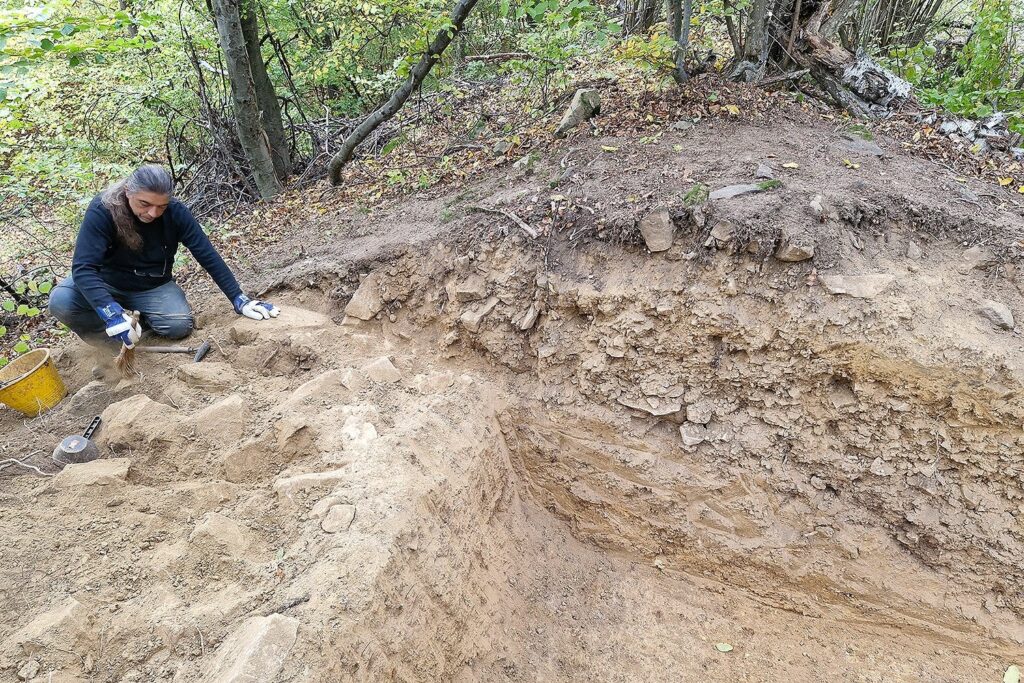
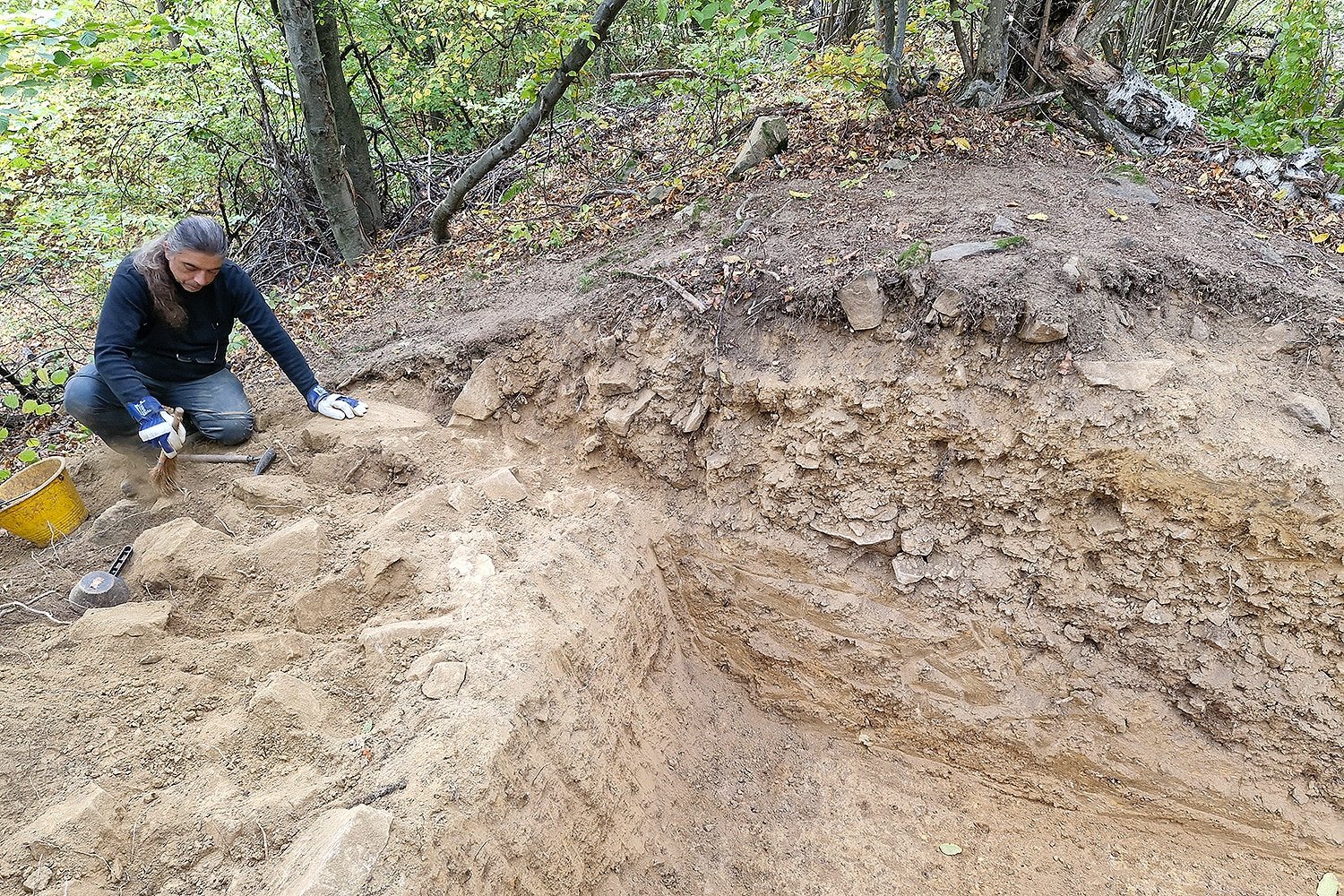
Archaeologists excavate the massive Late Bronze Age fortification uncovered on Papuk Mountain, Croatia. Credit: Kristijan Toplak / Virovitičko-podravska županija
Researchers have uncovered a monumental Bronze Age fortification on Papuk Mountain that challenges long-held assumptions about early settlement in northeastern Croatia. The discovery was made at the Gradina site, a steep and forested peak 611 meters (2,005 feet) above sea level, where the terrain feels so exposed that aircraft seem close to the treetops.
Two-year investigation finally leads to breakthrough
The excavation is led by Hrvoje Potrebica, professor of archaeology at the University of Zagreb, with collaborators Franka Ovčarić and Luka Drahotusky-Bruketa. Mislav Šljivac, director of the Papuk Gate Tourist Board, observed the latest phase of work. Potrebica says the team spent two years testing different parts of the site with limited results. That changed when the exposed section of rampart revealed something far more substantial than expected.
Potrebica describes the moment as striking. He said the discovery felt like hitting the jackpot, and those nearby compared his reaction to the famous story of Archimedes shouting, “Eureka,” Greek for “I have found it.”
Massive stone ramparts reveal advanced prehistoric engineering
The site sits between the volcanic formations of Rupnica and the Trešnjevica quarry, an area first brought to archaeological attention through illegal metal detecting. A hoard of Celtic silver coins was removed and later surfaced on the black market.
Experts analyzed part of the recovered material and found that the coins may be a special type, possibly minted locally. That clue encouraged researchers to investigate more deeply.
During the latest campaign, the team cut a cross-section through what had seemed like an ordinary rampart. The section exposed a three-layer defensive system: an inner core of compacted earth, a substantial stone framework, and an outer layer of packed soil. The design reflects deliberate engineering rather than simple piling of material.
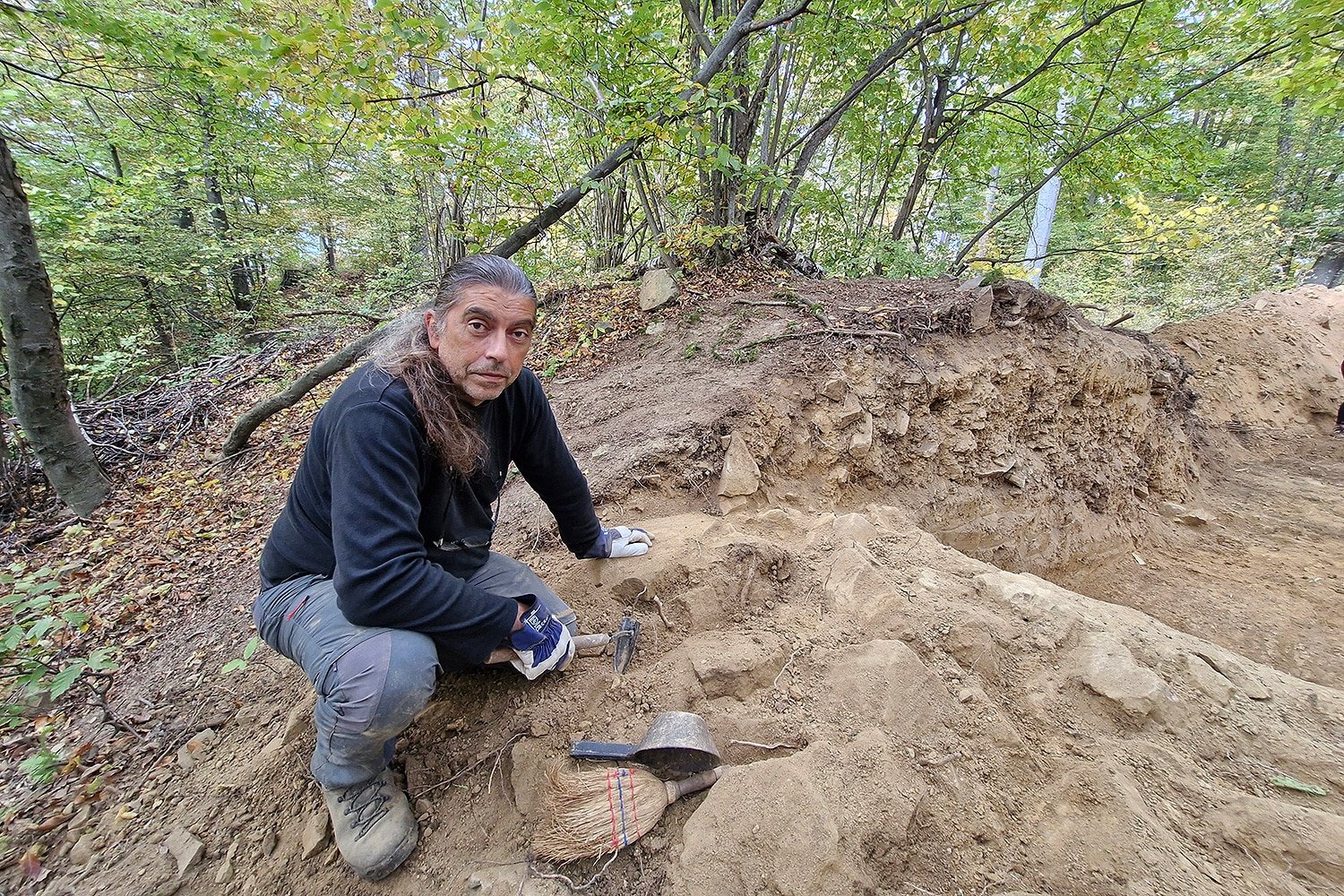
Excavation exposes the three-layer construction of the prehistoric ramparts. Credit: Kristijan Toplak / Virovitičko-podravska županija
In some places, the rampart reaches two meters (6.5 feet) on the inside and rises up to seven or eight meters (23–26 feet) on the outside, where it follows the natural slope of the mountain.
Rare dry-stone wall uncovered inside outer fortification
Inside the structure, the team identified another defensive wall built in dry stone and measuring more than a meter and a half (5 feet) in thickness. Potrebica says that dry-stone constructions of this size and preservation level are uncommon for this region and period. He added that in his 25-year career, he has never seen a comparable example.
The fortification encloses roughly four hectares, a scale that points to a significant prehistoric presence. Many prehistoric defenses in the region were built from wood and earth and did not survive. The stone construction at Gradina stands out as one of the best-preserved examples in this part of Croatia.
Finds push the site back to the Late Bronze Age
The team originally believed the site belonged to the La Tène period, dating to the century before Christ. Excavated ceramics, however, shifted the timeline dramatically. The pottery belongs to the Late Bronze Age, roughly 1,000 to 1,200 years B.C., a period with few comparable finds in the area.
Archaeologists also uncovered traces of a dwelling and fragments of a ceramic vessel, early evidence of daily life inside the fortification. Potrebica says the discovery marks a turning point in the investigation, revealing a much earlier and more complex community than researchers initially expected.