
Subscribe
Vienna, Austria – A new chapter in Africa–Europe cooperation opened this week as the United Nations Industrial Development Organization (UNIDO) signed a project document with the Government of Rwanda to bolster national capacities for responding to industrial and natural hazards. The initiative, funded by the Republic of Poland, aims to strengthen Rwanda’s resilience and industrial safety in the face of rising risks.
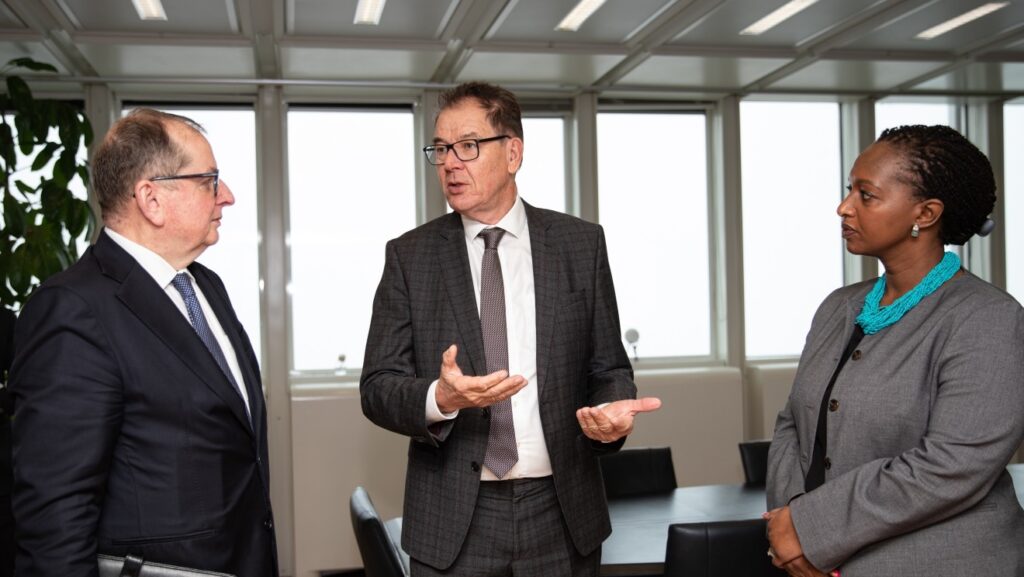
The ceremony took place at UNIDO headquarters in Vienna, where Director General Gerd Müller and Rwanda’s Permanent Representative to UNIDO, Ambassador Urujeni Bakuramutsa, signed the agreement in the presence of Poland’s Head of Mission to UNIDO, Ambassador Marek Szczygieł, alongside representatives of Poland’s Ministry of Economic Development and Technology.
The project, titled Strengthening Rwanda’s capacities to respond to industrial and natural hazards, will be implemented by UNIDO in partnership with the Fire and Rescue Brigade of the Rwanda National Police. The focus is to enhance institutional capacity, conduct a comprehensive feasibility study and risk assessment, and develop a roadmap to improve national firefighting and emergency response systems. A second phase may involve specialised firefighting equipment and broader capacity building.
Ambassador Bakuramutsa said the project “embodies the principles of international cooperation that define effective multilateralism”. She highlighted that it aligns with Rwanda’s Second National Strategy for Transformation and Vision 2050, contributing to the goal of building a modern, competitive and green industrial economy.
From the Polish side, Ambassador Szczygieł emphasised Poland’s strong commitment to development cooperation with African countries. He described the Rwanda initiative as a prime example of that commitment and noted that Poland’s partnership with UNIDO in previous projects in Tajikistan, Moldova and Georgia now extends to Africa.
For Rwanda, the project arrives at a moment when the country is actively advancing its industrialisation agenda while confronting natural and industrial risks. Rwanda is vulnerable to floods, landslides and other climate-related hazards, which underscore the urgency for strengthened disaster risk management and industrial safety mechanisms.
The new initiative is expected to produce several key outcomes: improved institutional frameworks for hazard response; a mapped-out strategy for firefighting and emergency systems; and the groundwork for equipment and training to elevate Rwanda’s preparedness. In doing so, the project supports UNIDO’s strategic focus on industrial safety, resilient supply chains and sustainable industrialisation.
Critically, the triangular cooperation model – donor Poland, technical partner UNIDO and recipient Rwanda – signals an evolving architecture of global development partnerships. It demonstrates how emerging donors can engage in meaningful cooperation beyond traditional North-South models while promoting capacity building at the national level in Africa. The project also underscores the link between industrial policy, sustainable development and hazard risk reduction.
As Rwanda continues to push forward on its development trajectory, this targeted partnership offers a timely contribution to making the country’s industrial ecosystem safer, greener and more resilient. The hope is that the efforts will not only reduce the human and economic costs of hazards but will enable Rwanda to sustain its industrial growth with confidence.
Related