
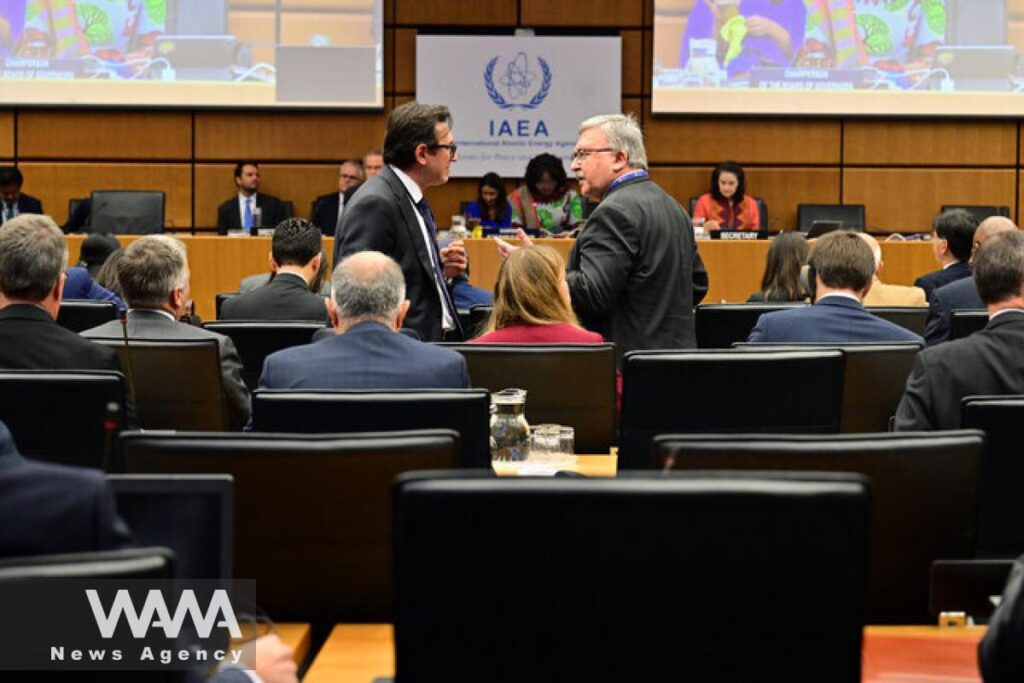
WANA (Nov 15) – Despite moves by three European countries ahead of the IAEA Board of Governors meeting, a Wall Street Journal correspondent says that referring Iran’s nuclear file from the Agency to the UN Security Council is not on the agenda.
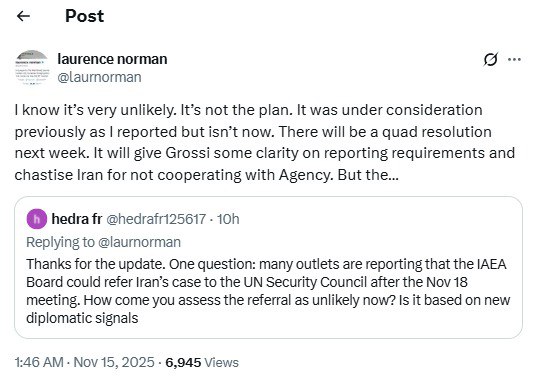
Lawrence Norman, the Wall Street Journal’s Vienna-based reporter, wrote on X that the possibility of the Board referring Iran’s case to the UN Security Council after its November 18 meeting is “very unlikely.” “I know it’s very unlikely. It’s not the plan,” he said.
Norman added: “It was under consideration previously, as I reported, but isn’t now. There will be a quad resolution [by the U.S. and the E3] next week. It will give Grossi some clarity on reporting requirements and chastise Iran for not cooperating with the Agency.”
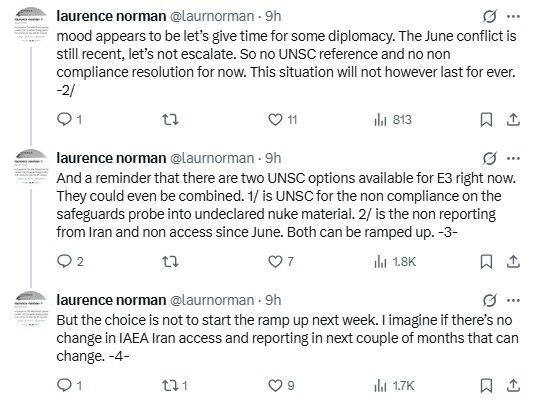
He went on to say that the prevailing mood appears to be: “let’s give time for some diplomacy. The June conflict [Israel’s and the U.S.’s attack on Iran’s nuclear facilities] is still recent; let’s not escalate. So no UNSC reference and no non-compliance resolution for now. This situation will not, however, last forever.”
Norman noted, as a “reminder,” that the Europeans currently have two potential Security Council paths — which could also be combined:
- Referral based on Iran’s lack of cooperation in safeguards investigations related to undeclared nuclear material, and
- Referral based on Iran’s failure to report and provide access to the Agency since June.
“Both options are viable sources of pressure,” he said.
He added, “But the choice is not to start the ramp-up next week. I imagine if there’s no change in IAEA Iran access and reporting in the next couple of months, that can change.”
Earlier, Iran’s ambassador to the IAEA, Reza Najafi, responding to the draft resolution introduced by the U.S. and the three European states, asserted Iran’s right to respond appropriately to any unlawful or unjustified action taken by those countries.
According to Al Mayadeen, the draft resolution demands that Iran halt all uranium enrichment and reprocessing activities, including R&D. Germany, France, and the UK have also urged Iran to act in accordance with the Additional Protocol, claiming Iran has withheld information on its uranium stockpile for the past five months.
Najafi, referring to the issue of “snapback,” said: “The U.S. and the three European countries are trying to impose in Vienna — by exploiting their numerical majority in the Agency’s Board — what they failed to achieve in New York.”
He stressed that imposing reporting obligations on the IAEA Director General based on expired Security Council resolutions is “entirely illegal and unjustified” and would only complicate the situation and deal “another blow to diplomacy.”
According to Russia’s permanent representative in Vienna, Mikhail Ulyanov, the IAEA Board of Governors will meet from Wednesday to Friday — the first meeting after the snapback episode.
Kazem Gharibabadi, Iran’s deputy foreign minister for legal and international affairs, recently emphasized that Director General Rafael Grossi has no obligation to keep the JCPOA and reporting on Iran’s JCPOA commitments on the Board’s agenda.
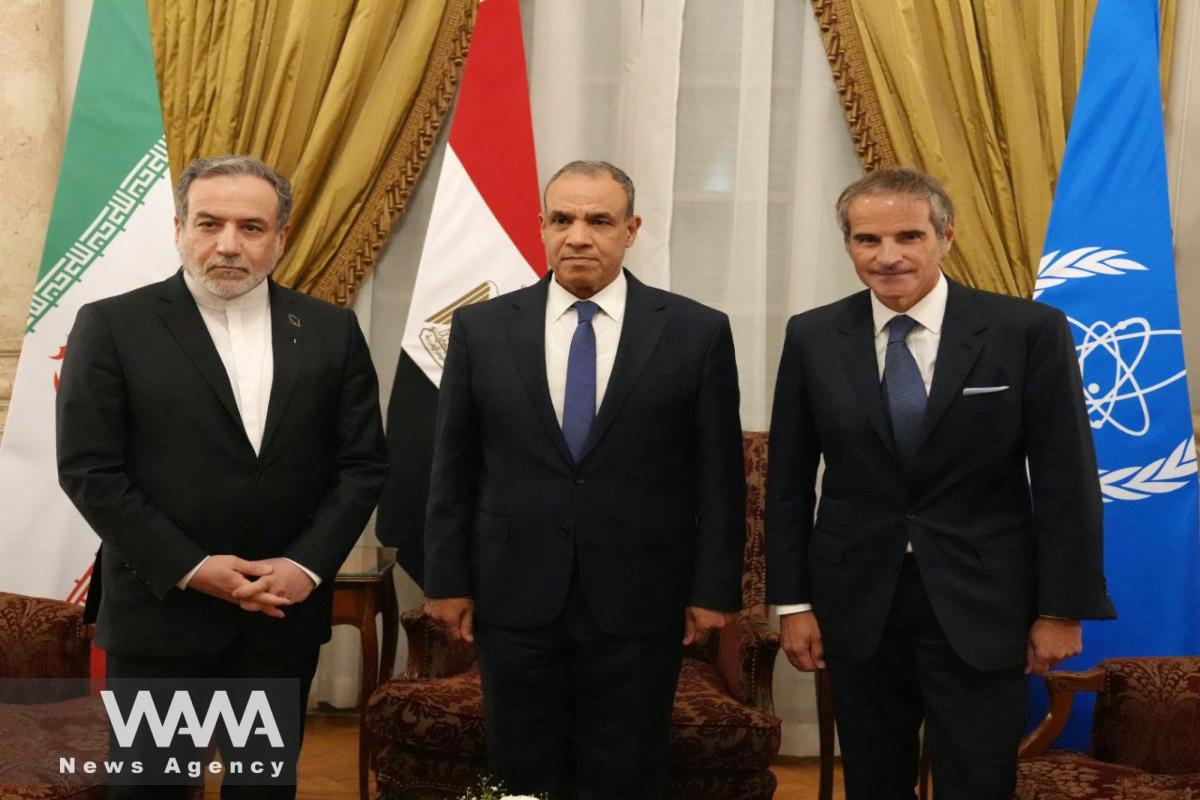
Meeting between Rafael Grossi, Director General of the International Atomic Energy Agency, Seyed Abbas Araghchi, Minister of Foreign Affairs of the Islamic Republic of Iran, and Badr Abdelatty, Minister of Foreign Affairs of Egypt. Social media / WANA News Agency
Nonetheless, Grossi’s recent reports state that the Agency has been unable to verify Iran’s enriched-uranium stockpile since the 12-day war, and that the situation “requires urgent attention.”
Regarding the enriched uranium in question, Foreign Minister Seyed Abbas Araghchi has repeatedly said the material remains buried at the site bombed by the U.S. and Israel.
Iran’s Foreign Ministry spokesperson Esmaeil Baghaei recently said, “Because of the aggressive action by Israel and the U.S., we are facing exceptional circumstances that the Agency must understand. The situation is not normal. Before the latest military attack, we were cooperating with the Agency in the usual manner, and after the Cairo agreement, we reached an understanding for cooperation under the new conditions.”
“The Europeans are the side that should be blamed — they misused the JCPOA dispute-resolution mechanism to try to restore sanctions and destroyed the entire process with the Agency,” he added.
He stressed that Iran’s mission in Vienna is in constant contact with Board member states and “will work to best protect our national interests at the upcoming meeting.”
Iran’s ambassador to the UN, Amir Saeed Iravani, told the UN General Assembly on Friday that the three European states, which have themselves violated the JCPOA and Resolution 2231, “have no legal standing to invoke its provisions.”
He added, “We will never surrender to threats or coercion. Military aggression and economic terrorism will never force Iran to abandon its legitimate rights.”
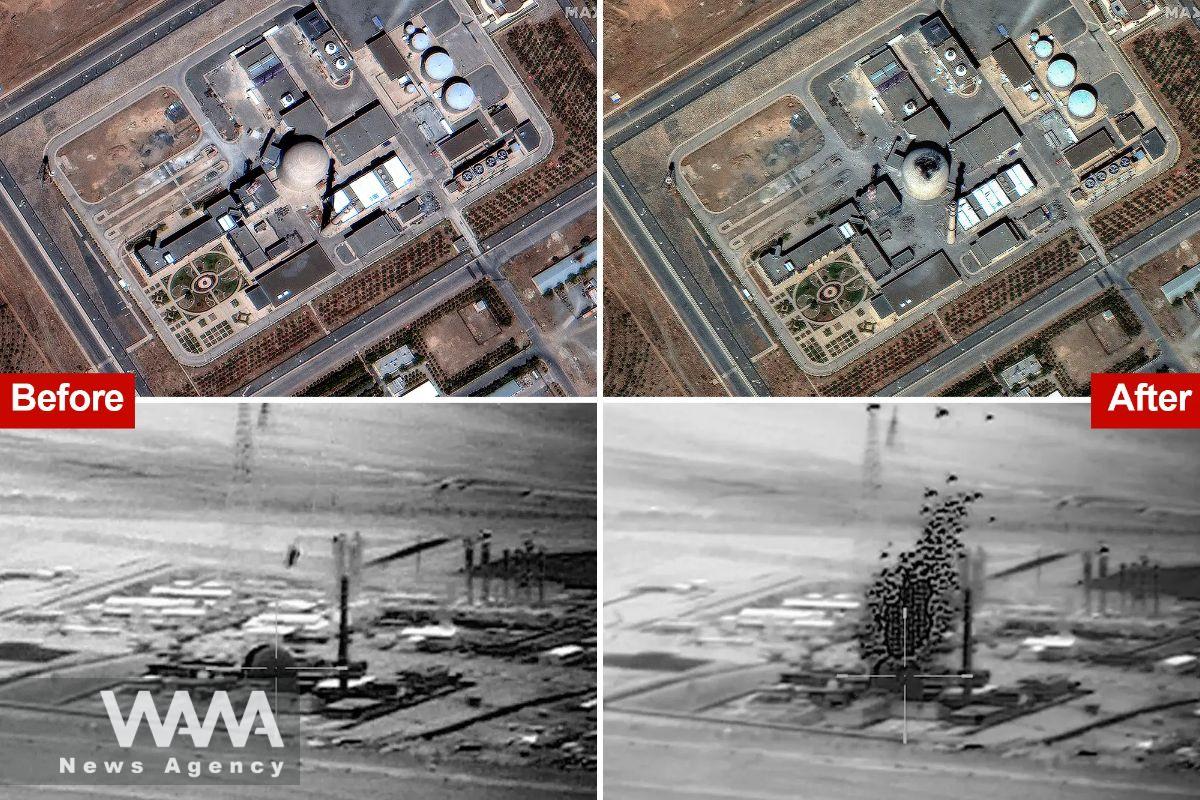
Arak nuclear facility after the U.S. strike. Social media/ WANA News Agency