
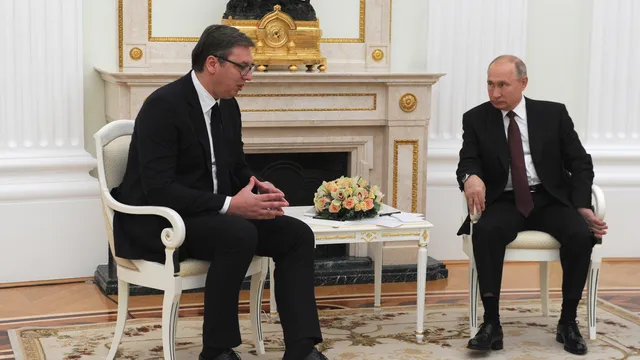
For 11 months, Vucic has been hoping for some kind of political and economic miracle that will allow him to remain the self-styled Serbian oasis.
Is President Aleksandar Vucic’s fear of Vladimir Putin stronger than Serbia’s national interest? For now, there is no answer to this question, raised by the opposition in Belgrade — but in seven days, when the government must decide the fate of NIS, it will become clear. By then, Serbia will also learn what the so-called “most difficult decision in its modern history” will be, and how the oil-sector knot will be untangled — the same knot on which Serbia’s economic future now depends after Washington’s explicit sanctions.
For 11 months, Vucic has been hoping for some kind of political and economic miracle that will allow him to remain the self-styled Serbian oasis — the man who gets friendly pats on the shoulder from both Trump and Putin, even though his heart beats for Moscow.
Putin, however, shows no interest in Vucic, is unwilling to compromise, and ignores Belgrade’s reminders that Serbia is the only country in Europe that has not imposed sanctions on Russia — as if he has forgotten the “eternal friendship” once proclaimed. Vucic had counted on Moscow to find some form of compromise, even after the illusions were shattered that Russia might sell Serbia its share in NIS. This remained true even when it became clear that Vucic was not asking about the price and was prepared to pay far more than any potential buyer if negotiations failed.
For now, Vucic does not want nationalization or confiscation of NIS, but economic experts in Belgrade warn that finding a buyer in a single week is close to impossible.
Others note that Russia did not extend its gas-supply contract with Serbia, a decision that unsettled the Serbian president. Many stress that Moscow is determined to preserve its political influence in Serbia — exerting the pressure of a great power that clearly sees Vucic as its obedient vassal.
Professor Goran Radosavljevic argues that the decision on NIS is not difficult for the Serbian state, only for the Serbian government. It is dramatizing the situation to appear as though it is sacrificing itself for the people, despite having done nothing for 11 months — even though it has been clear since January that the United States wants NIS free of Russian ownership.
And while officials in Belgrade publicly express hope that Serbia’s “Russian friends” will understand the seriousness of the crisis and help the country, Vucic should also be concerned that not all of his ministers share his views. It is becoming increasingly difficult for him to convince ordinary Serbs that Russia’s affection is limitless and that Moscow is not acting solely in its own interests. Despite Vucic’s attempts to reassure people that there will be no fuel crisis and that the gasoline-filled bottles from the 1990s are a relic of the past, a sense of quiet panic, uncertainty, and unease is palpable.
Serbian democrats are clear: the solution to the crisis is obvious. Serbia must align its policies with the standards of the European Union — not with Vucic, who for years amplified Russian propaganda and is now trying to present himself as the savior from a crisis with NIS that he created himself. | BGNES
—
Eli Yurukova, BGNES correspondent in Belgrade