
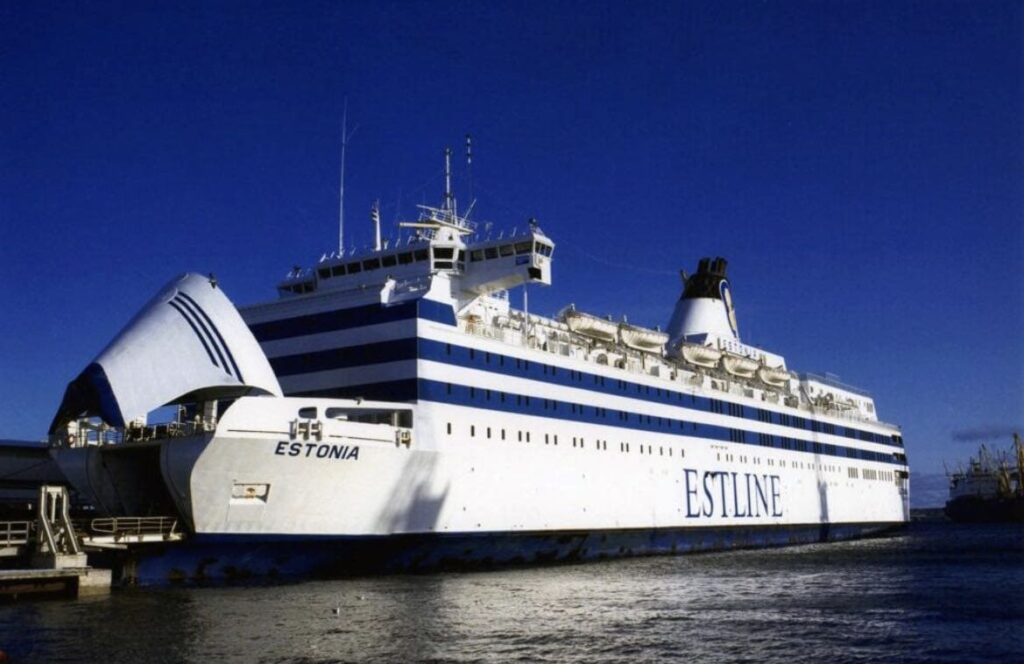
Russia stands accused of using a marine grave site for espionage operations against NATO ships.
A report accuses GUGI, Russia’s Main Directorate for Deep-Sea Research, of attaching underwater sensors on the sunken wreck of the ferry Estonia. The allegations were made by German outlets WDR, NDR and Süddeutsche Zeitung, who accuse Russia of exploiting the site’s status as undriveable and a protected grave to install underwater monitoring sensors.
On September 28th, 1994, the Tallinn–Stockholm ferry Estonia sank in a fierce storm about 35 km/22 miles from the Finnish island of Utö. Sadly, the event was very quick and resulted in the death of 825 people.
Due to the wreck lying at a depth of nearly 80m/250ft, very few bodies were recovered and the wreck has been treated as a mass grave. The governments of Finland, Sweden and Estonia established a legal exclusion zone in 1995, called the “Estonia Law.” This, in effect, barred access to the site.
According to reports, suspicions have arisen that Russia has turned the wreck into a training and operational site for underwater activities. Investigators suggest the possibility that equipment has been cached on or near the wreck to aid precise navigation for remotely operated vehicles and underwater drones.
In addition, devices fixed to the wreck would be challenging to detect without authorized dives or specialized inspections. Russia is no stranger to allegations of underwater espionage, and security sources indicate that similar installations have been found elsewhere in the Baltic and Barents seas, and that there have been previous reports of suspected Russian sensors off the UK coast.
Two Swedish filmmakers, Henrik Evertsson and Linus Andersson, were prosecuted in 2021 for diving the site and making a documentary called. “Estonia – A Find That Changes Everything.”