
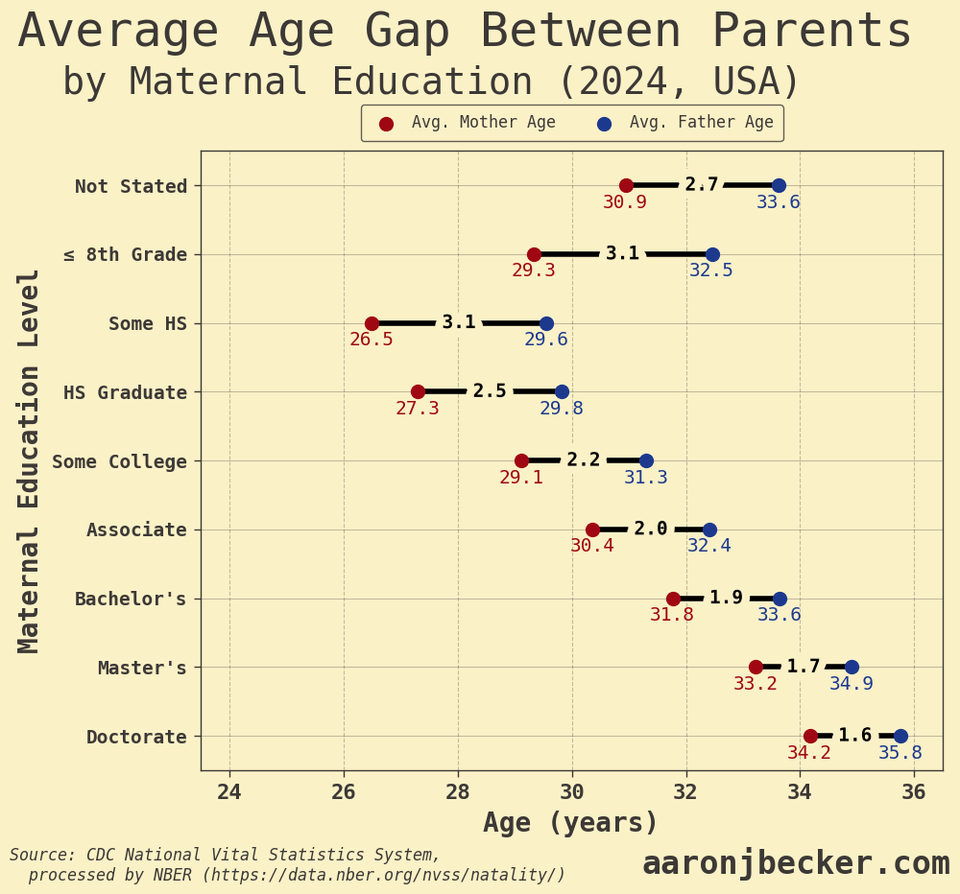
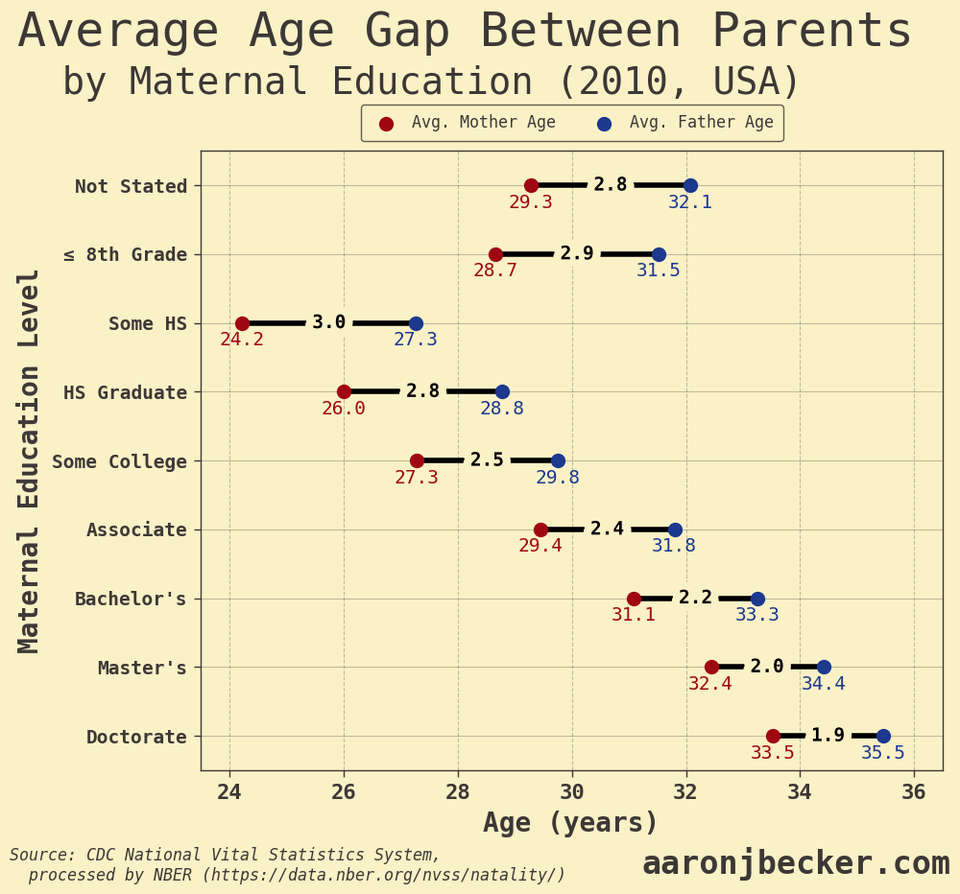
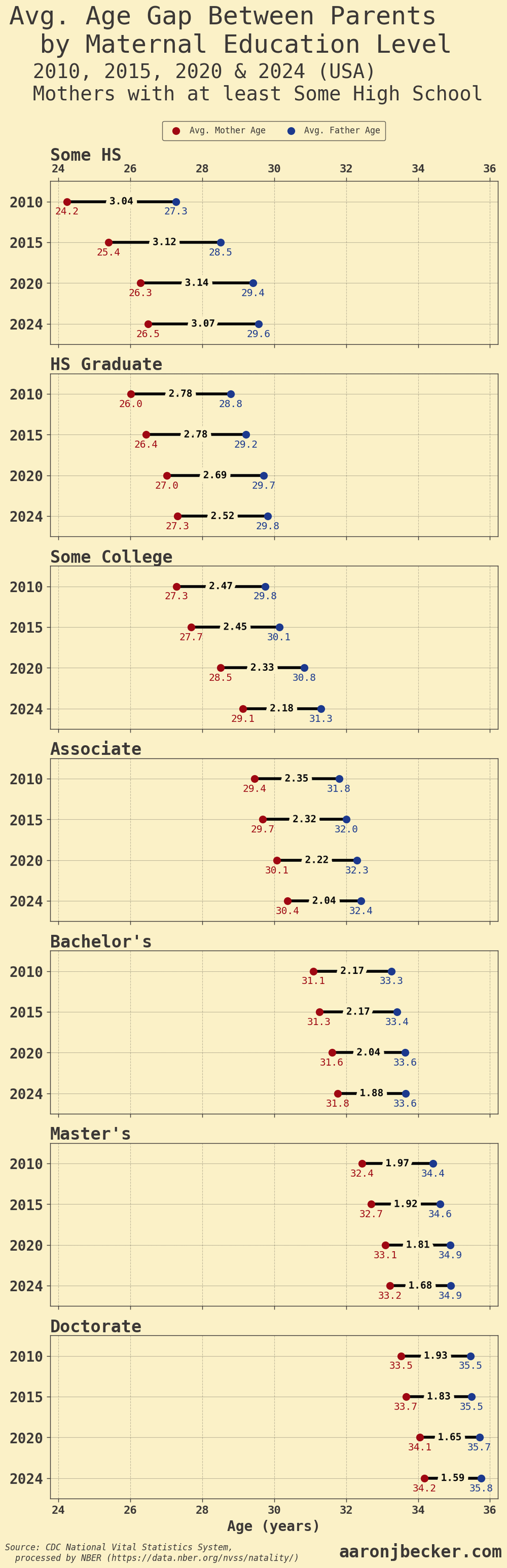
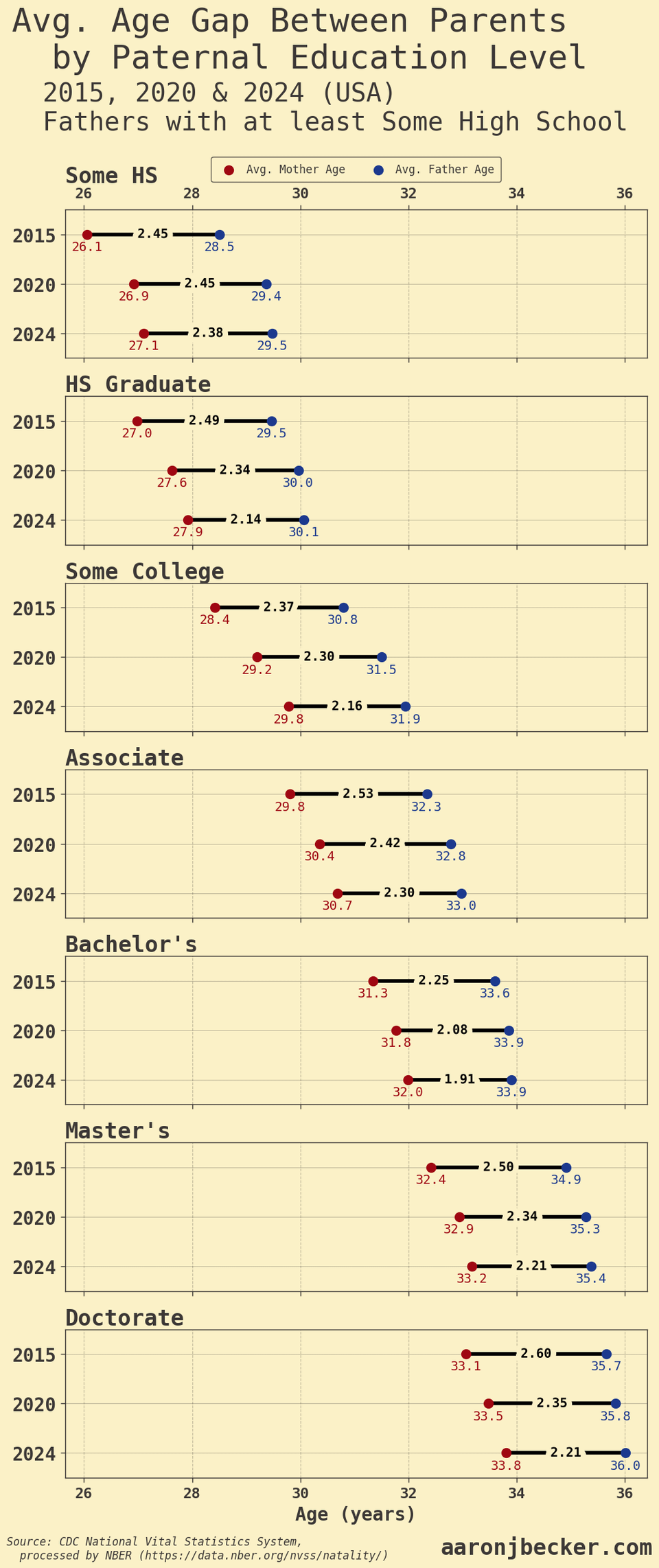
In the United States, more educated mothers are not only older, on average, but also closer in age to their male partners. As couples have delayed having children between 2010 and 2024, age gaps have narrowed at every level of parental educational attainment, indicating that parents are increasingly having children at a similar life stage.
2010 and 2024 charts are on the same X axis to make comparison easier. Third chart shows trends over time grouped by maternal education level, fourth chart shows the same but by paternal education level.
Code walkthrough, more details, and notes on data sources: https://aaronjbecker.com/posts/syncing-life-stages-trends-in-parental-age-by-educational-attainment/
Posted by aar0nbecker
11 Comments
Data source:
* birth data files and documentation: [https://www.cdc.gov/nchs/data_access/vitalstatsonline.htm](https://www.cdc.gov/nchs/data_access/vitalstatsonline.htm)
* CSV versions of birth data files: [https://data.nber.org/nvss/natality/csv/](https://data.nber.org/nvss/natality/csv/)
Tools used:
* Analysis: polars
* Visualization: matplotlib
Data on maternal educational attainment is only available since ~2005, and remains very spotty until 2010. Before 2005 education was reported in terms of years of education rather than attainment levels, which makes it difficult to compare earlier and more recent data. To make matters worse, there’s a blind spot in the data while this transition is underway. Paternal education has only been reported since 2011, and only reliably since ~2015. Although it’s collected by the CDC’s National Center for Health Statistics, the data is ultimately sourced from each state’s vital records office, meaning that different reporting standards and encodings introduce some noise, particularly over time.
Code walkthrough, more details, and notes on data sources: [https://aaronjbecker.com/posts/syncing-life-stages-trends-in-parental-age-by-educational-attainment/](https://aaronjbecker.com/posts/syncing-life-stages-trends-in-parental-age-by-educational-attainment/)
The age-gap part is interesting but…
> more educated mothers are not only older, on average,
Isn’t the maternal age data skewed by the fact that a mother basically **can’t** have completed certain levels of education without reaching a certain age?
For example, in the “Some HS” category there could be 19-year-old mothers and 41-year-old mothers. But in the “Bachelor’s” category there are probably *zero* 19-year-old mothers because (almost) no one completes a bachelor’s degree by age 19, and in the doctorate category there are probably zero mothers younger than 24 or 25, for the same reason.
Interesting that the average age of the father is always older than the mother
Given this is from the USA, how does one “not start” education? In most places primary and secondary school attendance is mandatory right? Unless this label mostly applies to homeschooled kids?
Well, this does not bode well for me
It is amazing how robust the ~2yr age gap is robust through time, culture as well as education and age.
I’ve mentioned it in replies to other comments, but for those confused by <= 8th grade, this is primarily cover:
1) Foreign-born people
2) Very old people (people born before the 50’s mostly)
3) Neuroatypical kids (especially before the ’00s)
4) A small number of homeschooled kids (particularly the ultra-religious)
Ha, gonna break that, two PhDs and he’s 9 years younger than I am
Was the background color intentional or are you screenshotting with an eye strain reducer like fl.ux?
I’m curious how the data would look with median vs mean.
Puberty does place a functional lower limit on age, but at least for men there isn’t really an upper limit so I feel like the distributions of age may be somewhat right skewed.
Is the gap between average ages the same as the average age gap? I wonder how much averaging individual age gaps would change the results.