
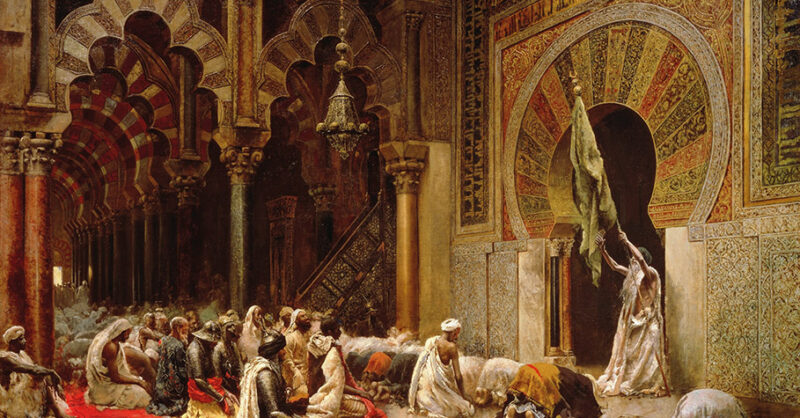
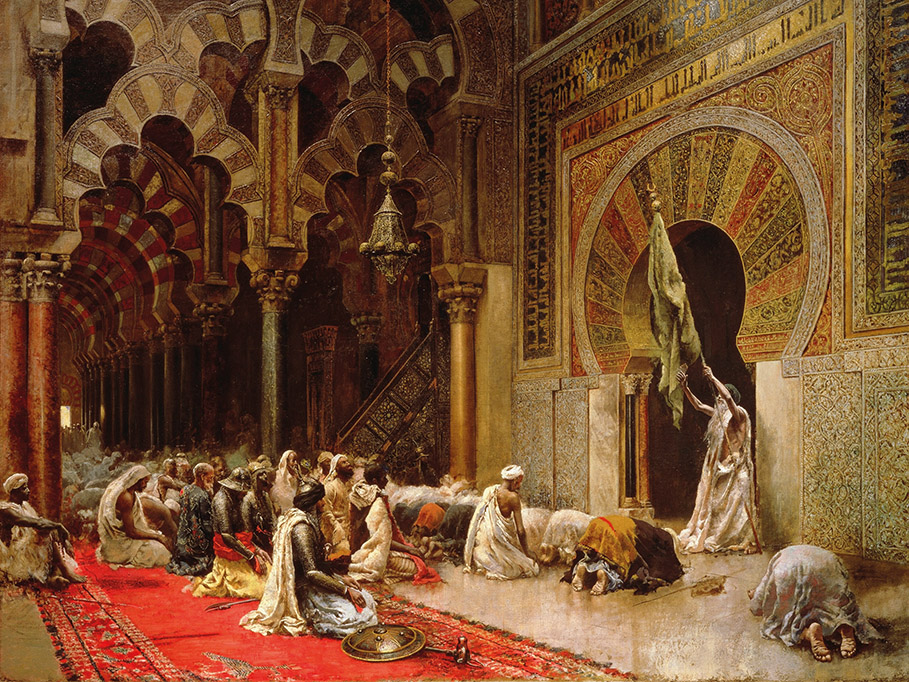
Edwin Lord Weeks’s Interior of the Mosque at Córdoba (1880). Image by Bridgeman Images
In 1993, Prince Charles, now King Charles III, gave a spectacular speech at the University of Oxford, entitled “Islam and the West”, lamenting that Europeans “have tended to see Islam as the enemy of the West, as an alien culture, society and system of belief”, which is why “we have tended to ignore or erase its great relevance to our own history” in Europe. “The surprise, ladies and gentlemen,” he continued, “is the extent to which Islam has been a part of Europe for so long, first in Spain, then in the Balkans, and the extent to which it has contributed so much towards the civilisation which we all too often think of, wrongly, as entirely Western.” He was one of the few major Western leaders calling upon Europeans to recognise their Islamic past. His fascination with the Muslim world dated back to the early 1970s, when he developed an interest in Islamic art and architecture.
The speech resonated with many Muslims. Tharik Hussain, author of Muslim Europe, admits that reading the prince’s lecture had left him “gobsmacked”. Hussain criticises the fact that most of our textbooks on European history either exclude or diminish the importance of the continent’s medieval Islamic past. If covered at all, the episode is often portrayed as one of invasion, which, even if it brought some innovations, was overall alien to the Western civilisation. Today, the popular view prevails that Muslims have never been part of European history. It is an environment in which populist right-wing polemics critical of Muslim migration can reach a receptive a mass audience.
At the same time, this historical narrative signals to Europe’s Muslim minority that they are not part of Europe. Muslims themselves, Hussain bemoans, have “been oblivious to their own rich history and heritage” on the continent. He warns that the lack of a historical narrative of belonging has contributed to feelings of disconnection from their European societies, which, in turn, can lead to anti-Western radicalisation.
The author himself knows that feeling. A young Bangladeshi who grew up in the mosques of east London in the 1980s and 1990s, he embraced Salafism. After 9/11, caught up in the wave of popular anti-Islamic resentment, he decided to move to Saudi Arabia, sharing with European Islamophobes the belief that Muslims do not belong in Europe. On his way to Jeddah in the autumn of 2003, during a stopover in Cyprus, he visited Larnaca’s Hala Sultan Mosque. His later discovery that the mosque housed a tomb from the time of the first generation of Muslims sparked his interest in the early history of Islam in Europe.
He decided to go on a tour of the northern Mediterranean basin – Cyprus, Sicily, Malta, Portugal and Spain – in search of Europe’s Islamic heritage. “I needed to go back to the start, and revisit Europe’s early Muslim history through European Muslim eyes, using a lens devoid of the anti-Muslim bias in popular European histories to try and undo some of that gross negligence,” he writes. Muslim Europe, part travelogue, part history book, charts this journey.
He starts in Cyprus, where Europe’s Muslim history began. In 647 CE, only a few decades after the religion had been founded on the Arabian peninsula, a Muslim naval fleet commanded by the governor of Syria, Mu’awiyah, invaded the Byzantine island of Kypros. “Islam was in Europe a mere 16 years after the death of its founder,” Hussain writes proudly. “Even Christianity took longer to get here, arriving in Europe – at the earliest – within 40 years of the death of Jesus.” He continues to Sicily. Mu’awiyah, now the first caliph of the Umayyad Caliphate, occupied it in 667. Muslim rule brought revolutionary changes. Agricultural techniques, such as sophisticated systems of hydraulic irrigation, transformed the agricultural economy. Sicily’s living standards were among the highest in the world. It attracted scholars, artists and poets from faraway places. When the Normans conquered the Emirate of Siqilliya in the 11th century, they adopted much of the local Islamic culture. It was only in the 13th century, as a response to a Muslim revolt, that Frederick II – whose court was shaped by Arab influences and who cultivated close commercial and cultural ties with North Africa and West Asia – destroyed the Muslim presence in Sicily. Hussain, to his disappointment, finds “only scant remains are found scattered across modern Sicily”. The situation was not much different in today’s Malta, which had also been part of the Emirate of Siqilliya.

Treat yourself or a friend this Christmas to a New Statesman subscription from £1 per month
Next, Hussain moves to Portugal, known in the Muslim Middle Ages as Gharb al-Andalus (“West of al-Andalus”) or simply al-Gharb (“West”), hence the modern regional name “Algarve”. Muslim Portugal became part of the Umayyad Emirate of Córdoba in the 8th century. Over the centuries, popular Portuguese tales about the Islamic past depicted (and at times ridiculed) the “Moors”, or Muslims, as despotic characters and sexual deviants who engaged in fornication and sodomy. Hussain notes that the old anti-Muslim tropes could still be found in schoolbooks right up to the late 20th century.
Hussain’s journey ends in Spain, the legendary heartlands of al-Andalus. Here, in the middle of the 8th century, the Iberian Umayyads founded the Emirate of Córdoba, which eventually evolved into the Caliphate of Córdoba. Al-Andalus soon developed into a global centre of Muslim culture, an intellectual hub of philosophy and the sciences, and an economic powerhouse. Particularly fascinating is the author’s account of his visit to Madinat al-Zahra. Located outside the old caliphate capital, it has been dubbed the Versailles of Córdoba, with magnificently landscaped gardens, artificial lakes, spectacular fountains, palaces, baths, libraries, schools and a grand mosque. He also takes his readers to Alhambra in Grenada and Córdoba’s Caliphate Mosque, Mezquita-Catedral, which inspired architecture across the Iberian peninsula. He ends his tour in Madrid, or al-Majrit, as it was known in the Muslim era.
Eventually, the Umayyad-led Muslim conquest of Europe reached deep into western Europe. Alarmed, the Franks mobilised. Charles Martel’s legendary victory over the Muslim armies under Governor Abd al-Rahman al-Ghafiqi at the Battle of Tours (or Poitiers) of 732 halted that march. The Muslim presence in southern France continued for almost half a century. It was only when Martel’s son, Pepin the Short, founder of the Carolingian dynasty, took Narbonne in 759, that the Muslims retreated to their Iberian strongholds. Finally, in the 15th century, the last Andalusian Muslim state – the Emirate of Granada – fell, marking the end of the Christian “Reconquista”.
Unfortunately, although its title promises to provide a historical overview of 1,400 years of Islam in Europe, the book focuses almost exclusively on the Middle Ages. The Ottoman conquest of the Balkans in the 14th century is only mentioned in passing. Hussain could have visited the Gazi Husrev Beg Mosque in Sarajevo, for example, to offer insights into the history of Muslim south-eastern Europe. He could also have visited the wooden Kruszyniany mosque in Poland to discuss the history of the Tatars who first settled in the Grand Duchy of Lithuania around the same time. The age of empire, which radically reshaped western Europe’s entanglements with the Muslim world, deserves more attention. At the height of the imperial age, the rulers of Britain, France, Russia and the Netherlands each governed more Muslim subjects than those of any independent Muslim state, which had a significant impact on Europe itself. Hussain could have visited Britain’s first purpose-built mosque, the Shah Jahan Mosque in Woking, opened in 1889, which was soon mainly used by Muslims from British India; or the Grande Mosquée in Paris, inaugurated in 1926 as a sign of gratitude for Muslim colonial soldiers who fought in the First World War; or the Wilmersdorf Mosque in Berlin, founded by Muslims from British India in 1928. The 20th-century Muslim history of Europe, a story of labour and post-colonial migration, is arguably more relevant to the self-understanding of Muslim communities in Europe today than the Muslims of the Middle Ages who lived in societies that have little connection to (and in common with) the former.
Muslim Europe is not a work of historical scholarship. It provides a mainly textbook knowledge of the early history of Islam in Europe, not with new historical information or interpretations. Those readers interested in the subject of medieval Muslim Europe might want to turn to more substantial history books on the subject. Elizabeth Drayson’s recent Crucible of Light: Islam and the Forging of Europe from the 8th to the 21st Century, for instance, tells the story in great historical detail. Despite Hussain’s grandiose claims that he intends to “prove that Muslims actually came to Europe at a critical juncture in its cultural and intellectual development” and that “it was in fact Muslim intervention that resuscitated Europe”, he does not prove anything that has not been proven by other historians before. Indeed, Muslim Europe is really a travelogue – perhaps also an exercise in self-discovery.
Hussain’s wish to forge a European Muslim sense of belonging, a “place identity”, rooted in the Islamic European past is based on a peculiar notion of history. Historical writing has always served authors in their efforts to build group identities, but today, historians are generally more critical about the functionalist use of history, warning that it may seduce us into writing selective and skewed histories to serve our political purposes.
Hussain tends to romanticise Europe’s medieval Muslim past, celebrating it as a utopic paradise, boasting advanced science and medicine, superior hygiene standards, high literacy and education levels, artistic, literary and musical innovations and great religious tolerance. This triumphalist narrative constantly contrasts an advanced Muslim Europe with a backward Christian Europe. It seems as if the author believes that a sense of Muslim belonging in Europe can only be built on a pristine historical record. But no past is simply rosy. It would not have diminished the author’s case if he had critically discussed slavery, discrimination against women, and social, ethnic and religious inequalities in these medieval Mediterranean societies.
In the end, we might ask if the history of the medieval Mediterranean basin is really of any use to the Muslims of Europe today. The Muslims of medieval Córdoba have arguably very little in common with the 20th-century Muslim migrants of east London. Hussain himself admits that many Muslims show no interest in the Islamic heritage of Europe.
Nevertheless, the merit of Muslim Europe is that it complicates our notion of “Europe” as a closed Judeo-Christian space, reminding us that Muslims have since the early days of Islam been an integral, important part of the continent.
David Motadel is associate professor of international history at the LSE
Muslim Europe: A Journey in Search of a Fourteen Hundred Year History
Tharik Hussain
Viking, 432pp, £25
Purchasing a book may earn the NS a commission from Bookshop.org, who support independent bookshops
[Further reading: Cameron Crowe’s endless adolescence]