
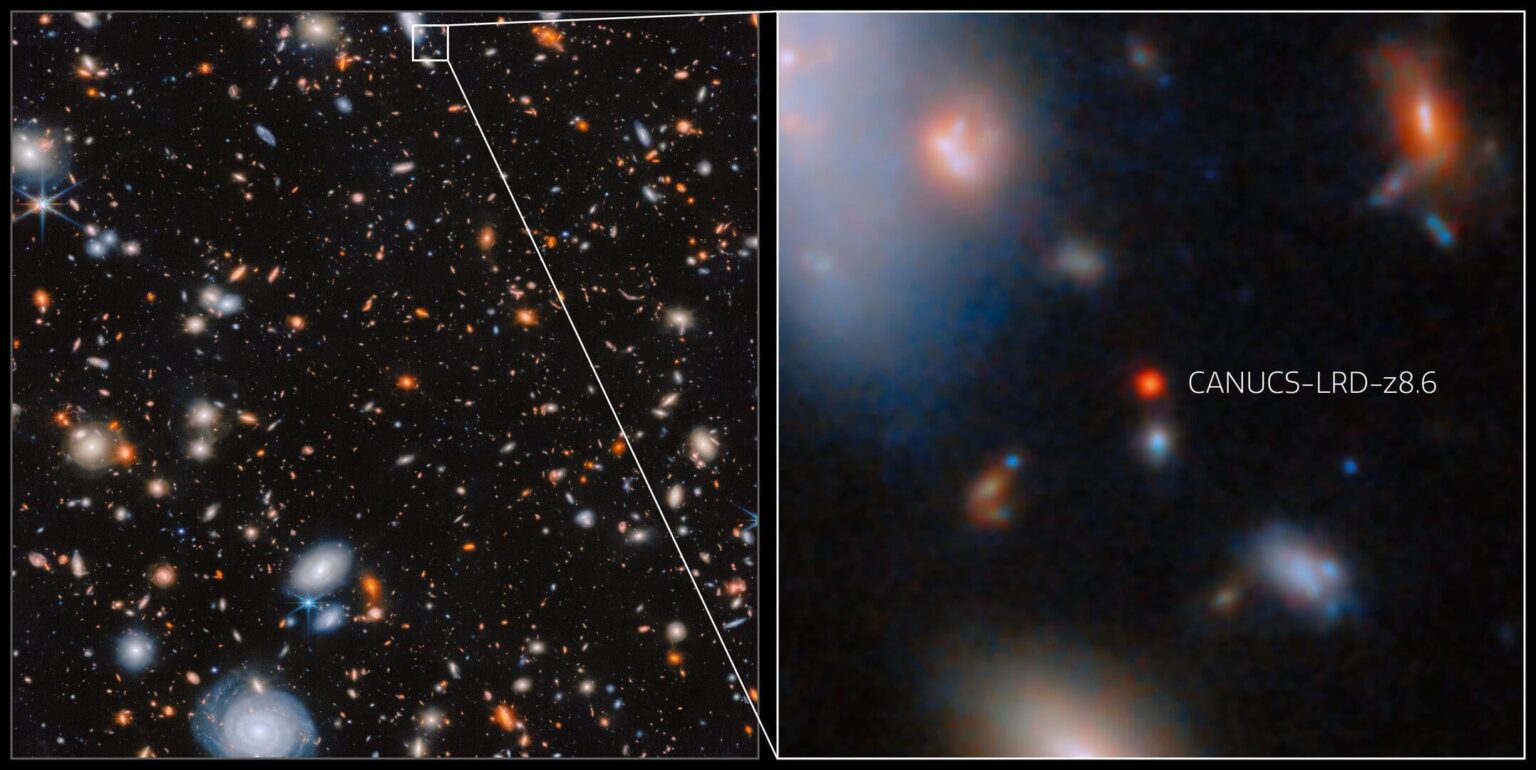
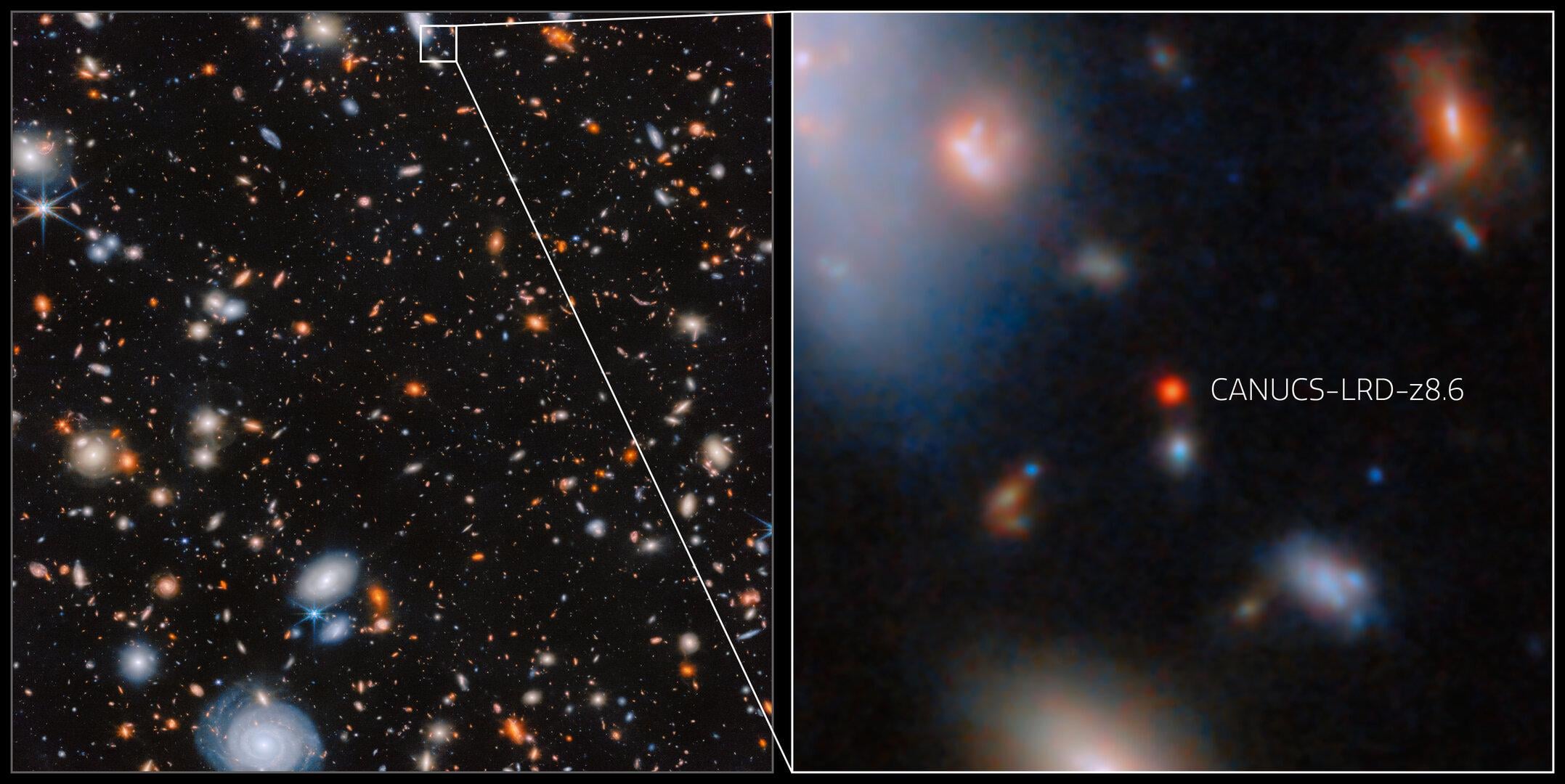
Astronomers from the University of Ljubljana and the CANUCS collaboration, led by researcher Roberta Tripodi, utilized the James Webb Space Telescope (JWST) to confirm the presence of an actively growing supermassive black hole within CANUCS-LRD-z8.6, a mysterious "Little Red Dot" galaxy located less than 600 million years after the Big Bang.
Webb’s Near-Infrared Spectrograph (NIRSpec) detected highly ionised gas rotating quickly around a central source, providing precise spectral data that confirms the black hole is unusually massive relative to the host galaxy's low heavy element content and is growing far faster than expected for its size.
This defiance of the usual mass-relation ratio challenges cosmic evolution models because, according to University of Ljubljana collaborator Dr. Nicholas Martis, "this suggests that black holes in the early Universe may have grown much faster than the galaxies that host them."
Article | Image (Webb: CANUCS-LRD-z8.6 in MACS J1149.5+2223)
https://www.esa.int/Science_Exploration/Space_Science/Webb/Webb_spots_greedy_supermassive_black_hole_in_early_Universe
2 Comments
>This defiance of the usual mass-relation ratio challenges cosmic evolution models because, according to University of Ljubljana collaborator Dr. Nicholas Martis, “this suggests that black holes in the early Universe may have grown much faster than the galaxies that host them.”
If we assume the Big Bang Theory is correct then everything would have been very close together initially meaning there would have been substantially more material within the initial gravitational field of the black holes causing them to grow faster. Fast forward to our time and all matter in the universe is significantly more spread out so black holes would grow much slower because there’s simply less mass around for them to pull in. This just seems like very basic logic.
If there are supermassive black holes to begin with, why didn’t the big bang collapsed back into a black hole when space is more cramped in the minutes or hours thereafter?