
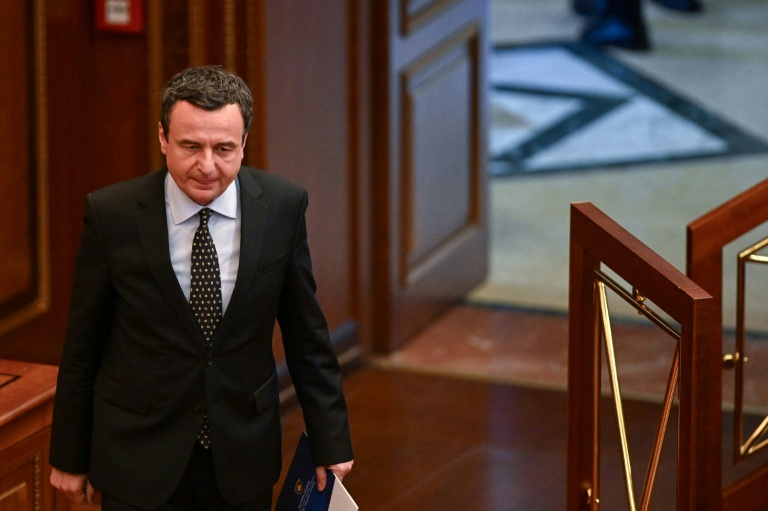
After months of political wrangling, Kosovo’s caretaker prime minister Albin Kurti failed to form a government on Wednesday, pushing the tiny Balkan nation toward its second election in under a year.
With fresh elections expected to be announced, Kurti’s party will hope to improve on its result from February’s vote, when it fell short of a majority despite topping the poll.
The 50-year-old left-wing leader — whose political roots lie in Kosovo’s independence movement during the war-ravaged 1990s — has plenty of campaigning experience and a formidable popularity with voters to guide them there.
But after months of bruising parliamentary stasis, the pathway back to government remains unclear for the man who, when in opposition, tear-gassed the legislature and was once dubbed “Kosovo’s Che Guevara”.
– Record vote tallies –
Kurti’s first, short-lived term as prime minister lasted from February to June 2020, before his coalition collapsed — though fresh elections allowed his return within a year.
Pushing reform and fervent nationalism, Kurti’s Vetevendosje (Self-determination) party won the 2021 ballot with more than half of the vote, a record result in the young country.
As the first prime minister to survive a full term since Kosovo’s independence from Serbia in 2008, Kurti’s time in power saw a dramatic departure from the past.
A key theme of his tenure has been countering Serbian influence, particularly in the ethnic Serb strongholds in the north of the country — angering Belgrade, which has never recognised Kosovo’s independence.
Kurti has worked to dismantle services offered by Belgrade to Kosovo’s Serbs, which have remained in place since Serbian troops withdrew from the country under NATO bombardment at the end of the 1998-1999 war.
But his actions have also drawn criticism from European and US allies, who fear that any provocation in the fraught northern regions could again boil over into violence.
Kurti has remained undeterred, even during his caretaker period, dismantling what he views as “instruments of intimidation, threat and control”.
Domestically, his popularity has boomed — in February’s elections, he secured the most votes ever for a single candidate.
But his party failed to win the numbers needed to govern, leading to months of political deadlock.
– Serbian prison to parliament –
First known for his student activism in the 1990s, dreadlocked and often sporting a T-shirt of Argentine revolutionary icon Che Guevara, he led protests against the expulsion of ethnic Albanians from the country’s education system following the break-up of Yugoslavia.
That movement was a prelude to the country’s war for independence and eventually led to two years in a Serbian-run prison.
According to other inmates, he was targeted by his jailers and regularly suffered physical abuse.
After the war, Kurti became an outspoken critic of both local leaders and the UN-led peacekeeping force that entered Kosovo after the end of its war against Serbia in 1999.
His movement often drew massive crowds to decry the outside influence over his country.
Several rallies spiralled into violence, with two supporters killed by UN police during clashes in 2007.
His movement eventually evolved into a powerful opposition party, infamous for unleashing tear gas on the floor of parliament to protest against vote outcomes.
In the past decade, Kurti and his party have attempted to shake off links to its radical past, instead promoting themselves as a social democratic party.
– Tough road ahead –
But as Kurti looks to contest for a third term, he will have to contend with a polarised political landscape where coalition partners are unlikely and voter fatigue could play a factor.
Heavy pressure from the West for any new government to revive a deadlocked dialogue with Aleksandar Vucic’s government in Belgrade will likewise loom over the ballot.
The question of autonomy for Kosovo’s Serb minority is also likely to feature in the campaign.
ih/al/sbk