
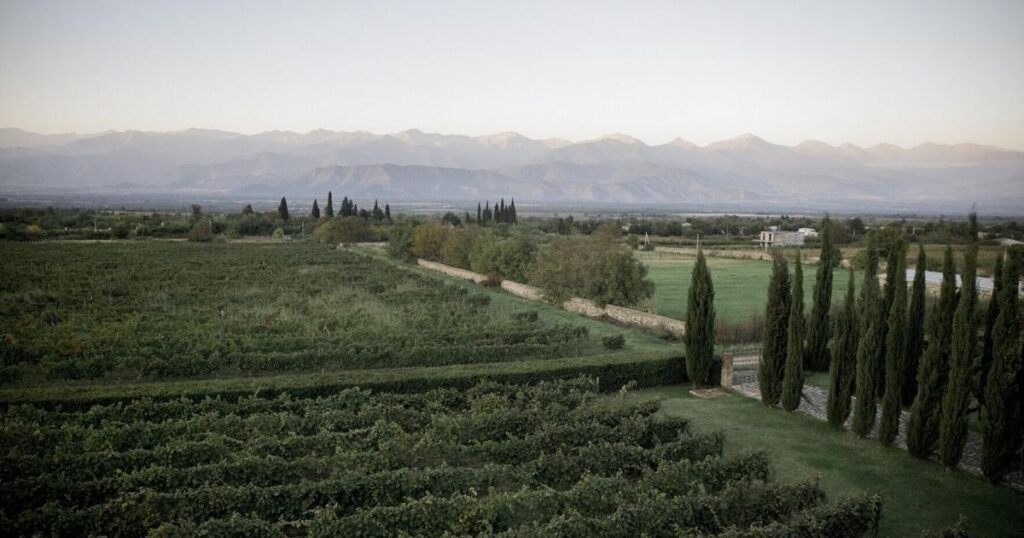
Soon after our cab leaves the chaotic streets of Tbilisi, the capital of Georgia, we end up in sprawling farmland and vineyards. Babushkas in head scarves are set up on the roadside, selling produce like their prized tomatoes, crunchy fuyu persimmons and, of course, grapes. So many varieties of grapes.
As the elevation changes, we find ourselves crossing the Gombori Pass, a stunning scenic route through the Caucasus Mountains. We’re heading east towards Kakheti, the post-Soviet country’s heart of winemaking, just a couple of hours away.
Georgians have been making wine since ancient times; its UNESCO-recognized traditional method involves the qvevri, a clay amphora, which dates back more than 8,000 years. At Vino Underground, a Tbilisi wine bar, I’d also learned that the country is home to over 500 endemic grapes, with at least 100 heritage grapes now being used for wines.
Roughly 75 per cent of Georgian wines are produced in the Kakheti region. This makes this the right place to be for rtveli, the fall harvest season. The mood is festive and known for parties where the wine flows abundantly and freely.
“Most families make their own wine. I produce 500 bottles a year,” explains our driver Gela (with help from my Russian-speaking partner). Georgia was once a republic of the Soviet Union but regained its independence in 1991. Afterwards, the government divvied up land to families. Gela tells us his family received a hectare.
Celebrations — weddings, birthdays, christenings — are frequent, and everyone brings their own wine. “You know whose wine is the best because they are the most popular people at parties,” Gela says.
Outside the town of Velistsikhe, on the southern slopes of the Caucasus Mountains in the Alazani Valley, we arrive at Berika’s Winery. It’s led by Ana Berikashvili, who is, at age 27, one of the country’s youngest established natural winemakers.

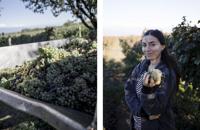
Left: Grapes at Berika’s Winery. Right: Ana Berikashvili, 27, is one of Georgia’s youngest established natural winemakers.
Misha Von Shlezinger
“During the Soviet occupation, Georgia became a major wine-producing hub for the Union,” Berikashvili tells us. “Farmers were forced to abandon heritage varietals like chinuri and kisi, and focus on a handful of high-yielders,” she adds. “The Soviets didn’t care about the quality, varieties or anything. They wanted a billion bottles of ‘this.’”
Georgia’s 2008 war with Russia brought embargoes, including for wine. “Many factories were forced to close as Russia was our biggest customer, and that was really good because this was bad wine,” says Berikashvili. Another silver living: there was an opportunity for a new generation of winemakers to emerge.
Berikashvili herself specializes in natural, or biodynamic, winemaking. “We don’t use pesticides, additives, (other) chemicals or artificial yeast. It’s just fermentation and temperature control,” she says as we sip a sparkling flute of rkatsiteli and mtsvane. It’s amber and light-bodied and has a funk to it, with notes of green apple and fermented pear.
In nearby Kardenakhi, in the Gurjaani region of Kakheti, we meet Zura Mgvdliashvili, founder of the Natural Wine Association and winemaker at Nikalas Marani. He pours me a glass of khikhvi, a “forgotten” varietal. “You can call this orange wine, or white because it’s from white grapes, but it is amber,” he clarifies.
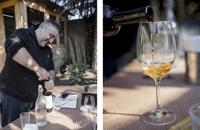
Left: Zura Mgvdliashvili, winemaker and founder of the Natural Wine Association. Right: The amber wine at Nikalas Marani.
Misha Von Shlezinger
I nibble on churchkhela, a treat made from walnuts coated in a gummy grape paste, and take a sip. It’s like a slap in the face. I can’t even place any familiar tasting notes. It’s so tannin-heavy, if I closed my eyes I’d think it’s a big Burgundy red, or even hard liquor. It’s unlike any other wine I’ve tried.
In the pastoral village of Artana, I meet another woman involved in Georgia’s wine revival. Tamuna Bidzinashvili runs her own winery and organizes Supernatural, a festival that showcases natural wines and local foods alongside hip bands and DJs.
We meet at her friend’s country home and cellar, where I can hear a gurgling tributary to the Alazani river, and spot a farmer moseying down the road with some calves.
Bidzinashvili opens a rosé as she explains how natural winemaking methods differ from conventional ones. For example: she doesn’t use a refractometer to measure sugar content in grapes. “I know they’re ready when I see the jackals are eating them. They don’t eat the sour ones,” she tells us. She is dead serious.
At Chateau Mosmieri, the operation is more modern. The property, founded by German industrialist Joerg Matthies, is known for its restaurant, stunning mountain views, and wines that blend traditional European grapes with Georgian ones.
We’re welcomed with a supra, a harvest feast, including shkmeruli (grilled chicken in a creamy garlic sauce), “Georgian pizza” (flatbread stuffed with stretchy, mozzarella-like sulguni cheese) and shashlik (grilled pork on skewers).
“We have a malbec, and a malbec saperavi, but we mainly focus on Kakhetian grapes,” says Matthies, before detailing his individually cooled, double-housed steel tanks, which use a nitrogen generator to protect against oxygen (“or else you get vinegar”).
It’s a stark contrast to Bidzinashvili’s rustic garden, but as we catch the harvest in action, I still see villagers working the fields the old-fashioned way, picking manually. In another area, a grape-processing conveyor belt is loaded and ready, but the power is out. It happens. This is rural Georgia after all.
Soviet-era wines remain popular, especially in Russia. But it’s exciting to see first-hand how Georgia’s winemaking tradition is evolving, as the next generation nurtures new roots in the fertile soil of an ancient heritage.