
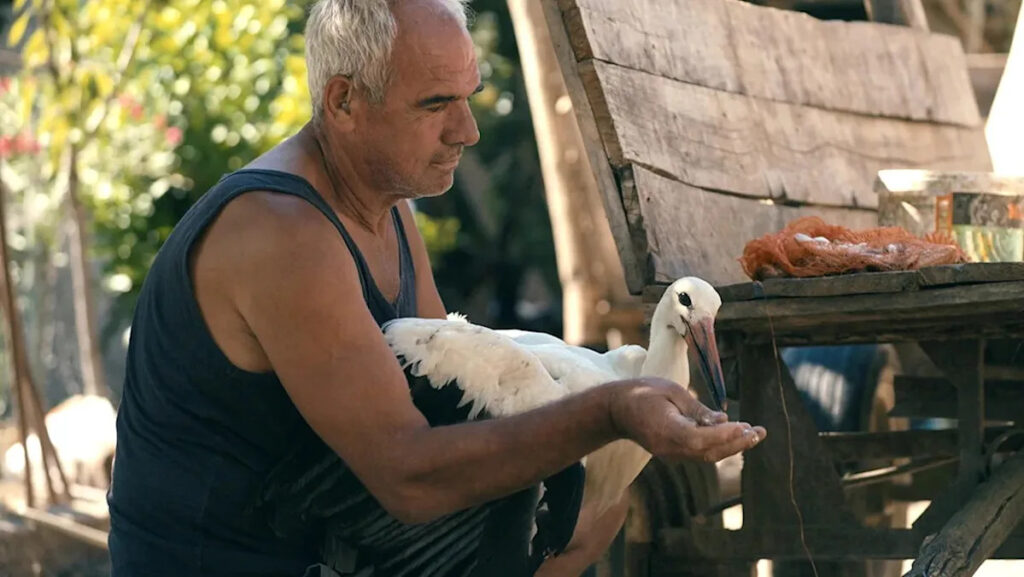
For The Tale of Silyan director Tamara Kotevska, inspiration came from the skies above her native North Macedonia. “Storks are a major part of our culture,” she says. “Silyan is one of our most popular folk tales, and it didn’t come into the film until very late in the process. But storks have inspired me since childhood.”
Kotevska, whose Oscar-nominated Honeyland chronicled another intimate bond between humans and nature, found her new story by observing migration patterns and a changing landscape. Initially, she planned an environmental piece about storks feeding on landfills — a symptom of industrial waste and rural decline. “I started working closely with animal-activist organizations who gave me pin locations to about a hundred stork nests across the country,” she recalls on our Gold Derby “Meet the Experts: Spotlight” panel. “But the storks brought us to the farmers.”
More from Gold Derby
Among those farmers was Nikola and his family, who would become the emotional center of the film. Their daily struggles — and humor — mirrored the resilience of the birds they shared the land with. “He was such a charismatic character,” Kotevska says. “The love he has with his wife is something rare to meet in poor farming areas. They were raw people, living from the earth and doing heavy physical work, yet so full of warmth.”
That warmth deepened when Nikola found a wounded stork on a landfill and chose to nurse it back to health. “That moment changed the story completely,” says Kotevska. “I thought I’d end the film when the farmers left and the storks left, but then Nicola found this hurt stork and decided to take care of it. So I stayed another year — and I’m so happy I did.”
As the film unfolds, the connection between man and bird becomes a metaphor for the fragile balance between progress and tradition. “The migration from farming areas is one of the biggest problems we face,” Kotevska explains. “The country is 90 percent farming, so when people leave, the economy falls — and the environment follows. It’s happening everywhere, not just here. The monopolization of agriculture by corporations is a huge threat to modern societies.”
The lyrical cinematography and sound design evoke a kind of spiritual realism — from the rhythmic clapping of storks’ beaks to the hum of tractors that accompany the farmers’ daily labor. “I worked with two wonderful musicians, Joe Wilson Davies and HunOuk Park,” says Kotevska. “We spent a year online deciding what instruments would define the identity of the storks and the humans. For the storks we used drumming and air instruments, and for the humans, more streaming instruments to resemble the sound of tractors. It was a motivational and wonderful experience.”
Kotevska’s dedication to authenticity extended beyond the creative process. The production was self-funded, a bold choice for a project that criticizes government policy. “I didn’t get funding from Macedonia because the film speaks against the government,” she says. “I preferred to make it independently.” Despite that, The Tale of Silyan went on to represent North Macedonia as its official Oscar submission for Best International Feature.
When she screened the finished film for Nikola and his family, the reaction was overwhelming. “They were crying a lot — we all were,” Kotevska recalls. “It was a special moment. Everyone was happy with what we created together.”
And yes — the stork was there, and still lives with them. “Silyan is an honorable member of the family,” she says with a smile.
This article and video are presented by National Geographic.
Best of Gold Derby
Sign up for Gold Derby’s Newsletter. For the latest news, follow us on Facebook, Twitter, and Instagram.