
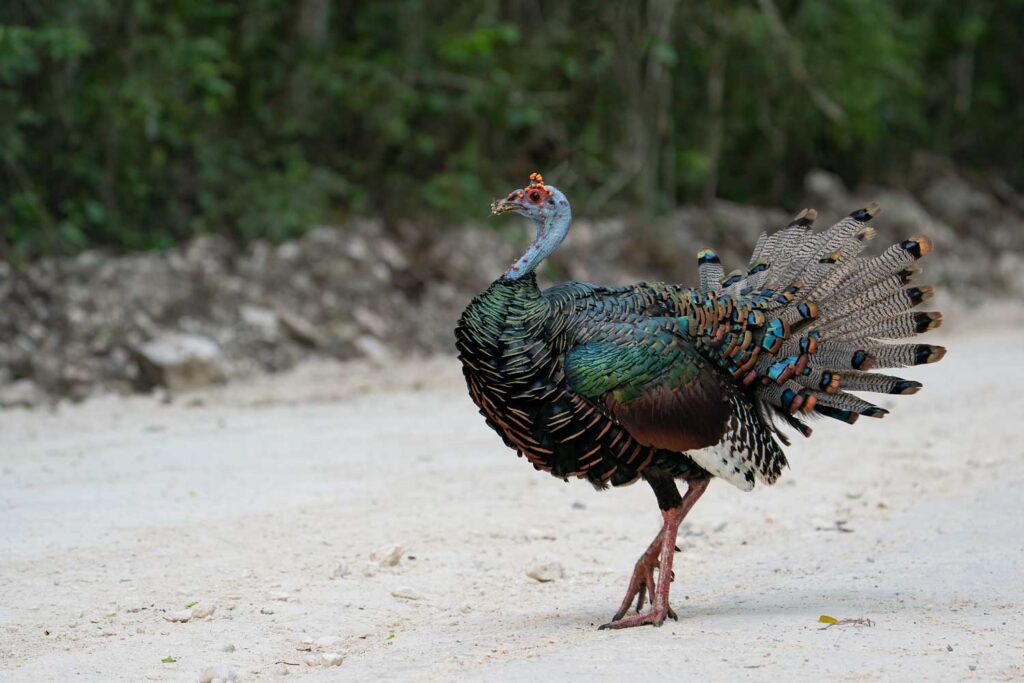
An ocellated turkey. (Photo via Adobe Stock)
Editor’s note: Our Wild Relatives story series will explore the connections between our local wildlife species and related animals from around the globe. By learning about these exotic species, we hope to foster appreciation for the remarkable creatures that live in our backyards and neighborhoods.
In the bird world, there are dozens of species of ducks and warblers and more, but there are exactly two kinds of turkeys. One of those — the wild turkey — is well-known and familiar to those of us in the eastern United States, but the other — called the ocellated turkey — is a mystery to us.
The ocellated turkey looks a lot like a wild turkey, but the males have more color and flair — sort of like a technicolor version of the turkey we are so familiar with. They lead similar lives to wild turkeys, but there are some differences too.
Big and colorful birds
The most obvious difference between the wild turkey and the ocellated turkey is their plumage. Like with wild turkeys, males are more vibrantly colored than females. Their body feathers are shiny and iridescent, appearing green or bronze-colored in the right light, according to Animal Diversity Web. They have blue tail feathers with gold tips and bluish-bronze eye spots toward the ends. It is these spots for which the ocellated turkey is named, because oculus is the Latin word for eye.
Ocellated turkeys have dark red legs and bright blue featherless heads that are typically covered in wart-like growths. On males, these warty growths get larger and more pronounced during mating season, as do their eye rings. Their crowns (chests) also grow larger.
SEE MORE STORIES IN THE WILD RELATIVES SERIES
Size wise, ocellated turkeys are quite a bit smaller than American wild turkeys, with males weighing up to 10 pounds and females weighing about 6 pounds, Animal Diversity Web reports. Wild turkeys can weigh between 7 pounds and 24 pounds.
Tropical turkeys
Ocellated turkeys live in only a small part of the world. They are native to Belize, Guatemala and the Yucatan Peninsula of Mexico, according to the Rainforest Alliance. Their entire range covers an area of about 50,000 square miles. For comparison’s sake, Illinois is about 57,900 square miles.
Like wild turkeys, ocellated turkeys prefer wooded areas. They live in tropical deciduous forests as well as lowland evergreen forests. They tend to stick to the edges of the woodlands, where they can forage for food.
The ocellated turkey is an omnivore, just like the wild turkey. Their diets do differ slightly, though. Ocellated turkeys primarily eat seeds, berries, leaves and grasses as well as some insects, reports Animal Diversity Web. Wild turkeys are noted acorn lovers, and they also eat seeds and other plant matter, but they eat a wider variety of animals, including salamanders.
One noted difference between the two turkeys is that ocellated turkeys do not gobble like wild turkeys. Instead, they make a drumming sound and they sing, primarily to attract a mate, according to Cornell Lab’s Birds of the World. Males will begin looking to attract a mate in late winter or early spring, with most breeding happening in March or April.
Ocellated turkeys nest on the ground, with the female forming a depression in the ground to lay her eggs in. Clutches can include as many as 15 eggs, but a dozen is typical, the World Land Trust reports. The chicks, called poults, hatch several weeks later, and they can walk and feed on their own after a few days.
Like wild turkeys, ocellated turkeys can fly, although they are usually seen on the ground. They are quite strong in flight, however, relying on it to reach roosts in trees or escape predators, Animal Diversity Web reports.
Similar threats
Ocellated turkeys are generally considered rare across their range, but they are quite populous in some parts of Belize, according to Animal Diversity Web. Overall, their population is decreasing, and they are listed as near threatened on the International Union for Conservation of Nature Red List of Threatened Species.
These turkeys face two main threats to their population: hunting and habitat loss. These are the same threats that pushed the wild turkey to the brink of extinction in the United States in the late 1800s and early 1900s. Breeding and reintroduction programs were successful in helping grow the wild turkey population, and their current estimated population in the United States is estimated at about 7 million birds, National Geographic reports.