
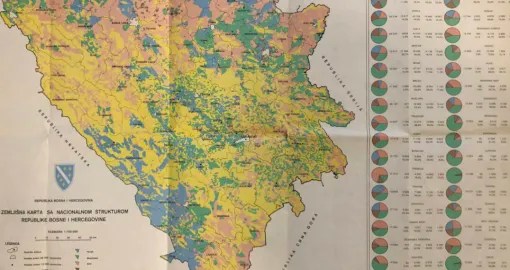
This very map, with accompanying instructions and explanations, alongside other documents and maps, was used during many wartime negotiations.
The Institute for Geopolitics, Economics, and Security (IGES) possesses a map issued by the Republic Administration for Geodetic and Property-Legal Affairs from Sarajevo, which was published in 1992. The map was made on the order of the then state leadership of the Republic of Bosnia and Herzegovina (RBiH), using exclusively official data and documents based on international and domestic law and legal regulations dealing with state property.
This very map, with accompanying instructions and explanations, alongside other documents and maps, was used during many wartime negotiations. According to testimonies of direct participants in the Dayton negotiations, the then representative of the aggressor side, Slobodan Milosevic, tried to persuade BiH negotiators to hand over ownership of state property to the entities. Despite heavy pressure and threats of continued war, he did not succeed because dividing state property would have meant dividing the state of BiH. The position of the negotiators at the time on behalf of the RBiH was clear and unwavering, considering that any transfer of state property to the entities, even of a part of it to lower levels of government, represents a reduction or loss of statehood itself.
To this day, state property has been preserved, as confirmed by the final rulings of the Constitutional Court of BiH in favor of BiH. Since it was not possible to achieve this by force during the war, and then not through illegal transfers to lower levels of government, currently, decisions regarding property are being attempted to be shifted to the political level under blackmail and threats, so that, through voting in the BiH Parliament, property would be taken from the state and transferred to the entities. Therefore, the question arises why there is again a desire to negotiate over something defined by Dayton, or whether the Dayton Agreement serves whoever needs it?
Below is the transcribed text from the Land Map of the RBiH from 1992, where the definition of state property, its composition, and the areas occupied by state and private property are clearly stated:
“Land map with national structure of the RBiH
The Land Map of the RBiH with national structure provides information on public (state) property and its spatial position, as well as the population distribution by municipal areas and at the level of the Republic.
The territory of the RBiH has a total area of 5.119.683 hectares. Public (state) property accounts for 53.26% or 2.726.971 hectares, and property owned by citizens accounts for 46.74% or 2.392.712 hectares.
In the structure of public property, the dominant area is forest, covering 1.789.307 hectares (34.95% of the total area of the Republic), and pastures occupy 572.856 hectares (11.19% of the total area).
In citizens’ ownership, arable land covers 1.470.318 hectares, or 28.72% of the total area of the Republic.
The distribution of public (state) property in the territory of the Republic is significant from the standpoint of the use of natural resources and the state’s influence over the management of such important areas.
Previous maps dealt with the issue of population settlement within the territory of the Republic, neglecting the space of public (state) property, which makes up more than half of the Republic’s area.
The second segment of the map is the spatial settlement of the population of the Republic’s territory. Statistical data from the 1991 population census by settlements were used to represent this component of the map.
Urban areas are represented graphically because small areas have a high concentration of people, and the space of urban regions consists of public (state) property. For example, in the urban areas of 12 cities (Sarajevo, Banja Luka, Zenica, Tuzla, Mostar, Bihac, Brcko, Bijeljina, Prijedor, Doboj, Bugojno, and Trebinje), a total of 1.044.450 inhabitants live, of which 110.214 are Croats, 454.908 Muslims (Bosniaks), 295.437 Serbs, and 183.891 others.
Regarding state possessions, or ownership, it is clear that it encompasses the entire state territory, i.e., state land, public goods, mines, oil fields, mountains, rivers, roads, railway, sea, and air transport, etc. The legal owner of all state property, i.e., territory, is the state, while municipalities are only holders of usage rights. According to international law, state territory or possession, including BiH, belongs to the total number of its citizens regardless of their national, religious, racial, social, or other affiliation. Therefore, in BiH, there is no individual national possession, and consequently, no individual national state territory.
This concept of the land map provides insight into the territory of the RBiH, the settlement of the population by nationality, and the shared space of public (state) property.