

The remaining 16 European teams still in with a chance of reaching next summer’s World Cup now know what they have to do.
The draw for March’s play-offs was made on Thursday, pitting four-time World Cup winners Italy against Northern Ireland. If they come through that single-leg home semi-final, they will travel to face either Wales or Bosnia and Herzegovina for their bracket’s final a few days later.
The 16 countries in the draw — there either via performance in regular World Cup qualifying or the 2024-25 UEFA Nations League — were divided into four qualification paths. Each path comprises two semi-finals and a final, meaning four teams will emerge with places at the tournament in the United States, Canada and Mexico.
Here, James Horncastle, Nick Miller and Tim Spiers break down the draw.
- The Athletic has launched a World Cup WhatsApp Channel. Click here to join.
How did the European play-off draw come out?
Path A
Semi-final 1: Italy vs Northern Ireland
Semi-final 2: Wales vs Bosnia and Herzegovina
Final: Wales/Bosnia and Herzegovina vs Italy/Northern Ireland
Path B
Semi-final 3: Ukraine vs Sweden
Semi-final 4: Poland vs Albania
Final: Ukraine/Sweden vs Poland/Albania
Path C
Semi-final 5: Turkey vs Romania
Semi-final 6: Slovakia vs Kosovo
Final: Slovakia/Kosovo vs Turkey/Romania
Path D
Semi-final 7: Denmark vs North Macedonia
Semi-final 8: Czech Republic vs Republic of Ireland
Final: Czech Republic/Republic of Ireland vs Denmark/North Macedonia
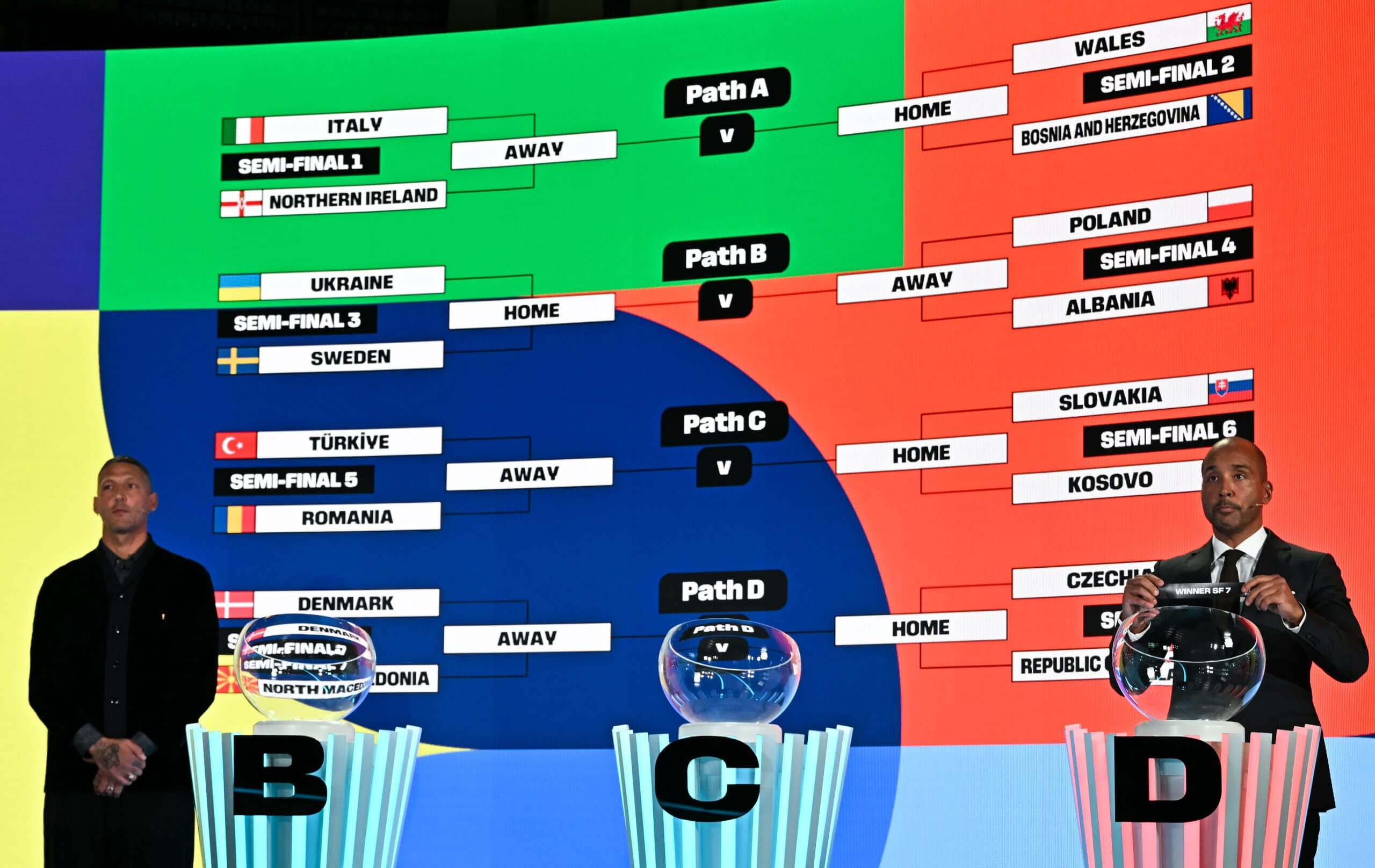
How the draw played out in Zurich (Fabrice Coffrini/AFP via Getty Images)
Path A: Can Italy overcome the psychological barrier?
Italy vs Northern Ireland
Italy were seeded, so will play their semi-final on home soil — but that will offer little comfort. Italy could not reverse a 1-0 play-off first-leg defeat in Sweden at Milan’s San Siro when trying to qualify for the 2018 World Cup in Russia. They even failed to make their play-off bracket’s final for Qatar 2022, losing 1-0 at home to North Macedonia in the semis.
Carrying excess psychological baggage, Italy are filled with dread at missing out on a third World Cup in a row. Their biggest challenge in March will be overcoming their own fear of failure.
Coping with it makes this a mental exercise. Italy were better on paper than their opponents in those previous play-off failures. They won the European Championship played between the successive World Cups they didn’t qualify for. They topped a Nations League group in 2022 that contained England and Germany. More recently, in September 2024, they beat France 3-1 in Paris.
Frankly, none of this matters when the fear sets in and the pressure compounds. Three of Italy’s four prospective opponents from this draw (Sweden, North Macedonia and Northern Ireland) figure as ghosts from failures past. As bad as Sweden have been, the prospect of Viktor Gyokeres and Alexander Isak playing themselves into form by the early spring meant there was some relief at being paired with Northern Ireland.
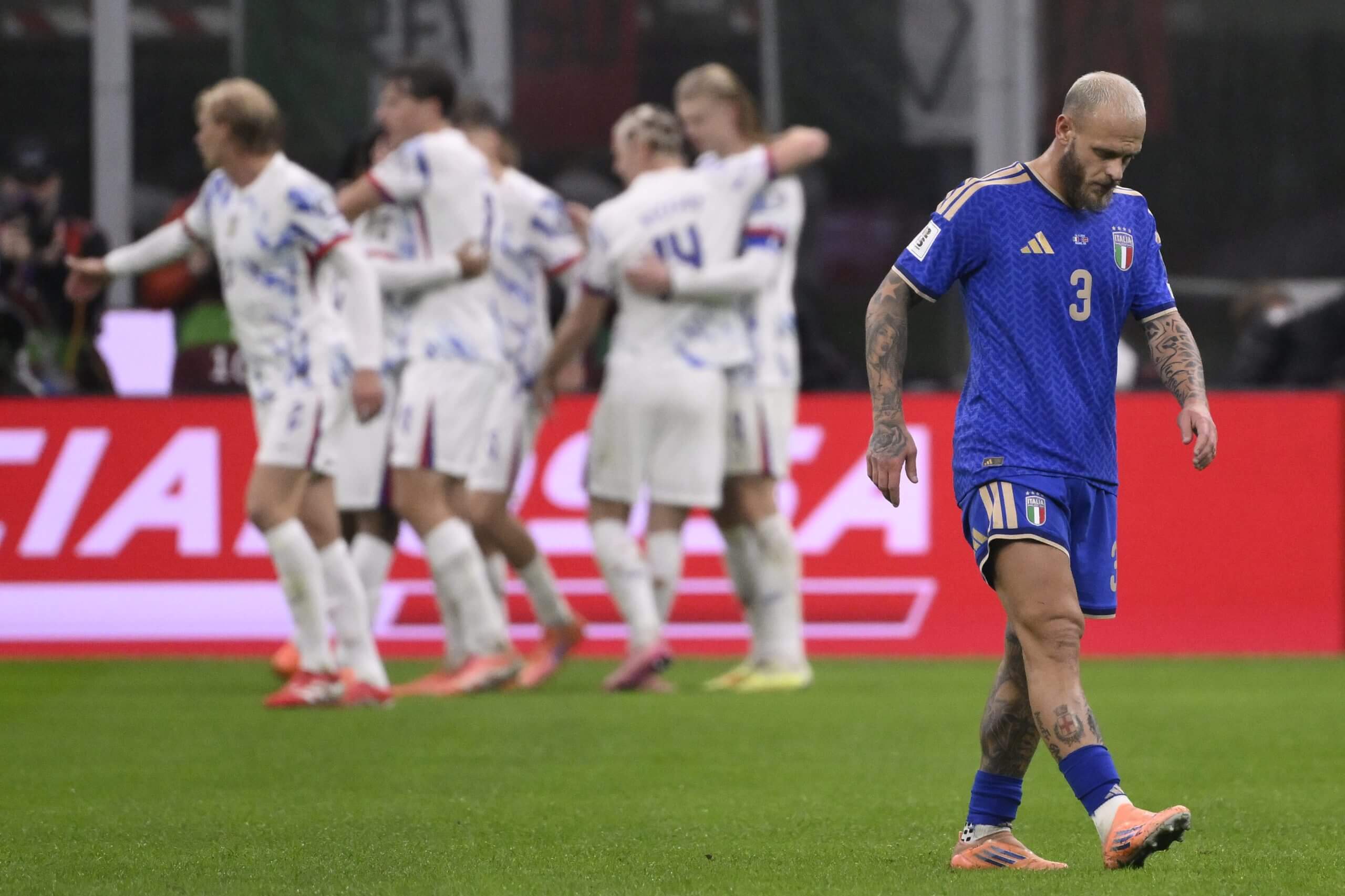
Italy were beaten home and away by Norway in qualifying (Elianton/Mondadori Portfolio via Getty Images)
The Italian Football Federation (FIGC) is yet to decide on a venue for the game against Northern Ireland.
The New Balance Arena in Bergamo has been mentioned. With a capacity of just over 23,000, it is smaller than Rome’s Stadio Olimpico and San Siro, where tend to raise their games. A tighter ground with a raucous home crowd is favoured, although anyone who attended that game against North Macedonia in Palermo four years ago knows a 12th man is not enough on its own.
James Horncastle
Wales v Bosnia and Herzegovina
Welsh minds will immediately wander to the tantalising prospect of facing Italy in Cardiff in a one-off shootout for a place at the World Cup… that is one spicy meatball.
However, first there is a Bosnia and Herzegovina-shaped hurdle to overcome, and the bad news is that Wales have never beaten them.
Sure, they have faced them just four times (Bosnia and Herzegovina has only been an independent nation since 1992, following the break-up of the former Yugoslavia), but pertinently, two of those came during qualification for the 2016 European Championship, with Bosnia and Herzegovina proving the only side the Welsh, eventual semi-finalists at that tournament, could not beat in their group.
Arguably, the most famous defeat in Welsh football history came against them in that campaign, on the night Wales qualified for a tournament for the first time in 57 years despite the 2-0 loss, thanks to results elsewhere in the group.
Bosnia and Herzegovina actually came within 13 minutes of reaching only their second ever World Cup on Tuesday. They were a goal up in Austria and heading to North America as Group H winners, before a late equaliser brought the 1-1 draw that dropped them into the play-offs.
However, Wales will be the slight favourites for this semi-final, largely because of home advantage. Anyone who has been to a big qualifier at the Cardiff City Stadium can attest that ‘The Red Wall’ really is a thing. The atmosphere will be loud, proud and boisterous. Of four play-off ties for the past two major competitions, Wales have beaten Austria, Ukraine and Finland in Cardiff, with a home defeat on penalties against Poland, when Euro 2024 was qualification on the line, representing their only blemish.
“When we play at home, it’s very important for us,” Wales manager Craig Bellamy, who famously scored the goal that beat Italy 2-1 in Cardiff during Euro 2004 qualifying, said this week.
You’d be hard-pressed not to back Wales — against Bosnia and Herzegovina or indeed Italy.
Tim Spiers
Path B: Can Potter galvanise Sweden’s stars?
Ukraine vs Sweden
On form alone, Sweden are probably the worst team still in with a shot of qualifying for the World Cup. And that is in any confederation, not just UEFA.
Of the 16 teams partaking in these European play-offs, they are the only ones who did not win a single match in their World Cup qualification group. The next-worst team of the 16 won three games. That is despite having two of the best strikers in European club football last season in the squad, namely Gyokeres and Isak, plus fellow Premier League players Anthony Elanga, Lucas Bergvall and Gabriel Gudmundsson.
They are only in this draw because of their Nations League performances a while ago — worth an article on its own — and yet here they are, just two victories from the World Cup final.
What chance, then, of them winning away at Ukraine (a game that will not actually be played in Ukraine, more on that in a minute) and landing a home final against Poland or Albania? Well, the talent is there (they should also have Dejan Kulusevski fit and available by March), so it is whether new head coach Graham Potter can get a tune out of a footballing nation on its knees.
Ukraine had a solid group stage, missing out on top spot to France but getting the better of Iceland, so pretty much as expected.
‘Home’ advantage against the Swedes is negated a little by the fact the match will possibly be played in Poland, as most of Ukraine’s games have been since the Russian invasion in 2021 (although the Poles being drawn at home in the other Path B semi-final may be a complicating factor), but they will still be backed by tens of thousands of Ukrainians and they are likely to be strong favourites.
Tim Spiers
Poland vs Albania
Poland are ominous opponents in Warsaw. They were undefeated at home in qualification, beating Finland, Lithuania and Malta, and drawing 1-1 with the Netherlands.
They took the group down to the final matchday, leaving the unbeaten Dutch needing to beat Lithuania in Amsterdam to qualify, which they did, meaning Poland had to settle for a widely expected play-off spot.
You pretty much know what you are going to get from a Poland side, and this latest bunch are not too different — they will be organised, hard to beat and Robert Lewandowski will probably score. He netted four times in the eight group matches and the 37-year-old Barcelona striker’s form and fitness in March could be the deciding factor in Poland’s hopes of reaching a third successive World Cup.
Albania have never played in a World Cup, but did qualify for the past two European Championships, and will be cursing the fact that neither of today’s play-off draws puts them at home, where they have an excellent defensive record (they had not conceded at home for eight qualifiers until last week’s 2-0 loss against England).

Sylvinho led Albania against England this month (Armando Babani/Getty Images)
Manager Sylvinho, a Brazil international who played for Arsenal and Barcelona, has worked wonders with the national team. They were impressive in a tough group (Spain, Italy and Croatia) at last year’s Euros, as well as notably edging out Serbia to reach these play-offs.
Albania have some creative attacking talents and should not be underestimated. Poland are perhaps the slight favourites, but this may be the tightest European tie to call.
Tim Spiers
Path C: Can Kosovo complete a remarkable rise?
Turkey vs Romania
Some teams will be disappointed to be in these play-offs, but Turkey should not be among them. Perhaps in his more ambitious moments, head coach Vincenzo Montella might have thought they could finish above European champions Spain in Group E, but realistically, a strong second place was the best they could hope for. Aside from being hammered 6-0 at home against Spain in September, Turkey performed about as well as could be expected in their other games, and will go into the UEFA play-offs as Path C favourites.
If nothing else, it would be a real shame if this incredibly talented collection of players did not make it to the World Cup. Thrilling youngsters Arda Guler, Kenan Yildiz and Can Uzun, alongside slightly older stagers including Hakan Calhanoglu, Baris Alper Yilmaz and Kerem Akturkoglu, will be a fantastic prospect, assuming Montella figures out a way to get the best from them.
Romania are another side here thanks to the Nations League. Their results in World Cup qualifying do not suggest they will get much further than this semi-final. They finished six points behind Group H winners Austria, despite recording a surprise win over them in October, but a 2-2 draw with Cyprus a month before that will tell you that this is not a vintage Romania side.
Turkey should take this one fairly comfortably.
Nick Miller
Slovakia vs Kosovo
The prospect of Kosovo reaching the World Cup is an incredibly romantic one, considering they were not even an official footballing nation a decade ago. It was a long road to recognition for a country previously part of Yugoslavia, which took in many disappointments, knockbacks and political manoeuvrings, but they have punched well above their weight since finally being admitted to FIFA in 2016.
They were in the play-offs for Euro 2024 and were promoted to second-tier League B of the Nations League last year, then took advantage of Sweden’s collapse to finish a creditable second behind the qualification machine that is Switzerland in their World Cup group. Even taking into account the state of the Swedes, doing the double over them was remarkable.
But as much as that would appeal to the sentimental neutral, making it through this qualification path will be a long shot.
Slovakia are aiming for only their second World Cup as an independent nation, but their group-stage performances suggest they should get through this tie. Nobody would have expected them to finish above Germany in Group A, and they duly finished second to them, but beating the four-time world champions 2-0 in September will go down as one of their greatest results. Losing 2-0 in Northern Ireland a month later was a hiccup, but the romantics will probably be disappointed after this semi-final.
Nick Miller
Path D: Will the Republic of Ireland’s momentum carry over?
Denmark vs North Macedonia
What impact will failing to qualify automatically have on Denmark, from a psychological point of view? All being equal, they should probably have topped their group with relative ease, given their FIFA ranking (21st), World Cup pedigree (they have qualified for five of the past seven tournaments) and general talent (including Andreas Christensen, Christian Norgaard, Christian Eriksen and Rasmus Hojlund), but they fell at the last to Scotland.
Maybe they will reason that they were generally the better side for most of that astonishingly dramatic game in Glasgow, and were scuppered by Rasmus Kristensen’s very harsh red card when it was 1-1 with an hour played. But equally, you could say they should not have been in a position to be scuppered, with home draws against the Scots and Belarus (99th in FIFA’s world rankings) having done the damage earlier in the campaign.
They will be favourites to win this one, though. North Macedonia actually went into the final game of their group with a chance of qualifying automatically (hopes which admittedly rested on Belgium losing at home against Liechtenstein), but the way they capitulated to Wales, losing 7-1 in Cardiff, was pretty embarrassing. Were they affected by the knowledge they already had a play-off spot in the bag, thanks to their Nations League exploits? Maybe, but it will not leave anyone feeling confident about their prospects.
Another former Yugoslav republic, they do have some play-off pedigree, having made fools of Italy at this stage of qualifying for the 2022 World Cup, but it would be a big shock if Denmark did not prevail, and indeed beat whoever they have to visit in the Path D final.
Nick Miller
Czech Republic vs Republic of Ireland
After the explosive ecstasy of Ireland’s last-minute win against Hungary to get them to this stage, it would be a bit of an anti-climax for them to quietly slip out of contention via a narrow defeat in Prague.
The cold reality is that they were pretty desperate in qualifying before those magical few days last week when Troy Parrott briefly turned into Robert Lewandowski at home to Portugal and in Budapest. There was a sense they had surrendered to the inevitable after losing 2-1 away to Armenia in September, so on that basis and taking their qualification campaign as a whole, you would logically make the Czech Republic favourites.
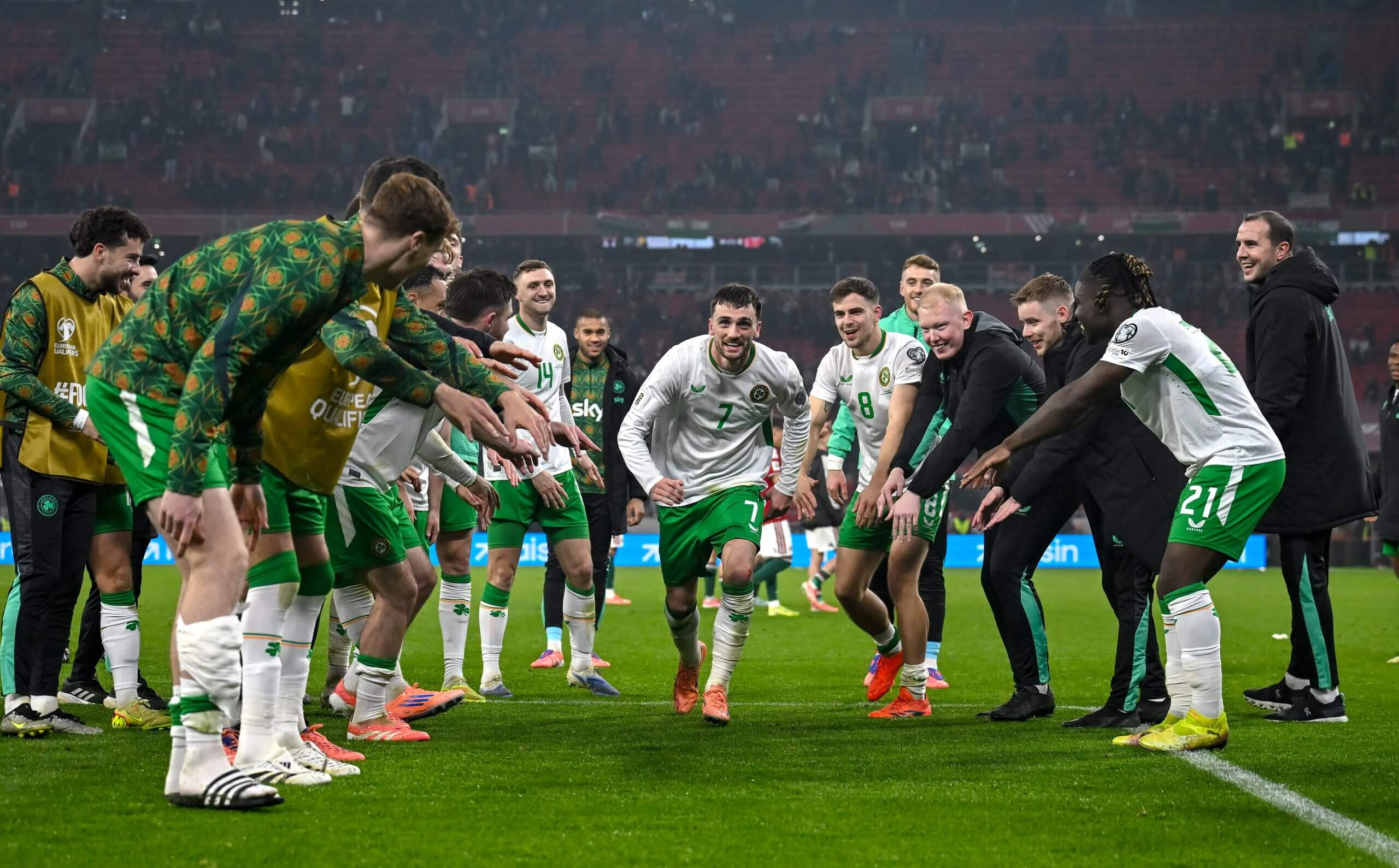
Troy Parrott and Ireland made it this far after a remarkable final two games in their qualifying group (Stephen McCarthy/Sportsfile via Getty Images)
That said, this was probably the most favourable semi-final the Irish could realistically have been given.
The Czechs finished some way behind Croatia in their group, both in terms of actual results and general class. Coming second to the World Cup’s 2018 finalists and 2022 third-place side is no disgrace, and to their credit they did get a draw at home against Luka Modric’s boys, but the other three opponents in Group L were Montenegro, the Faroe Islands and Gibraltar, not sides that should have troubled them too much.
A 2-1 defeat away to the Faroes in October put qualification in doubt, and though they did recover after that, they were generally unconvincing.
Ah, hell… you’d need a heart of stone not to go with Ireland after those scenes in Hungary on Sunday night.
Nick Miller