
Work time reduction via a 4-day workweek finds improvements in workers’ well-being. Data shows improvements in burnout, job satisfaction, mental health and physical health. Three key factors mediate the relationship: improved self-reported work ability, reduced sleep problems and decreased fatigue.
https://www.nature.com/articles/s41562-025-02259-6
8 Comments
Work time reduction via a 4-day workweek finds improvements in workers’ well-being
Abstract
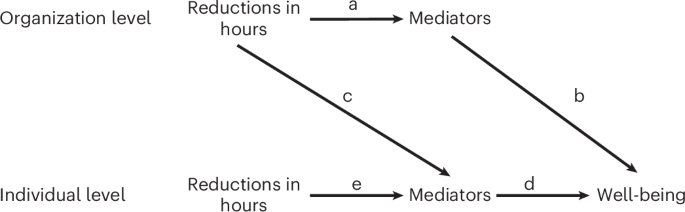
Time spent on the job is a fundamental aspect of working conditions that influences many facets of individuals’ lives. Here we study how an organization-wide 4-day workweek intervention—with no reduction in pay—affects workers’ well-being. Organizations undergo pre-trial work reorganization to improve efficiency and collaboration, followed by a 6-month trial. Analysis of pre- and post-trial data from 2,896 employees across 141 organizations in Australia, Canada, Ireland, New Zealand, the UK and the USA shows improvements in burnout, job satisfaction, mental health and physical health—a pattern not observed in 12 control companies. Both company-level and individual-level reductions in hours are correlated with well-being gains, with larger individual-level (but not company-level) reductions associated with greater improvements in well-being. Three key factors mediate the relationship: improved self-reported work ability, reduced sleep problems and decreased fatigue. The results indicate that income-preserving 4-day workweeks are an effective organizational intervention for enhancing workers’ well-being.
Let me guess, coming soon, a study that is funded with millions of dollars finds out that 😱a 3 day work week results in even LESS fatigue, even BETTER sleep, even MORE positive outcomes!
Essentially everywhere this has been tested has reported amazing results.
Still not being widely adopted because executives are genuinely leaking sacks of shit. Control over the employees is more important to companies than productivity. It’s why millions of dollars are spent each year on org psych research about employee mental health, productivity, engagement, loyalty etc and then you’re still in a noisy open office layout, with forced engagement pizza parties, fluroescent lighting, and an expectation that you respond to your bosses emails or texts whenever the ysend them regardless of your leave status or time of day.
Jokes on them, American employers don’t give a shit about any of that!
The evidence seems to be pretty conclusive over multiple studies that 4-day workweeks are better for employee health and productivity. Whenever I see these kinds of posts, I also see a flood of negative, Debbie Downer-style comments – the corporate stooges – about how this could never happen. I challenge people reading this to believe it is possible, just like those who thought the very concept of a weekend was possible too. When you are around your colleagues, speak up positively about this concept. Trickles become floods.
Literally the only reason it isn’t being introduced is because executives like having bullshit things to show investors that they are improving productivity.
The call back to the office being the latest example despite every study showing that it doesn’t help.
There’s also a branch of the corporate sector which would support this — the entertainment sector. More time off from work means more time to watch Netflix, listen to music, play video games, listen to podcasts etc.
The pro-capitalist slogan should be — four days as a worker, three days as a consumer.
I personally have a 4 day work week (4 10hr shifts) and I never want to go back.