
Two years of testimony, hundreds of witnesses, and a court that will decide how the Kosovo Liberation Army (KLA) and its leaders — Hashim Thaçi, Kadri Veseli, Jakup Krasniqi and Rexhep Selimi — will be remembered.
The four men, in detention since 2020, await the verdict in The Hague. Over the last two years, the testimonies have shed light on their roles and responsibilities during and after the war in Kosovo.
The Kosovo Liberation Army was formed in the early 1990s as a guerrilla group fighting for the rights of Albanians under the Serbian regime of the time. During the 1998–1999 war, it became the main armed resistance force.
Its political leaders, including Hashim Thaçi, emerged on the international scene in early 1999 when they participated in the Rambouillet negotiations. There, the KLA was legitimized as a negotiating party in a process aimed at ending the war and paving the way for a political solution for Kosovo.
When the country declared independence in 2008, Thaçi was prime minister. Eight years later, he was elected president and served until 2020, when he resigned to face charges brought by the Specialist Court in The Hague.
“I will not allow under any circumstances for the President of the Republic of Kosovo to appear before the court. Therefore, to protect the integrity of the Presidency of the Republic of Kosovo, the integrity of the state of Kosovo, the integrity and dignity of the citizens of Kosovo, the people of Kosovo, while also respecting the partnership with the international community, today I resign from the position of President of the Republic of Kosovo,” Thaçi said on November 5, 2020.
Alongside Thaçi, Kadri Veseli, who had led the KLA’s intelligence service; Jakup Krasniqi, its spokesperson; and Rexhep Selimi from the KLA’s general staff also surrendered to the court.
The indictment against them, confirmed on October 26, 2020, and published on November 5 of the same year, charges each of them with crimes against humanity and war crimes committed between March 1998 and September 1999 in Kosovo and northern Albania.
According to the indictment, the four men were part of a “joint criminal enterprise” and “shared the common purpose of gaining and exercising control over all of Kosovo through means that included intimidation, mistreatment, violence, and the unlawful removal of those considered opponents.”
These “opponents” allegedly included ethnic minorities — Serbs, Roma, and others — as well as Albanians who did not support the KLA. At least 102 people are believed to have been killed, and more than 20 others are considered missing.
The indictment also refers to the superior responsibility of the accused, due to their high-ranking leadership positions within the KLA, for crimes committed by persons under their control and by other members of the “joint criminal enterprise.”
All four pleaded not guilty, and the trial began on April 3, 2023.
In his opening statement, the acting Specialist Prosecutor, Alex Whiting, said that “most of the victims of the accused were their fellow Kosovo Albanians.”
“In their zeal to strike and eliminate those they considered opponents, the accused supported and implemented a policy that often victimized even their own people,” Whiting said.
Over these two years, the prosecution presented hundreds of pieces of evidence: 117 written statements and 125 witnesses who testified in the courtroom.
“Since he came in ’98, I saw with my own eyes his [Thaçi’s] actions… He intended to wipe us out… intended to wipe us out… We don’t have time because we have other examples to show… I have many other examples. This is the truth… with my whole family, his goal was to wipe us out,” said prosecution witness Fadil Geci in October 2024.
Thaçi’s defense began presenting its evidence on September 15 of this year. Krasniqi’s team announced two in-person witnesses and two written statements, while the defenses of Veseli and Selimi presented no evidence.
The defense witnesses — mostly high-ranking Western officials with direct knowledge of the events — began with James Rubin, former U.S. Assistant Secretary of State.
The defense strategy was to argue that the KLA did not have a clear command structure and that Thaçi, often outside Kosovo and in a political role, did not exercise authority over KLA operations.
Rubin testified for three consecutive days, while current U.S. State Department officials were present as observers. Rubin stated that Thaçi “had superiors from whom he needed approval” and that he was “more of a public face for presenting the KLA to the West.”
“Hashim Thaçi had to turn to KLA commanders for information, knowledge, decisions… I saw him showing respect to them on substantive matters of the KLA,” Rubin said.
His testimony was supported by several notable figures who followed him on the stand — from Paul Williams, former legal advisor to Kosovo, to Wesley Clark, the general who led NATO’s air campaign against Yugoslav targets in 1999.
“I remember seeing Thaçi because he was the spokesperson. He was clean, well-dressed, looked more Western than the others. He didn’t look like someone who had been in the mountains fighting for one or two years straight. It was clear he wasn’t responsible,” Clark testified.
Clark was the final defense witness, completing his testimony on November 18. A day later, at a status conference, Thaçi’s lawyer, Luka Mišetić, signaled that the defense might request one additional witness.
However, the defense and prosecution agreed that their final briefs would be submitted by January 30 of next year — 60 days after the conclusion of the evidentiary phase. It was also decided that closing statements from the prosecution, defense, and victims’ representatives would follow the submission of those final briefs.
The court’s spokesperson, Michael Doyle, told Radio Free Europe that “rules require the judges to issue a verdict within 90 days of the close of the case — except in circumstances requiring more time.”
Legal expert Mark Ellis expects the verdict to be delivered in the spring or early summer. He believes the case is genuinely balanced: the current evidence allows for both the possibility of conviction and acquittal. Everything will depend on how the judges interpret the KLA’s command structure.
“Each piece of evidence is assessed individually, based on credibility, accuracy, consistency, and not on which side called the witness. Judges consider factors such as the witness’s demeanor, coherence of the account, possible interests or biases, and how well the testimony stands during cross-examination,” explains Ellis, director of the International Bar Association, for Radio Free Europe’s Expose program.
In this trial, the prosecution and defense offered two entirely opposing narratives about the KLA: the first depicted it as a structured organization with a chain of command reaching all the way to Thaçi, while the second portrayed it as a guerrilla group without a formal hierarchy.
Ellis says that in such cases, judges must evaluate the credibility of each version, because often both sides may contain elements of truth. He adds that legal standards are also decisive in this process.
“For example, international law on command responsibility and ‘joint criminal enterprise’ does not necessarily require a typical military hierarchy; effective control or functional organization is sufficient to implement a common plan. Judges will examine whether Thaçi and the others had effective control over those who committed abuses,” Ellis says.
Proving the existence of a hierarchy — formal or factual — as well as determining each defendant’s role within it will be crucial for establishing criminal responsibility, Ellis concludes.
This trial is the most significant to date for the Specialist Court, which forms part of an international effort to investigate internal conflicts in Kosovo during and after the independence war in the late 1990s.
Whatever the verdict, it is expected to resonate far beyond Kosovo — perhaps even in the United States, because as Rubin noted in his testimony, Thaçi worked closely with Washington for years on peace and independence.
Joe Biden, as U.S. Vice President, called him “the George Washington of Kosovo” when he visited the White House in 2010.
Richard Grenell, who served as the special envoy for Kosovo–Serbia normalization negotiations during Donald Trump’s first administration, described Thaçi’s arrest as a “grave injustice.”
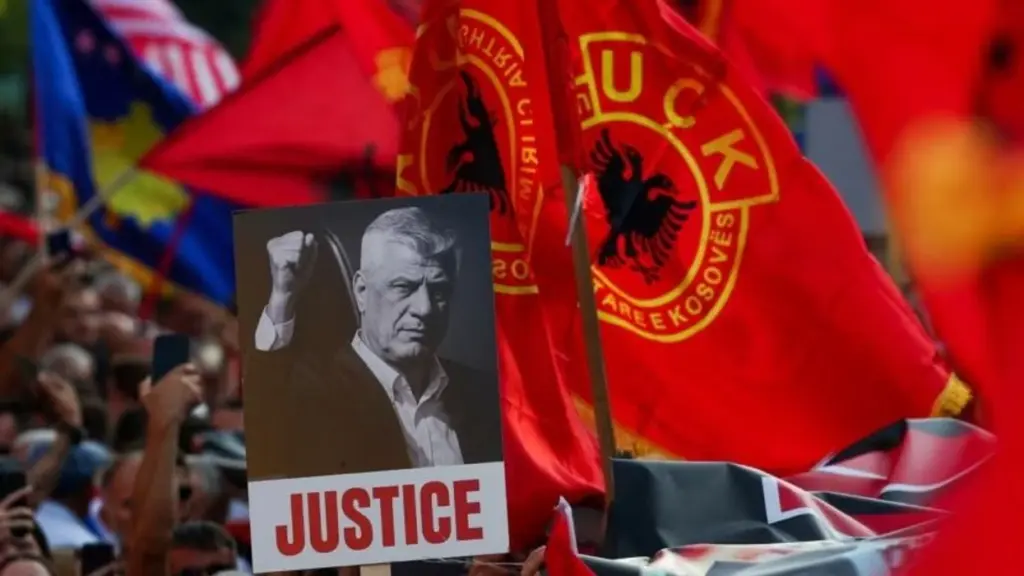
The Kosovo Liberation Army, though disbanded, remains a popular organization for many Kosovars, who credit it with leading the fight that led to independence. Many citizens believe the Specialist Court in The Hague is biased against the KLA and seeks to discredit its role. This has prompted protests not only in Prishtina but also in Tirana, The Hague, and other cities.
The Specialist Court, officially known as the Kosovo Specialist Chambers and the Specialist Prosecutor’s Office, operates as part of Kosovo’s judicial system but is composed of international judges and prosecutors. In terms of staff, Americans are the second-largest group after the Dutch.
Their decision will determine not only the responsibility of the accused but also the way Kosovo views and narrates a sensitive part of its recent history.