
The limitations of technological climate interventions highlighted above point to a deeper systemic issue—as we proliferate complex technological solutions, we may be creating more problems than we solve. In our pursuit of technological solutions to climate change, have we inadvertently created a system that undermines the very knowledge we need to survive? This question becomes particularly pressing as we examine how the exponential growth of technological solutions actually increases systemic complexity, contributing to resource inefficiencies and the systematic loss of Indigenous and Local Knowledges. While multiple factors such as colonialism, assimilation, and marginalization have contributed to Indigenous and Local Knowledge erosion (Aswani et al., 2018; Gómez-Baggethun, 2022; Johnson-Jennings et al., 2020; Kodirekkala, 2017; Tran et al., 2025), in this section, we apply GITT to explain how information processing mechanisms systematically bias knowledge selection in complex decision-making environments.
What is GITT?
Granular Interaction Thinking Theory (GITT) is an emerging transdisciplinary framework designed to explain how humans and institutions absorb, process, and prioritize information within complex environments (Vuong & Nguyen, 2024a, 2024c). GITT posits that human decision-making, at both individual and societal levels, can be understood as the result of granular interactions among information units shaped by cognitive, cultural, and institutional filters. The theory integrates three foundational theories: Shannon’s information theory (Shannon, 1948), quantum mechanics (Hertog, 2023; Rovelli, 2018), and mindsponge theory (Vuong, 2023) to provide a holistic model of information management. Each component addresses a different aspect of the information processing, and their integration reveals mechanisms that none could explain in isolation.
At its foundation, GITT uses Shannon’s information theory to model the challenge facing any decision-making system: informational entropy. From an ecological and social perspective, a high-entropy information environment, which is rich with diverse “knowledge units” ranging from scientific data to traditional practices, is potentially the most resilient and just, as it contains a wide array of adaptive solutions. However, for a decision-making system with finite cognitive, economic, and institutional resources, this diversity induces high informational entropy: a state of uncertainty and potential overload. This processing challenge is a systemic stressor; when the variety of available knowledge exceeds the system’s evaluative capacity, it can lead to cognitive overload, poor prioritization, and institutional paralysis. Shannon quantified this principle of processing uncertainty with the formula:
$$H\left(X\right)=-\mathop{\sum }\limits_{i=1}^{n}P\left({x}_{i}\right){\log }_{2}P\left({x}_{i}\right)$$
Here, H(X) represents the informational entropy of a random variable X with possible outcomes \(\left\{{x}_{1},{x}_{2},\ldots ,{x}_{n}\right\}\) and corresponding probabilities \(\left\{P\left({x}_{1}\right),P\left({x}_{2}\right),\ldots ,P\left({x}_{n}\right)\right\}.P\left({x}_{i}\right)\) is the probability of the outcome \({x}_{i}.\)Each probability \(P\left({x}_{i}\right)\) represents how likely each outcome x_i is to occur. In our study context, the variable X can be interpreted as humanity’s processing system in the current state, with i number of knowledge or solution units. Each knowledge or solution unit has its \(P\left({x}_{i}\right)\) probability to be stored and processed within humanity. Peak entropy is reached when all solutions appear equally probable \((P\left({x}_{i}\right)\) is uniform), creating a decision-making bottleneck where the system is overwhelmed by choice. For example, when decision-makers face numerous climate solutions, from CCS to Indigenous practices, the system can become paralyzed by indecision. Information theory predicts that such a system must develop filtering mechanisms to reduce this internal uncertainty, but it does not specify what those filters will be or whether they will select for the most effective solutions.
To explain the nature of this filtering process, GITT incorporates three fundamental principles from quantum mechanics: granularity, relationality, and indeterminacy (Rovelli, 2018; Schrödinger, 1944). These principles describe the universal constraints governing how complex systems interact with information.
Granularity establishes that information and energy within any system are finite and discrete rather than infinite and continuous. For human decision-making, this means that cognitive resources—such as attention, processing capacity, and memory—have absolute limits. No individual or institution can simultaneously attend to an unlimited number of information inputs. This forces selective attention, which inevitably prioritizes certain knowledge units while excluding others from consideration.
Relationality demonstrates that information exists only in relation to other information within existing frameworks. Knowledge cannot be evaluated in isolation; it gains meaning only through comparison with existing beliefs, institutional structures, and cultural values. This principle explains why identical information (such as Indigenous fire management practices) receives different evaluations depending on the institutional framework through which it is processed.
Indeterminacy reveals that future outcomes remain fundamentally probabilistic rather than deterministic, even with complete information. When decision-makers choose between climate solutions, they cannot predict outcomes with certainty. This uncertainty forces reliance on value-based judgments and institutional preferences rather than objective calculations of effectiveness.
Finally, the mindsponge theory provides a specific cognitive and psychological model that explains how humans filter and prioritize information when facing complexity (Vuong, 2023). The theory conceptualizes the mind (whether individual or collective) as an information collection-cum-processor that functions like a sophisticated “sponge, ” which absorbs or rejects information based on its perceived compatibility with a core set of values and beliefs. Information that aligns with this core is absorbed and integrated, while information that conflicts with it is rejected consciously and subconsciously.
In the context of GITT, the mindsponge mechanism is the engine of knowledge prioritization. The criteria for absorption are not based on objective truth or empirical effectiveness but on compatibility with values existing within the system. This explains why certain solutions (e.g., those aligning with values of economic growth or technological progress) may be readily accepted and funded, while other, perhaps more effective, solutions (e.g., those rooted in Indigenous and Local Knowledges) are marginalized if they challenge dominant norms and values.
Taken together, GITT provides a comprehensive framework for understanding information processing in complex environments, where information theory explains the problem of entropy, quantum principles describe the universal constraints on processing information, and mindsponge theory details the value-driven mechanism of filtering and selection. This entire adaptive process is fundamental to survival, as GITT suggests humanity can be understood as a collective information-processing system that continuously interacts with its external environment, restructuring itself to sustain its existence. Aligning with Charles Darwin’s theory of evolution (Darwin, 2003; Darwin & Wallace, 1858), this principle emphasizes that only systems that effectively manage information—by efficiently acquiring, storing, transmitting, and processing it—can survive, grow, and reproduce in a dynamic environment.
GITT and the formation of the innovation curse
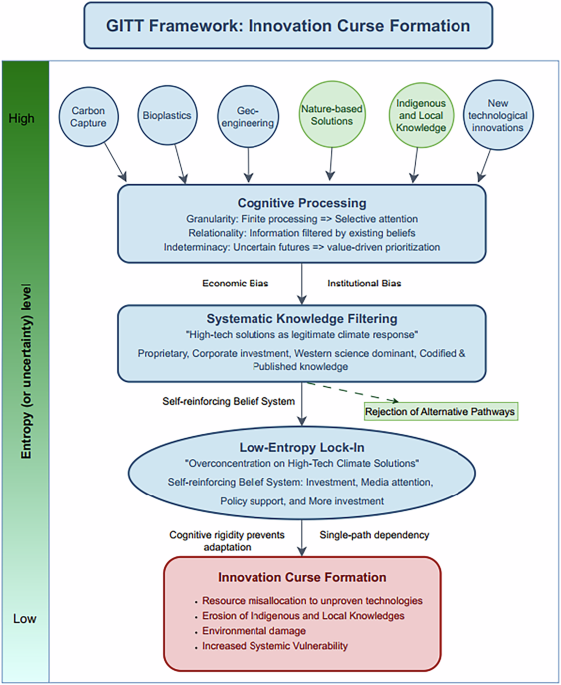
Building on the theoretical foundation of GITT, we can now trace the systemic progression from information overload to the formation of the innovation curse in climate solution selection. As established in Section 3.1, GITT posits that humanity functions as a collective information processing system that must filter environmental ideas, knowledge, and data to survive and adapt. In the context of climate change, the sheer volume and diversity of proposed solutions create a high-entropy environment, triggering the cognitive, social, and institutional filtering mechanisms that GITT describes. This process, illustrated in Fig. 1, explains how well-intentioned efforts can lead to a counterproductive lock-in to a narrow set of solutions.
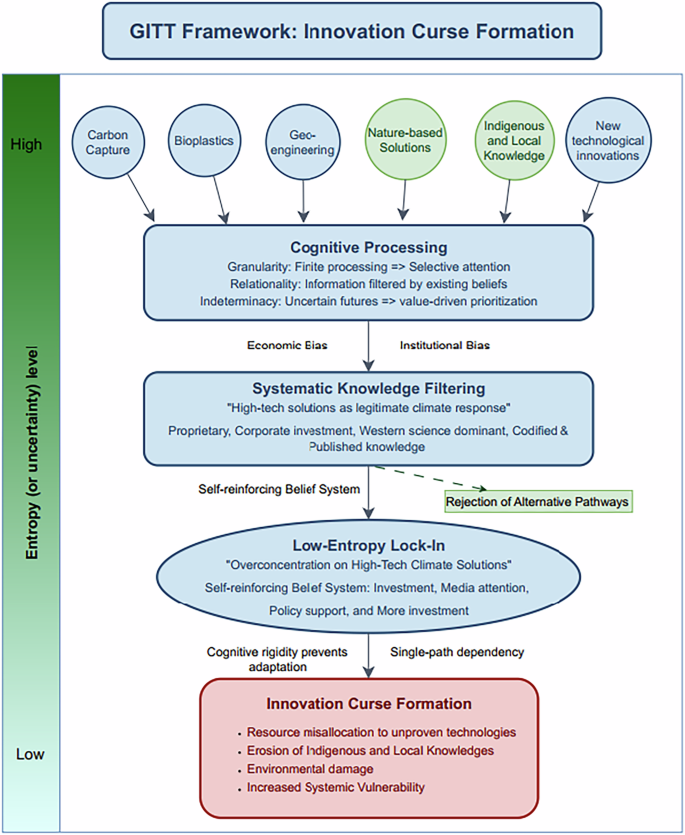
The formation of Innovation Curse.
Stage 1: high-entropy information environment
As depicted in the upper portion of the diagram, contemporary climate discourse is characterized by a maximum entropy condition. Decision-makers are confronted with a vast and varied landscape of potential solutions, ranging from high-tech interventions like CCS, geoengineering, and AI-driven monitoring systems to nature-based alternatives rooted in Indigenous and Local Knowledges, such as traditional agroforestry and community-led conservation. In this high-entropy state, where numerous, disparate solutions appear equally viable, the cognitive and institutional capacity for evaluation becomes overwhelmed.
The overabundance of competing knowledge or solution units leads to decision paralysis, inefficient resource allocation, and policy stagnation. As a result, even costly, high-tech, and unproven innovations receive the same level of legitimacy as time-tested, nature-based solutions despite clear differences in effectiveness, resilience, and long-term impact (Chausson et al., 2020; Nguyen et al., 2025). This knowledge prioritization can take two distinct forms:
First, decision-makers often favor expensive, uncertain innovations that require substantial investment, continuous updates, and corporate backing (Arora et al., 2016; Pries & Guild, 2011). These technologies often promise large-scale solutions but come with hidden costs, long-term uncertainties, and dependence on proprietary systems (Vuong & Nguyen, 2024a). For example, while CCS and geoengineering are marketed as revolutionary climate solutions, CCS plants have failed in over 80% of cases, proving economically and operationally unviable (Rai et al., 2010). Similarly, AI-driven environmental monitoring systems, while valuable, often require constant updates and expensive maintenance, making them inaccessible to resource-limited regions (Dai et al., 2023).
Alternatively, decision-makers could prioritize readily available, time-tested nature-based solutions that have proven effective through generations of Indigenous and Local Knowledge systems (Gómez-Baggethun, 2022). These solutions require lower financial investment while delivering long-term ecological and social benefits (Mendonça et al., 2021). They are locally adapted, ensuring resilience in specific environmental and cultural contexts (Blackman & Veit, 2018; Ramos-Castillo et al., 2017), and offer co-benefits beyond carbon sequestration, such as biodiversity conservation, soil regeneration, and water cycle restoration (Chausson et al., 2020).
Ultimately, when peak informational entropy is reached without clear, evidence-based knowledge prioritization, decision-makers and institutions encounter systemic inefficiencies, resulting in paralysis, misaligned policies, and poor resource allocation (Shannon, 1948; Vuong & Nguyen, 2024c). This informational saturation creates the exact conditions of maximum uncertainty that Shannon’s theory predicts, necessitating a systematic and inherently biased filtering process described in the next stage.
Stage 2: cognitive filtering and biased prioritization
The overwhelming volume of information forces the system to apply filters, which are governed by the GITT principles of granularity, relationality, and indeterminacy. Granularity establishes finite processing constraints that force selective attention. Relationality means that solutions are not evaluated independently but are filtered through pre-existing institutional frameworks, economic models, and cultural values. Indeterminacy drives value-based prioritization when facing uncertain future outcomes.
These cognitive constraints give rise to two main systemic biases: first, an economic bias that favors proprietary, patentable technologies that align with market incentives and promise scalable, profitable returns; and second, an institutional bias that privileges formalized, Western-scientific approaches that fit into existing bureaucratic, academic, and policy structures. This is the mindsponge mechanism in action: information compatible with dominant values (e.g., technological progress, perpetual economic growth) is absorbed, while information that challenges these values (e.g., non-proprietary, place-based Indigenous and Local Knowledges) is rejected, often before its effectiveness can be rationally assessed.
Stage 3: low-entropy lock-in and the innovation curse
This filtering process generates systematic knowledge prioritization that creates what the diagram terms “high-tech solutions as legitimate climate response.” The belief system becomes self-reinforcing: proprietary technologies receive corporate investment, which generates media attention and policy support, which attracts more investment. Simultaneously, alternative pathways, particularly nature-based solutions and Indigenous and Local Knowledge systems, face systematic rejection through structural exclusion from funding mechanisms, policy frameworks, and institutional recognition. The consequence is low-entropy lock-in, characterized by overconcentration on high-tech climate solutions despite their proven limitations. The cognitive rigidity of this system prevents adaptation to new information about the effectiveness of nature-based solutions, while single-path dependency limits society’s ability to respond to technological failures.
This progression culminates in the innovation curse formation, manifesting in four critical consequences: resource misallocation to unproven technologies, systematic erosion of Indigenous and Local Knowledge systems, continued environmental damage from end-of-pipe approaches, and increased systemic vulnerability stemming from technological dependency. This demonstrates how information entropy dynamics, rather than objective effectiveness assessments, primarily drive climate solution prioritization, leading to significant inefficiencies and misaligned policies.
Why expensive innovation wins: market bias and institutional legitimacy
Despite the inefficiencies, high costs, and long-term risks associated with these high-tech, corporate-backed solutions, they consistently receive greater economic and institutional support than low-cost, time-tested nature-based solutions (Lafortezza et al., 2018; Slavíková, 2019; van der Jagt et al., 2020). This reflects what Winner (1980) identifies as the inherently political nature of technological choices, in which technical artifacts embody forms of power and authority that systematically privilege certain solutions while excluding others. Our GITT framework reveals the information-processing mechanisms underlying this bias: when facing high informational entropy from competing solutions, institutional cognitive constraints favor codified, proprietary knowledge over oral, place-based wisdom. This systemic bias is primarily driven by two interconnected factors: economic incentives and institutional legitimacy, both of which shape global knowledge hierarchies and funding priorities.
A fundamental reason for the preference for costly innovations lies in the economic structure of proprietary knowledge. Market-driven models prioritize patented technologies because they create commercial opportunities for investors and corporations, reinforcing a system where profitability, rather than effectiveness, determines which solutions receive support (Arora et al., 2016; Pries & Guild, 2011). The “battery bubble,” for example, shows how hype, policy incentives, and financial speculation can drive investment into a single technology, risking outcomes like “immiserizing growth” (Vuong et al., 2025). Meanwhile, many Indigenous and Local Knowledge-based solutions lack clear ownership structures, making them incompatible with Western intellectual property regimes and market-driven funding models (Mendes et al., 2020). Furthermore, Indigenous and Local Knowledges are collective, context-dependent, and transmitted across generations, which makes it difficult to commodify or integrate into deeply rooted mainstream financial system (Nguyen et al., 2023). This economic misalignment ensures that high-cost technological solutions, despite their inefficiencies, receive disproportionate financial backing, while Indigenous and Local Knowledge-based practices remain systematically excluded from funding opportunities (Bellamy & Osaka, 2020; Slavíková, 2019).
A clear example can be found in climate adaptation policies, where large-scale engineering projects, geoengineering solutions, and high-tech carbon capture technologies receive billions in funding, while Indigenous peoples and local communities, who play a critical role in managing carbon sinks and conserving biodiversity, receive less than 1% of global climate finance (Blackman & Veit, 2018; Nelson et al., 2023; Ramos-Castillo et al., 2017). This disparity is not merely a funding issue but a structural bias in how solutions are valued and prioritized. Governments and investors favor high-tech, capital-intensive projects because they fit within existing financial, legal, and governance structures, while simpler, community-led ecological practices are dismissed as “non-innovative” or difficult to scale (Bridgewater, 2018; Chausson et al., 2020). Ultimately, this economic misalignment reinforces a system where expensive innovations take precedence over simpler, more effective ecological practices, perpetuating a cycle of technological dependency rather than investing in more sustainable, localized solutions (Gómez-Baggethun, 2022).
The second major reason for this structural bias is the institutional legitimacy and media amplification that accompany expensive, corporate-backed innovations (Drury et al., 2022). Technologies endorsed by corporations and powerful institutions receive disproportionate media attention, policy integration, and financial backing, reinforcing the perception that they are the most viable solutions (Bellamy & Osaka, 2020; Dai et al., 2023). In contrast, Indigenous and Local Knowledges are often oral, context-dependent, and intergenerational, making them less visible within formal knowledge systems (Gómez-Baggethun, 2022). Knowledge transmission in Indigenous and Local contexts occurs through lived experience and everyday practice rather than codified reports, patents, or academic publications, creating a fundamental mismatch with dominant institutional frameworks (Nesterova, 2020). This lack of formalization leads to structural exclusion from funding mechanisms, governance structures, and climate adaptation policies, further reducing its perceived legitimacy (Mendonça et al., 2021).
Additionally, regulatory uncertainty, fragmented policies, limited financial incentives, and low public awareness of Indigenous and Local Knowledges further marginalize its adoption (Nesterova, 2020). Even in cases where Indigenous and Local Knowledges have proven their effectiveness, such as in forest conservation, agroecology, and climate resilience, their integration into mainstream decision-making remains weak due to scientific elitism, economic barriers, and institutional inertia (Blackman & Veit, 2018; Bridgewater, 2018). The tendency to favor high-tech, capital-intensive solutions over nature-based, community-led approaches not only distorts climate and sustainability discourse but also reinforces existing power imbalances in knowledge production and policy influence (Chen et al., 2020; Miklian & Hoelscher, 2020; Vuong, 2021b).
For example, for thousands of years, Indigenous Australians have practiced cultural burning to manage landscapes, reduce fuel loads, and prevent catastrophic wildfires. These controlled burns, carefully timed with seasonal weather patterns and biocultural indicators (McKemey et al., 2020), effectively clear dry vegetation while maintaining biodiversity and supporting traditional food resources (McGregor et al., 2010). Historical records and paleoecological studies confirm that widespread Indigenous burning shaped Australian ecosystems, keeping shrub cover low and reducing the intensity of wildfires (Mariani et al., 2024). However, colonial policies suppressed and even criminalized these practices, favoring fire exclusion and suppression strategies (Fletcher et al., 2021). Over time, this shift increased fuel loads, contributing to the very conditions that make modern wildfires so destructive. Despite growing evidence of its effectiveness, cultural burning remains marginalized in favor of high-tech firefighting interventions such as aerial water bombing and large-scale prescribed burns (Perry et al., 2018). These costly and reactive approaches receive disproportionate media attention, policy support, and public funding, reinforcing the perception that technological fire suppression is superior (Laming et al., 2022). However, studies show that such methods fail to address long-term fire risks because they do not integrate localized, fine-scale Indigenous fire management (Huffman, 2013).
The devastating 2019 – 2020 Australian bushfires (also known as Black Summer fires), which burned more than 17 million hectares of land, destroyed thousands of homes, and resulted in massive biodiversity losses, demonstrated the failures of modern fire suppression policies (NHRA, 2023; Wintle et al., 2020). Studies later acknowledged that Indigenous fire knowledge could have significantly reduced the severity of these fires, had it been systematically integrated into national fire management policies (Fletcher et al., 2021; Kreider et al., 2024; Mariani et al., 2024). However, despite this acknowledgment, Indigenous fire practitioners still struggle to secure funding and institutional support, while government-led large-scale fire strategies and bureaucratic fire management models continue to dominate wildfire policies worldwide (Maclean et al., 2023; Perry et al., 2018).
Losing what we need most: the erosion of time-tested solutions
Earth, our only known planet capable of supporting human life, has finite resources. Yet the persistent prioritization of uncertain, expensive innovations over time-tested, nature-based solutions continues to accelerate environmental degradation, deplete biodiversity, and drive irreversible knowledge loss (Li et al., 2022). This misalignment between technological investment and planetary constraints not only threatens present stability but also compromises humanity’s long-term adaptability and survival (Lafortezza et al., 2018).
At the heart of this crisis lies a fundamental limitation in humanity’s ability to process and retain information. As informational entropy rises, decision-makers and institutions are forced to filter out “non-prioritized” knowledge, often favoring digitized, standardized information over traditional, experience-based wisdom (Nguyen et al., 2025; Vuong & Nguyen, 2024b). Indigenous and Local Knowledges, which are deeply embedded in oral traditions, cultural practices, and ecological adaptation, are frequently the first casualty of this filtering process and, in many cases, irretrievable (Gómez-Baggethun, 2022). Without intentional prioritization, the rapid loss of traditional ecological wisdom not only erases invaluable cultural heritage but also disrupts proven sustainable resource management practices, leading to further ecosystem degradation and reduced climate resilience (Mendes et al., 2020; Ramos-Castillo et al., 2017).
The loss of Indigenous and Local Knowledges extends far beyond cultural heritage. It represents the erosion of sophisticated ecological understanding that has sustained local ecosystems and human societies for generations. Indigenous and Local Knowledge systems provide adaptive, sustainable resource management practices that are crucial for long-term environmental resilience, biodiversity conservation, and socio-economic stability (Nesterova, 2020; Vijayan et al., 2022). As this knowledge disappears, societies increasingly default to unsustainable, short-term practices, leading to biodiversity loss, ecosystem degradation, and declining community well-being (Mendes et al., 2020; Ramos-Castillo et al., 2017). As we advance in our efforts to address climate change, the central challenge is no longer merely generating more technological solutions, but rather discerning which solutions genuinely drive progress and which merely add to an overcrowded, high-entropy information landscape (Vuong & Nguyen, 2024a). If society continues to channel resources toward high-cost, uncertain technologies while neglecting Indigenous and Local Knowledges and nature-based solutions, we risk undermining the very foundations of sustainable solutions and knowledge that we need most.