
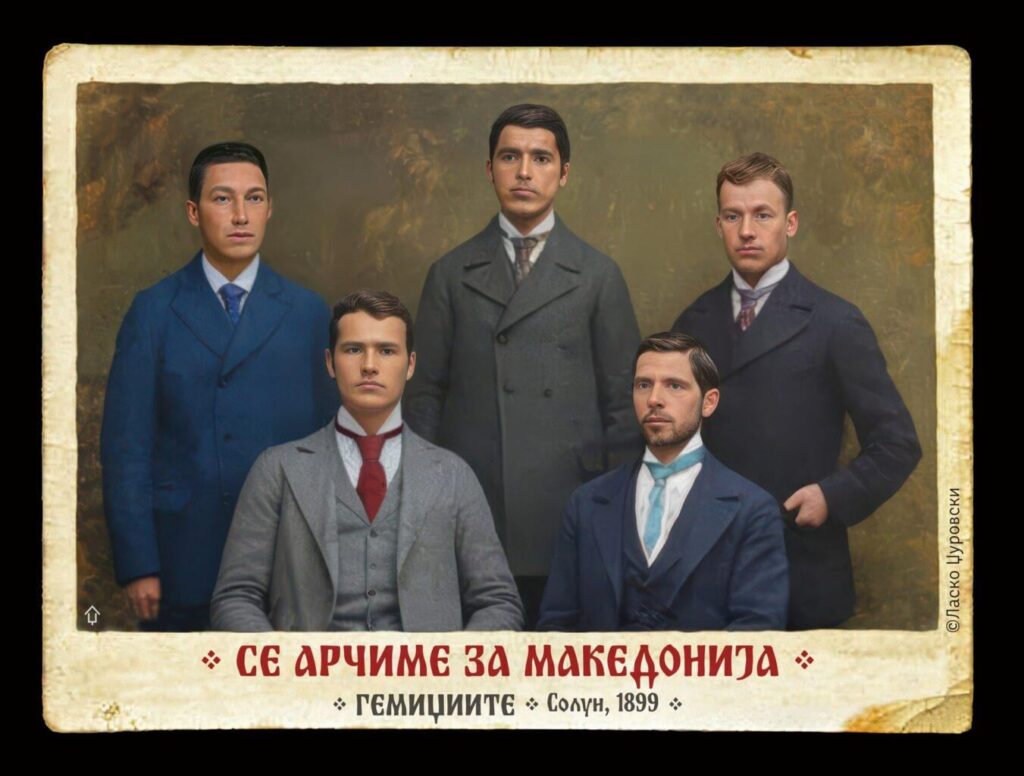
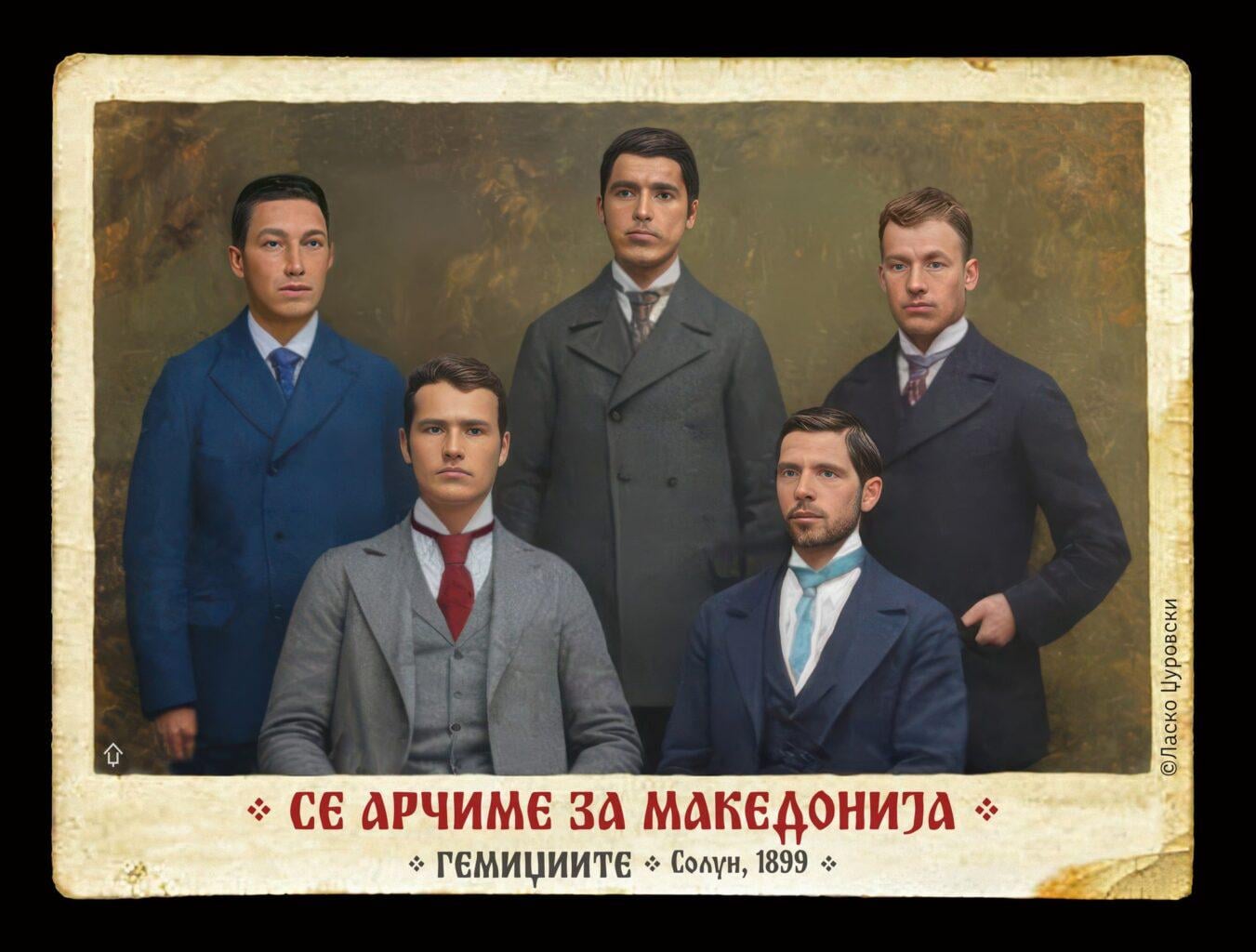
122 years ago in Thessaloniki, the sailors started the Thessaloniki assassinations, which, as an act of combat, lasted for several days, but as a collective memory, they grew into a national myth and historical legend. The Macedonian national genius will write about them: “Sing Thessaloniki, sing, play with all the sadness and pain/To be heard far, far in dear Macedonia/Youth did not regret, they gave their lives, for our dear Macedonia/They were all young, Orce, Shatev, Kirkov, Mechev, Trichkov, Pingov/Delicate flowers in the garden, dewy, in the sun not smiling/Youth did not they regretted, they gave life, but they did not take any innocent life/They sacrificed themselves for Macedonia…” In the history of Macedonia and the Macedonian people, there are many turbulent and significant events that attracted the attention of the Balkan, European and world public. One of the most significant such events is precisely the Thessaloniki assassinations, the so-called. “dynamite diversions” carried out by a revolutionary anarchist group called “Shipmen”. Named so, they will equate their life with a gem that floats on a stormy sea, which can come ashore or be broken by underwater rocks. The latter happened and all but one went down in legends and history. They believed that the world would wake up with a bang, with a blow to the capital of European corporations. They wanted to show the strength of Macedonia through a personal tragedy, sparing other people’s lives. They wanted to strike the conscience of the great powers and tell them that the Macedonian people are no longer a coin to be bribed. They will burn a ship, several bars, an inn, blow up a hotel, a bank and a post office… With these Thessaloniki thunders and the burning sky, they will shake the Turkish regime and shoot the conscience of blinded Europe. They were convinced that they owed it to the oppressed and tortured Macedonian people.
Who are and what do the Thessaloniki assassins represent?
These are our boatmen (shipmen, from “gemia”, which in Turkish means chun, boat, boat), who said goodbye to a life from which they did not expect anything good and surrendered to the sea of life, with the aim of either succeeding or getting their gemia, ship, on dry land, on the sand from the shore. In other words, people who have said goodbye to their lives and released their life raft on the stormy sea, which will either come ashore or be broken by the Scyllas and Charybdis and sink. This is a brief definition of their rebellious philosophy of life. In essence they are radical revolutionaries influenced by anarchist ideas. They carried out a series of bomb attacks and dynamite diversions on a foreign ship and a bank, post office, power plant, hotel and restaurants and bars of the Turkish Empire – the tyranny-enslaver of Macedonia. These were young men, just finished students of the Thessaloniki high school or early students, with their first love itches, with their undreamed dreams, with their concerns for Macedonia and hopes for the future of the Macedonian people. All of them: Jordan Pop Jordanov-Orce, Kosta Kirkov, Dimitar Mechev, Todor Organdzhiev, Ilija Trichkov, Todor Bogdanov, Gjorgi Bogdanov, Vladimir Pingov, Ilija Pop Jordanov and Milan Arsov from Veles, as well as Pavel Shatev from Kratovo, Marko Boshanakov from Ohrid, Dimitar Kostanov and others. they were aged 18, 19, 20 to 22 years. A little older were D. Mechev, D. Kostanov and M. Boshnakov, who were already members of TMORO.
One of the few surviving sailors, Pavel Shatev, will very specifically capture their personalities and profiles of young people – revolutionaries, anarchists and ready to lay down their lives for their homeland – Macedonia. Todor Organdzhiev will do something similar. All these young sons of Macedonia loved their suffering homeland the most, for which they were ready to sacrifice their youth, which was just springing up in front of them. What made them do it? Turkey’s political, social and economic oppression? Spiritual submission from anti-Macedonian propaganda (Bulgarian, Greek, Serbian)? Or, again, the lack of interest of the European powers in the Macedonian issue and their indecision to resolve it, once and for all? The answer is all that together – from the first to the last injustice and because of all the unresolved issues, important for the existence of the Macedonian people.
What did the boatmen do for Macedonia?
The Thessaloniki assassins – sailors, with their brave actions in April 1903, in which most of them laid down their young lives, aimed, at the cost of self-sacrifice, to draw the attention of the unjust and sleepy Europe to the suffering of the suffering Macedonian people. With their “dynamite diversions”, those young sons of Macedonia, with their struggle, brave act and act of self-sacrifice, created the epic of the sailors. Through daring bombings and suicidal dynamite diversions, they entered eternity. These bombings and dynamite diversions were carried out on April 29, 30 and May 1, 1903. The place of this brave, suicidal, but also bloody drama is the city of Thessaloniki – a city where most of the Macedonian intelligentsia, Balkan merchants, foreign diplomatic missions in the Ottoman Empire and the representatives of foreign institutions, such as banks, post offices, a gas factory and religious and educational missions, were concentrated. The organizers, preparers and executors of these assassinations were the members of the Thessaloniki “Sailors'” circle: ten of them threw bombs in the “Alhambra”, “Nyonjo”, “Egypt” cafes, in front of the “Grand Hotel”, in “Boschnak-an”, they sank the French ship “Guadalquivir”, they set off dynamite in the Ottoman Bank, the post office, the gas station, the German club, and six of them died, and four survived, were caught, tried and convicted. They served their sentence in the city of Murzouk, deep in the African province of Fezzan. And so, some were killed, others were sentenced and in dungeons, but the message of the sailors remained forever: “The assassinations are the work of a group of Macedonian patriots. With them, we strike at the conscience of civilized Europe in the name of a people, suppressed into slavery. We demand intervention from the free world! Down with tyranny! Freedom of the people!”
The Thessaloniki assassinations were very well organized and extremely well executed. The young sailors have shown in action that maximum effect can be obtained with minimal civilian casualties. Hristo Siljanov’s writings about the Thessaloniki assassinations and the sailors are very impressive. He is the man who wrote the best chronicle of the Macedonian revolutionary struggle and the Ilinden Uprising, who will write about the shipmen and their self-sacrificing revolutionary act, among other things: “But everything that can be taken as a reproach to the dynamitci pales in comparison to the greatness of their spirit. That spirit, which, it is seen, reaches terrible effects through proverbial demolition, is filled with a strange idealism and woven with unusual contrasts. In the short interval before the explosion, Orce’s first concern is to save the director of the bank and his family. What a moral beauty and how much human nobility there is in that cruel leader’s gesture! That leader who did not deviate from the start of the terrible act, often terrorized his comrades…” In support of the justification of their act, Krste Bitovski wrote, among other things: the bombs that the sailors threw at the bars were made with a long fuse, to give the guests the opportunity to leave the bar in time. The goal, then, was to destroy it, to make as much noise as possible through the dynamite explosions, and thus to create panic, to attack the enemy, but to do all this, if possible, with as few victims as possible among the innocent population.”
The Thessaloniki Assassins, the Thessalonica Assassinations – the series of dynamite diversions and bombings – are a crystal clear demonstration of how hard it was to get freedom in the Ottoman Empire. They are also proof of what freedom is and what its price is. The sailors were irrevocably and irreparably imbued with anarchist ideas. They were young men who willingly went to their deaths. For them, that suicidal act was an entry into the collective memory of the Macedonian people, which over time turned into an act of eternal remembrance. They showed and proved that they have a huge unbreakable will to contribute to the Macedonian work, a will that they realized through a pre-planned death in a revolutionary action. They realized the revolutionary and death vow by: some resisted the Turkish bullets with their young breasts; others charged at soldiers’ bayonets; others embraced bombs that had been set off by them. In that way, they expressed the boiling noble anger of their homeland Macedonia and bequeathed the Macedonians for centuries with the most wonderful example of self-sacrifice. The sailors were a small group, but conceptually unique and compact. Their determination to carry out the Thessaloniki dynamite diversions and assassinations was at the highest level. Despite all the unfounded attacks on their destructive revolutionary actions, the facts contained in the statements of their contemporaries, and especially the writings of Pavel Shatev, show that they were imbued with a sense of deep humanism. That humanism of theirs was expressed during the performance of the actions themselves, when they walked into the embrace of their own death, taking care to avoid unnecessary innocent victims. The fact is that sailors stopped thinking and caring about their lives a long time ago. That is why six of them caused and realized their brave death. But it is an even greater fact and an undeniable truth that in the most critical moments during the execution of the Thessaloniki assassinations and diversions, the conscientious sailors with the greatest composure took care to protect the lives of innocent people.
The sailors laid down their lives and youth for the freedom of Macedonia
The sailors succumbed to death in the prime of their youth. Their brave death and the diversions they carried out, such as the explosion of the ship “Guadalquivir”, the blowing up of the Ottoman Bank, the blackout in Thessaloniki and other sabotage and bombing actions, showed Turkey and Europe that Macedonia will not rest until it becomes independent and free. Let’s note that Orce grew up in a family that bled for Macedonia. His older brother was Mile Pop Jordanov, a revolutionary and duke, who died for the freedom of the people and for an independent Macedonia. Kirkov was a revolutionary who absorbed the reactions of the French Revolution and learned from them how to end blackness. Mechev was a poor orphan, to whom the crust of bread was a hard teacher from a young age. Pavel Shatev grew up with the patilla of his people and saw the injustices in every inch of Macedonia. Milan Arsov, on the other hand, longed for a free homeland and a more beautiful youth. All of them, as well as their other comrades, were furious, full of anger and angry at Europe and the world, for so heartlessly watching a suffering nation and a subjugated country suffer and sink into poverty and slavery. And what is most important, they wanted to draw the attention of that eyeless world to the suffering, pain and miserable living conditions of their people. They did that, and the national genius sang in a song: “…Bombs were rattling, the bank was shaking, the post office was on fire, the Guadalquivir was sinking/Macedonia spoke, spoke very loudly, spoke with the death of the sailors/Youth did not regret, they gave their lives, for our dear Macedonia/Listen peoples, listen all from the east, west, north and south – here there are people eager for freedom, they give their lives for mother Macedonia…” They simply thought that such a Europe (“Babylonian orospiia”) cannot be awakened by silence or prayer, i.e. kneeling. The Ilinden epic will confirm that, i.e. the Macedonian people will show courage like their sailors. Both the sailors and the suffering Macedonian people made sure that she was not moved by the tears of the suffering and oppressed people of Macedonia. They saw and felt all the misery of the diplomatic, financial and state circles in Thessaloniki and beyond. They made sure that no one really wants to help the poor, the oppressed, the unjustified, the enslaved. That’s why – because of the anemic and sleepy Europe – but also because of patriotic reasons, these young men decide on radical action, through dramatic dynamite actions. They were also ready for something much higher – to sacrifice their young lives to attract the attention of the European powers, to awaken their conscience, with a single goal – to help liberate the Macedonian people from political, social and spiritual oppression. Their self-sacrifice was and remains heroic. Generations of Macedonians remember them as a unique example of conscious self-sacrifice. My dear Macedonians, this magnificent act of our brave sailors is idealism, fanaticism, but above all a revolutionary action, a realized oath with an accomplished mission. The self-sacrifice of the sailors is heroic. Kudos to them. Before them and their brave work, we can only bow down and pay our respects.
https://i.redd.it/ewuetnymk73g1.jpeg
Posted by swisscheez1
6 Comments
https://preview.redd.it/n62tguo0l73g1.jpeg?width=953&format=pjpg&auto=webp&s=7b0cc41bd7e509b46e6adb0cd128c878c23388b0
Урнатините на разнесената Отоманска Банка
Многу го сакам филмот за нив: „Солунските Атентатори“
pisuvajte pocesto vakvi raboti, belki ke procitaat i ke naucat nesto ajvanive nashi na reddit
Sho e ova? Epot na gemidziite? 🤣
Ova e bukvalno najgolemiot crn pechat na makedonskite revolucionernite dvizenja (skoro isto nivo so chernozemski)
Edit: pred da pochnat golemite patrioti da komentiraat se preporachuva da go poglednat periodot I posledicite od “heroive nashi” ne samo od represijata sho ide, kaj sho makedoncite bile pushtosh praveni od otomancite, kidnapirani, macheni itd tuku I samoto ilindesko vostanie bilo poebano od vaa glupost…
Ama toa e od 80iq narod drugo nemoze da ispadne.
Терористи шо џиткаат четириес бомби од џам на улица, по кафани, театри, палат брод полн со патници цивили. За Хамас шо мислиш вака да те прашам, обично обратно се осеќаат во врска со нив вавките, од искуство
Нашиот UCK, не треба да се гордејме со ваквите