
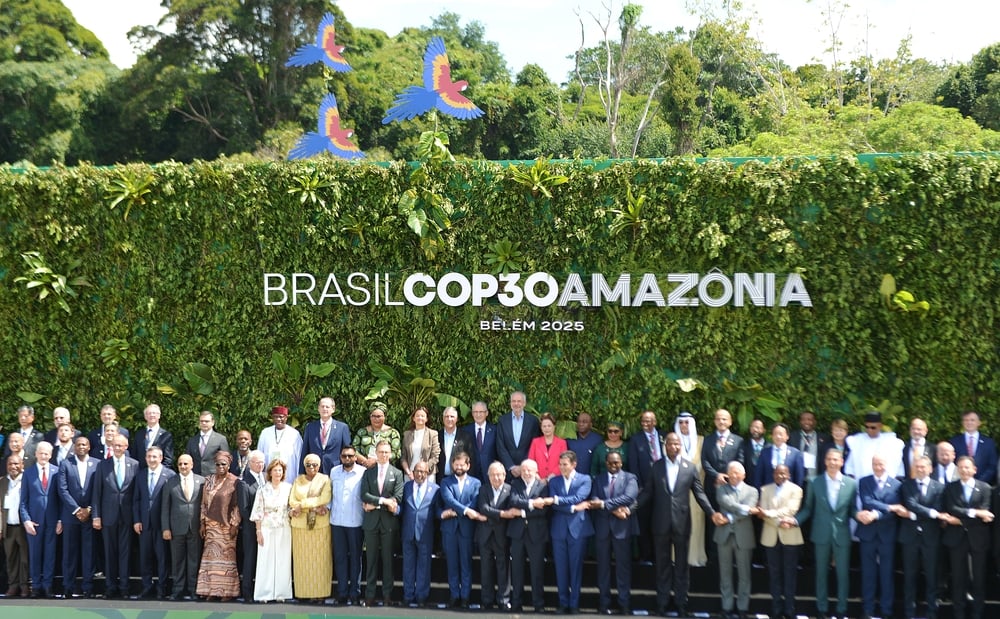
The 30th United Nations Climate Change Conference (COP30) concluded last Friday in Belém, Brazil. Countries met to discuss how to respond to climate change and support global climate goals. The meeting produced some progress, especially in climate finance. However, it did not include binding commitments to end fossil fuel use or stop deforestation.
The outcome, inked by 194 nations, showed both achievements and limits. It also highlighted the challenges that come with global climate talks that need agreement from almost 200 countries.
Adaptation Finance Gets a Lift — But Not Enough
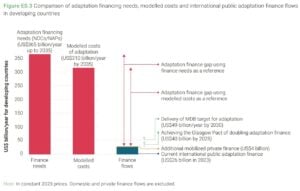
One major result of COP30 was the agreement to increase support for countries affected by climate change. The final text calls for a large boost in adaptation finance. This includes a plan to scale up support to around US$120 billion per year by 2035, which is about 3x more than the current pledge. This money will help nations prepare for floods, storms, droughts, and other climate impacts.
Developing countries welcomed this boost. They often face the worst climate impacts but have fewer resources to respond. The extra funding helps communities in several ways. It builds infrastructure, improves disaster response, supports farmers, and protects vulnerable groups.
However, experts note that the global adaptation finance gap is still over US$300 billion per year. This means the new target still falls far short of what vulnerable countries need. While COP30 showed progress in financial support, the scale of funding challenges remains large.
 Source: UNEP
The agreement also encourages countries to improve the reporting and tracking of adaptation funds. This aims to make the money more predictable and effective. Although the increase is significant, the exact details of how funds will be distributed are still being finalized.
Fossil Fuel Talks: Big Ambition, Small Commitments
COP30 introduced voluntary roadmaps for two important areas: fossil fuels and deforestation. Countries agreed to discuss long-term plans to reduce fossil fuel use and protect forests.
However, these roadmaps are not binding. They do not set legally enforceable targets. Countries can join voluntarily and report their progress, but there are no penalties for failing to meet the goals.
More than 80 countries supported the fossil fuel transition roadmap, including Brazil, South Korea, Germany, France, Colombia, Chile, Kenya, and Mexico. These countries said they were willing to explore pathways toward cleaner energy systems.
But some major fossil fuel producers opposed binding language. Countries such as Saudi Arabia, Russia, India, and China pushed back against any formal agreement to phase out fossil fuels. Because of this opposition, the roadmap remains voluntary and sits outside the official COP30 text.
Wopke Hoekstra, EU Commissioner for Climate, Net Zero and Clean Growth, posted:
“However, a group of mainly oil-producing countries did everything to block the reference to phasing out fossil fuels in the unanimous agreement. Instead, on an initiative led by Brazil, we will form a large coalition of the willing committed to a concrete roadmap for phasing out fossil fuels.”
The forest roadmap is also voluntary. It focuses on protecting and restoring forests, especially in important regions like the Amazon. The Amazon plays a major role in storing carbon, supporting biodiversity, and regulating weather patterns. But countries differed widely on how quickly deforestation should be reduced, which made it difficult to reach a binding agreement.
These voluntary roadmaps show how challenging it is to reach an agreement among nearly 200 nations. Different national priorities, economic pressures, and political interests shaped the final outcome. The voluntary nature of the roadmaps was a compromise to keep all countries involved in the process.
Limited Progress on Emissions Reduction
COP30 placed much of its emphasis on adaptation finance and voluntary initiatives. However, the conference did not make any binding commitments to reduce fossil fuel use. This created a large gap between scientific recommendations and political agreements.
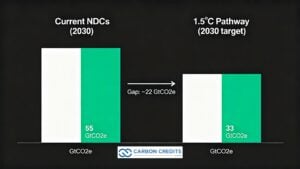
Global warming continues to speed up. Scientists explain that the world must sharply cut carbon emissions in the next decade to keep global temperature rise below 1.5 °C. Passing this threshold increases the risk of extreme climate impacts, including stronger storms, hotter heatwaves, and ecosystem loss.
The chart shows the large difference between where emissions are projected under current climate plans and where they need to be in order to stay on track for 1.5°C. The gap is huge — more than a third of current projected emissions.
 Data source: UNEP
COP30 did not introduce new binding measures to support the 1.5 °C pathway. Instead, delegates stressed the importance of national climate plans, or NDCs (Nationally Determined Contributions). Countries were encouraged to update their NDCs with higher ambition.
Before COP30, some countries submitted stronger NDCs. South Korea, for example, announced a plan to cut greenhouse gas emissions by 53% to 61% by 2035, compared to 2018 levels.
More than 120 countries also updated or strengthened their NDCs ahead of the conference. These updates show a willingness to act but still rely heavily on voluntary action without enforcement mechanisms. Scientists say this gap makes it difficult to meet global climate targets.
Forest Protection Goals Remain Voluntary
Deforestation was another major issue where COP30 did not deliver a binding result. The final text did not include a global commitment to end forest loss by a specific date. Instead, the forest roadmap remains voluntary, leaving each country to decide its own pace.
This outcome is notable because the Amazon rainforest, where COP30 was held, is one of the world’s most important ecosystems. It stores large amounts of carbon dioxide and contains rich biodiversity. Scientists warn that losing more of the Amazon could push parts of the forest toward a “tipping point,” where it can no longer recover from damage.
Some countries announced national programs and partnerships to reduce deforestation. Others introduced local community agreements and government-company collaborations. These efforts are helpful but limited without a binding global target. As a result, the overall potential impact remains uncertain.
Key Decisions and Frameworks
Despite the gaps, COP30 reached several agreements and introduced frameworks that could support future action. Key decisions include:
- Tripling adaptation finance for vulnerable nations.
- Launching voluntary roadmaps for fossil fuels and forests.
- Strengthening mechanisms to monitor and report climate finance.
- Encouraging countries to enhance NDCs and other climate plans.
- Creating new dialogues on trade and climate policy.
These measures aim to keep international cooperation on track. They also provide tools for tracking progress and sharing knowledge. While not legally binding, they may help countries coordinate and plan their next steps.
Why Global Climate Politics Remain Stuck: The Road After COP30
COP30 highlighted several challenges facing global climate negotiations. Political divisions made it difficult to reach strong agreements. Countries have different priorities, depending on their economic structure, natural resources, and development needs. Some focus on adaptation finance, others on fossil fuel transition, and others on forest protection.
Another major challenge is the COP process itself. With almost 200 countries involved, decisions must be made by consensus. This means that even a small number of countries can block stronger language. As a result, many proposals were softened to achieve agreement, especially those related to fossil fuels.
Future steps will focus on how countries turn voluntary plans into clear actions. Governments are expected to update their NDCs, implement adaptation projects, and improve transparency in reporting. Civil society groups, local governments, and the private sector are also expected to help track progress and hold governments accountable.
Experts say that future COP meetings will need to build on COP30’s progress and address its gaps. Stronger and more coordinated commitments, especially on fossil fuels and forest protection, will be crucial to staying within global climate goals. COP30 was another step in a long process, but much more work is needed to secure a safer and more stable climate future.