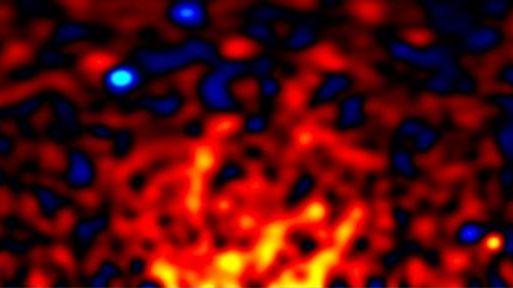
Scientists may have finally ‘seen’ dark matter for the 1st time – “This signifies a major development in astronomy and physics.”
https://www.space.com/astronomy/dark-universe/scientists-may-have-finally-seen-dark-matter-for-the-1st-time

Scientists may have finally ‘seen’ dark matter for the 1st time – “This signifies a major development in astronomy and physics.”
https://www.space.com/astronomy/dark-universe/scientists-may-have-finally-seen-dark-matter-for-the-1st-time
1 Comment
From the article
Scientists may have “seen” dark matter for the first time, thanks to NASA’s Fermi gamma-ray space telescope. If so, this would mark the first direct detection of the universe’s most mysterious substance.
Dark matter was theorized in 1933 by astronomer Fritz Zwicky, who found that the visible galaxies of the [Coma Cluster](https://www.space.com/15223-coma-cluster-galaxies-skywatcher-photo.html) lacked the necessary gravitational influence to prevent this cluster from flying apart. Then, in the 1970s, astronomer [Vera Rubin](https://www.space.com/vera-rubin.html) and colleagues found the outer edges of spiral galaxies were spinning at the same rate as their centers, something that would only be possible if the major amount of mass in these galaxies wasn’t concentrated at their centers, but rather more widely dispersed. These aren’t direct observations of [dark matter, ](https://www.space.com/20930-dark-matter.html)of course, but inferences made using dark matter’s interactions with gravity as well as the influence gravity then has on ordinary matter and light. Still, because of these findings, s astronomers have since calculated that all large galaxies are embedded within vast haloes of dark matter that expand way beyond the limits of visible matter in galaxies (such as galactic haloes of stars).
The particles of this mysterious substance are now estimated to outweigh the particles that make up everyday matter by a ratio of five to one. That means everything we see around us on a day-to-day basis — stars, planets, moons, our bodies, next door’s cat, and so on — all account for just 15% of the matter in the universe, with dark matter accounting for the other 85%. Adding to the mystery of dark matter is the fact that, because it interacts with electromagnetic radiation so weakly, or not at all, it doesn’t emit, absorb, or reflect light. Thus, it is effectively invisible in all wavelengths of light — or at least, we thought it was.