
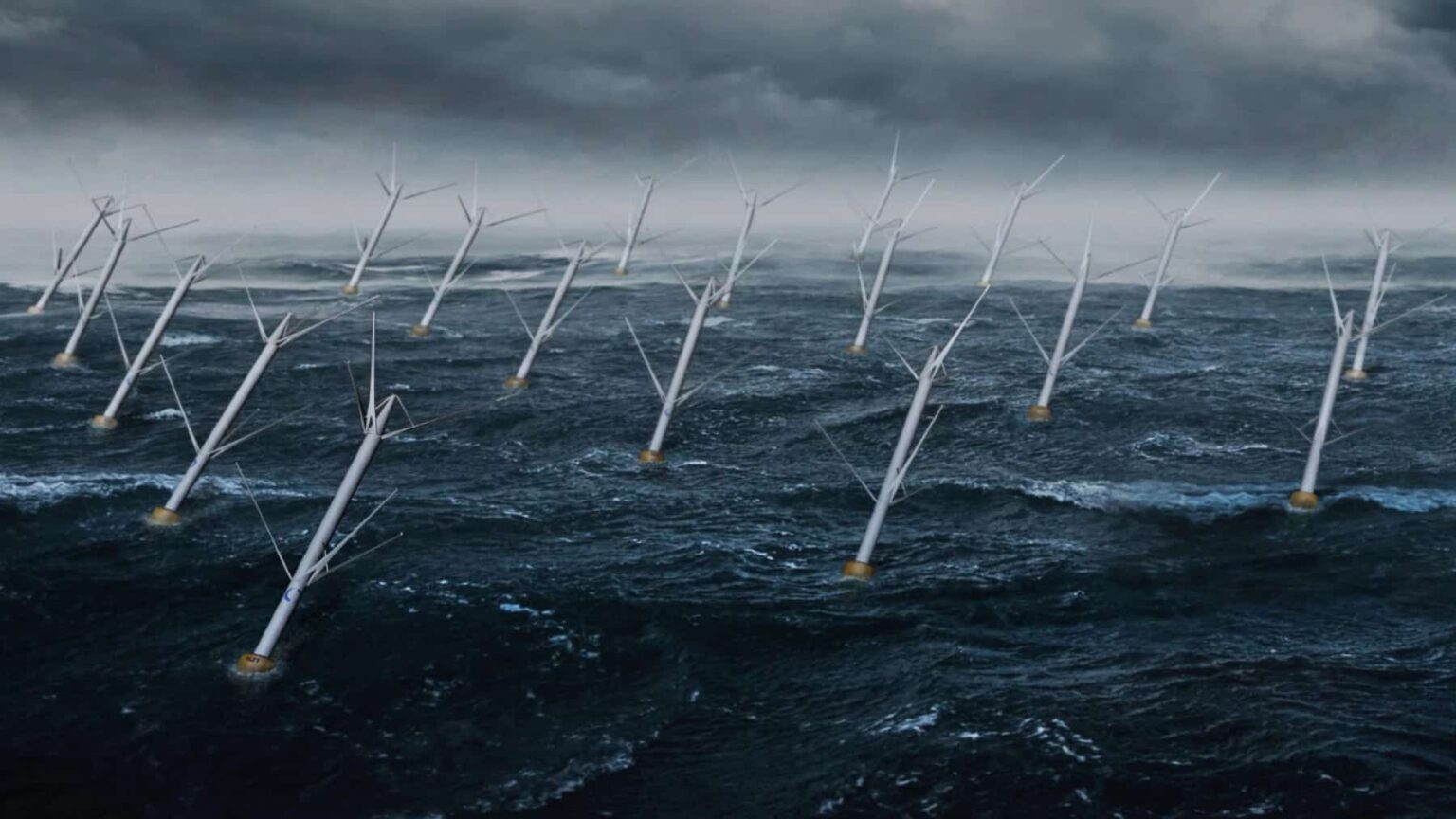
Norway’s World Wide Wind (WWW) has developed a 400-meter-tall wind turbine (also called Mother of Seas) that differs from the conventional wind turbine structure. It is developed in an upside-down mode with its rotor near the ocean surface. Its tower extends to the sky to endure storms and generate power.
How Norway’s turbine design differs from conventional structures
The wind turbine, also called the Mother of the Seas, uses a vertical-axis wind turbine (VAWT) setup. It has two sets of blades mounted on the same vertical shaft. Its rotors rotate in opposite directions to improve efficiency. As the turbine has two rotors, it generates more torque and power.
The generator of the wind turbine is located at the base or near the floating foundation. Having this heavier part of the turbine helps stabilize the turbine. It also makes maintenance easier, as the key components are not high up in the sky.
The turbine can tilt towards the wind direction and force. This allows the blades to align with the wind and reduce the load on the structure. Its floating ability gives room for deep-water deployment, which is unavailable in fixed-bottom turbines limited to shallow coastal waters. The turbine can reduce the risk of structural failure under powerful waves. Unlike the initial turbine design, this new structure can withstand heavy storms and generate energy continuously.
How Norway’s upside-down wind turbine works as a powerhouse
Offshore turbines face pressure from high waves, cyclones, and hurricanes. Top-mounted designs often risk structural failure, downtime, or collapse during extreme conditions. On the contrary, the Norway upside-down wind turbine lowers its center of gravity. This allows the blades to spin continuously while enhancing stability.
The prototype of the Norway upside-down wind turbine, which was tested this year, has a 30-kilowatt production capacity. The 400-meter-tall wind turbine also has a 40-megawatt capacity. This almost doubles what the previous turbine design can achieve. There is another turbine version, which will be made commercially available in 2030. This prototype will have a 24-megawatt production capacity. Before then, a 1.5-megawatt version will launch, like this powerful sailing turbine redefining clean energy.
The upside-down wind turbine brings much development and reduces dependence on energy types that heat up the Earth. These energy types, including coal, oil, and natural gas, are created by drilling, mining, and burning fossil fuels. Unlike these other energy sources, energy derived from wind turbines does not cause environmental or health issues.
Broader implications for global offshore wind energy
The Norway upside-down wind turbine can transfer offshore wind energy far and wide. This is achievable by exploring deeper waters with strong and steady winds. When these areas are accessed, taller rotors can be installed for increased energy output and efficiency.
Adopting this storm-resistant and more efficient turbine can improve the electricity supply and improve the provision of clean energy during harsh weather conditions. This innovation further demonstrates the possibility of balancing technological advancement, power generation and supply, and environmental and health protection.
Comparing Norway’s upside-down wind turbine with other floating turbines
The Mother of Seas demonstrates the next generation of offshore turbines. It outperforms existing floating designs in scale, sophistication, and resilience. Its engineering structure solves the issue of stability, height barriers during maintenance, and the inability to withstand storms.
Unlike other floating turbines with limited capacity, the Norway upside-down wind turbine is among the tallest turbines; unlike the SeaTwirl, for example, which is only tens of meters, smaller, and less resilient during extreme situations. The Norway upside-down wind turbine represents an advanced technological development in improving power supply through tidal energy. The Mother of Seas can withstand storms and supply electricity constantly by combining an upside-down rotor, a 400-meter height, and a floating design, just like this groundbreaking two-headed wind turbine with a strange effect.