
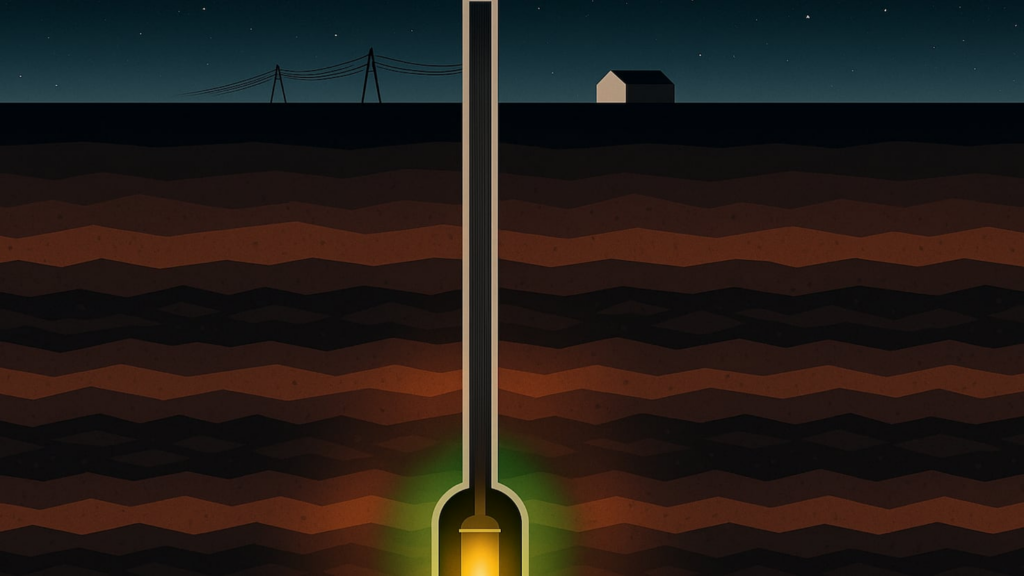
Deep Fission, a young California company, is preparing to start building a nuclear reactor a mile below ground, sealed inside a pressurized water shaft and almost invisible from the surface. The team expects it to be ready within six months, convinced that the future of nuclear power lies “at the center of the Earth.”
The reactor, named Gravity, is designed to gain two major advantages from being built underground – a fully mineral environment and naturally generated pressure. Gravity will follow a familiar template: a pressurized-water reactor powered by uranium, the same basic approach used in most existing power plants.
🌍⚛️ Deep Fission Names Its Underground SMR “Gravity Nuclear Reactor”
California-based startup Deep Fission has unveiled the name of its underground small modular reactor (SMR) — the Gravity Nuclear Reactor. Slated for its first unit in 2026, the design leverages Earth’s natural… pic.twitter.com/GvWVuBUTzq
— Nuclear Business Platform (@Nuclear_BP) November 25, 2025
The company believes this underground construction will be 80 percent cheaper than a surface project because it won’t require massive domes or heavily fortified structures. Its target production cost is $54 to $75 per megawatt-hour. As for the risk of an accident, Deep Fission argues that natural confinement makes one unlikely. The reactor will be fully isolated underground with a closed loop system.
Liz Muller, the company’s co-founder and CEO, said: “Reliability lies at the heart of our reactor design. By placing our Gravity reactors deep underground, we’re harnessing the Earth’s natural forces to make nuclear energy inherently safer, far cheaper and far faster to deploy.”
Deep Fission Plans to Sink Nuclear Reactors Deep Underground
Deep Fission’s small modular reactor (SMR), called Gravity, is designed to stand 9 meters tall while remaining slim enough to fit inside a borehole roughly three-quarters of a meter wide.https://t.co/OYh6W2MVHJ pic.twitter.com/2Jrg7DCL35
— Earl Jackson (@earljackson1776) November 22, 2025
As for development, the plan is set, but actual construction will take time. The first step is to have a working prototype by July 2026, a project backed by the US Department of Energy. The schedule calls for four weeks of drilling, 10 weeks of installation and then two months of testing.
Related stories


Get your game on! Whether you’re into NFL touchdowns, NBA buzzer-beaters, world-class soccer goals, or MLB home runs, our app has it all.
Dive into live coverage, expert insights, breaking news, exclusive videos, and more – plus, stay updated on the latest in current affairs and entertainment. Download now for all-access coverage, right at your fingertips – anytime, anywhere.