
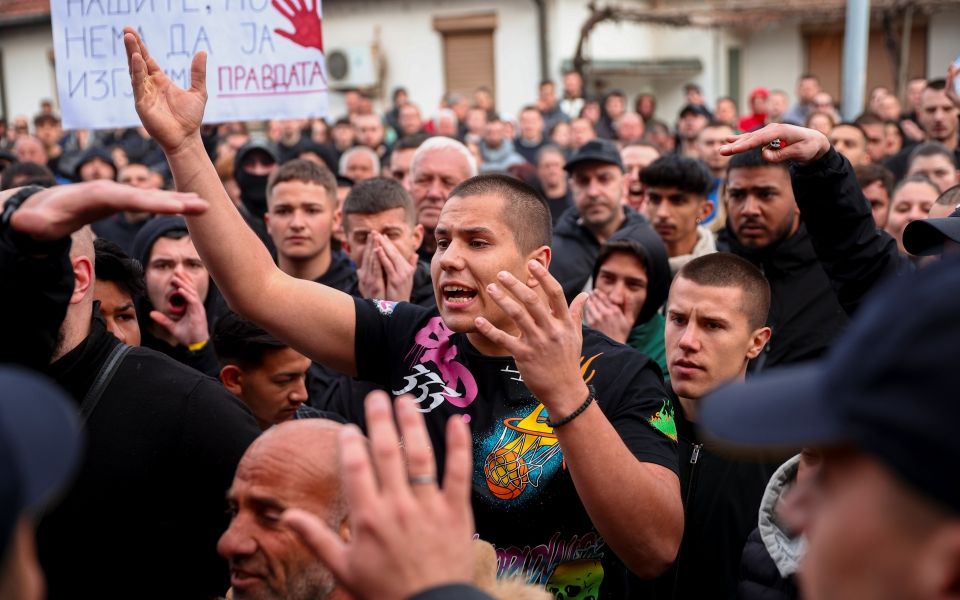
People argue with policemen, outside the home of the owner of a nightclub that was the scene of a massive fire, after a vigil for the victims in the town of Kocani, North Macedonia, Monday. [Armin Durgut/AP Photo]
Eight months after the tragedy that devastated the town of Kocani in North Macedonia, the trial of those deemed responsible began earlier this month.
Sixty-three young people – most of them teenagers – were burned alive, and another 200 suffered burns when a fire erupted in a packed nightclub during a hip-hop performance. The blaze, triggered by fireworks, consumed the building within moments.
Time seemed to stand still in the small community. Once the initial shock subsided, residents demanded a thorough investigation and accountability “in every direction.”
Relatives of the victims have held repeated gatherings calling for justice, yet the issue has not been pulled into the machinery of toxic political confrontation that could divide society.
Although political parties traded some accusations over long-standing responsibilities, they refrained from exploiting – or worse, capitalizing on – human tragedy.
They allowed the judiciary – an institution often accused of corruption in North Macedonia – to proceed with its work and avoided inflaming an understandably emotional public with conspiracy theories.
No fictitious hidden fuel depots in the building’s basement were conjured up in service of some politician or NATO, no “vanished” victims were fabricated, and no people’s courts were staged in public squares or on television panels. For families, society, and public opinion, this trial is not about the fate of the current or previous government; it is about the credibility of the justice system itself.
The Pulse club fire is a crucial test for an institution trusted by only 2% of citizens. The court must probe all levels of responsibility while remaining insulated from political pressure – pressure that, so far, does not appear to have influenced the investigative process.
As the court’s president, Daniela Dimovska, noted, “What is at stake is not only legal accuracy, but the restoration of trust in the rule of law.”