
There’s a lot to love about small-town living.
Any rural or frontier Coloradan will say as much, like 87-year-old Donna Belden, a Nucla resident of more than four decades.
She and her husband, Wally, have many memories in the tranquil, 600-person town located in the West End of Montrose County.
Like raising three boys, working for the local school, playing cards, practicing archery and crafting.
“Most of the time it’s quiet; we don’t have any problems around here. The disadvantages are the doctors and shopping,” Belden said, adding that the nearest Walmart is about two hours away.
However, those few downsides have become an increasing challenge for the aging couple, as their abilities to drive have degraded considerably over the past few years.
INCONVENIENT TO NEARLY IMPOSSIBLE
While aimless car rides were a familiar comfort for Wally, he has been unable to drive for about five years, after experiencing a “mini-stroke,” followed by a dementia diagnosis that has since progressed relentlessly.
Donna was able to pick up most of that slack, which was critical in getting Wally to the specialty health-care services located two to three hours away from home.
Then, almost a year ago, she was diagnosed with endometrial uterine cancer. While she recently entered remission, the toll of radiation and chemotherapy put an end to her driving days.
“There’s just no way that I feel comfortable that I wouldn’t be a hazard on the road,” Donna said.
Those three-hour one-way trips to her cancer care in Grand Junction were some of the last she drove solo, but the need for that commute only grew as Wally’s health declined. On top of his dementia, the former teacher was diagnosed with prostate cancer earlier this year.
As the list of diagnoses grew, the couple’s limited health care access became increasingly apparent.
Some of the basics, like primary care and behavioral health care, are a 10- to 30-minute trip. Essentially everything else — like oncology, occupational therapy and dementia services — is a two-hour drive away, in Montrose and Grand Junction.
Certain supports exist, like a medical shuttle service through All Points Transit. But with just one shuttle to each city per week, her family across western Colorado has had to fill the many remaining gaps.
“Tomorrow, Wally has an appointment that we couldn’t get on a Monday, so he can’t ride All Points. So, I will go down, pick him up in the morning and take him to Grand Junction,” Tami Belden, Wally’s daughter-in-law who lives in Collbran, said about a recent appointment.
“It takes me three hours to get to Nucla … Sometimes I go from Collbran to Nucla, from Nucla to Grand Junction, back to Nucla and then back home to Collbran,” she added.
According to the region’s health care leaders, the Beldens’ story isn’t uncommon for residents of Nucla. In fact, health care access disparities are pervasive across the many small towns in western Montrose County and northern San Miguel County.
COLLABORATING TOWARD IMPROVED CARE
While the towns might be tiny, and their gaps in access large, various solutions are in the works, if not already implemented.
One of the major players has been the Tri-County Health Network, a nonprofit formed under the Telluride Foundation in 2008 alongside health care leaders in Montrose, San Miguel and Ouray counties.
TCHNetwork Community Programs Co-Executive Director Amy Rowan said the organization offers a wide spectrum of services, from grief support and health insurance guidance to emergency assistance and multicultural advocacy.
One of those programs directly tackling health care access in the West End, Skippy Dental, brings a dentist into the area’s schools. TCHNetwork recently gained the ability to bill insurance for the service, with hopes of doing so next semester, but historically, the free or discounted services were subsidized with the network’s general funds and grants.

Courtesy of the Tri-County Health Network
A dentist with the Tri-County Health Network’s “Skippy Dental” program conducts a dental exam and cleaning on a student inside a room at Norwood Public School, 1225 Summit St. The dentist can provide exams and comprehensive dental care in each school’s clinic room, including X-rays, protective sealants, cleanings, fillings and education.
Courtesy of the Tri-County Health Network
“For families to have to travel two hours to get their kids’ teeth cleaned, it doesn’t happen,” Rowan said. “The number of kids that we see (with) decay in their teeth already is huge.”
The dentist can provide exams and comprehensive dental care in each school’s clinic room, including X-rays, protective sealants, cleanings, fillings and education.
Rowan added that they aren’t the only collaborative in town, as “The West End Vision Project” started just over a year ago. The group includes the Towns of Nucla, Naturita and Norwood, the West End Economic Development Corporation, Community Builders and many others.
After more than a year of extensive community engagement, the team recently identified key goals and strategies for various local challenges, including health care. According to their webpage, one focus will be on bolstering emergency and urgent care capacity, including paramedics and EMS.
Another notable goal is to improve access to essential health care services, specialty care and mental health care by diversifying and increasing funding opportunities. The group also aims to strengthen the region’s health care workforce by partnering with unspecified “regional learning institutions.”
“With that collaboration, we’re going to hopefully start seeing some solutions and positive results because … it really does take a village to work through some of the challenges,” Rowan said.
Naturita’s Basin Clinic has its own initiative in the works, which could secure stable funding and eventually lead to a critical access hospital.
According to Basin Clinic Executive Director Christina Pierce, sustaining the clinic has been difficult since 2013, when its management agreement ended with the (now-renamed) Montrose Memorial Hospital.
She said the clinic is largely dependent on county funding since it operates on rural margins, but doesn’t qualify for the usual federal designation that subsidizes rural providers because of its proximity to the Uncompahgre Medical Center, which already has the rural status.
Since the county’s appropriations are subject to change, she said the clinic is looking toward a potentially more stable
Courtesy of the Basin Clinic
Basin Clinic Executive Director Christina Pierce said sustaining the clinic has been difficult since 2013, when its management agreement ended with the (now-renamed) Montrose Memorial Hospital.
Courtesy of the Basin Clinic
alternative. In September, the clinic’s board approved a plan to pursue hospital district status and eventually become a critical access hospital.
The largest benefit of becoming a special-service district is how it would allow the clinic to collect property taxes on residents of the proposed district boundaries. Given that, residents will have to vote on the decision (in April 2026).
Beyond the new revenue stream, the clinic could transition into a critical access hospital over the following years. According to Pierce, the hospital could have 24-hour emergency care, acute (inpatient) care, hospice care and even nursing home services.
“How much is it going to cost? We don’t know yet,” Pierce said. “We just want people to be aware that these are the things we’re looking at with the hope of one day having these services where you don’t have your loved one two hours away.”
BRINGING HOSPITAL CARE TO THE HOME
A growing model of care, known as community paramedics, could also benefit the region.
According to the deputy chief of the Delta County Ambulance District’s (DCAD) Mobile Integrated Healthcare Team, Reuben Farnsworth, the program offers in-home medical care, including most services outside of surgery and advanced imaging.
Beyond the standard paramedic trainings and certifications, Farnsworth said the team’s six full-time staff have an additional board certification in “community paramedicine,” and three are dual-certified in critical care.
Essentially, the team enjoys the added ability to conduct and analyze patient labs while remotely collaborating with specialty physicians to guide and implement treatment plans. The community paramedics also have the same prescribing privileges as physicians.
Courtesy of Rocky Mountain Health Plans
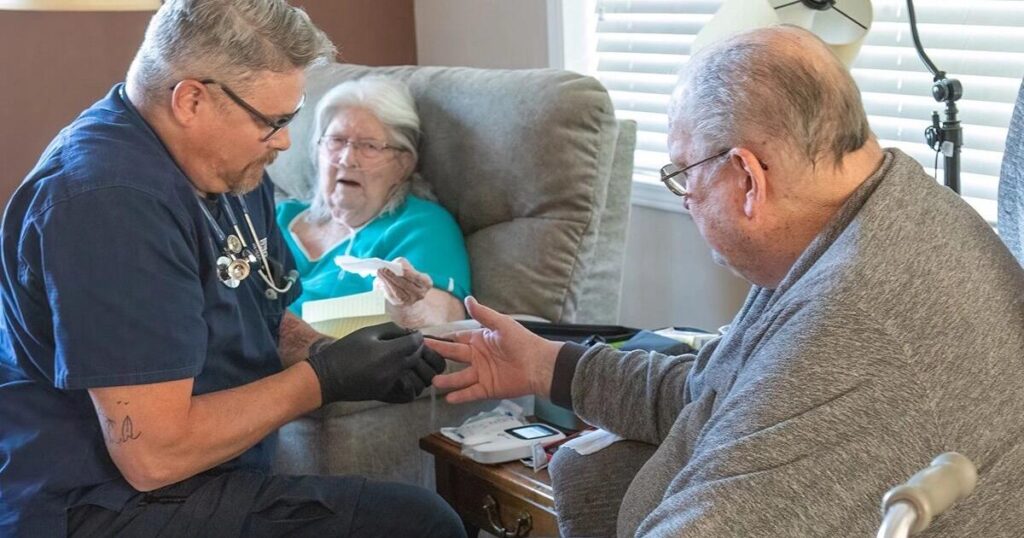
A Delta County Ambulance District paramedic with the Mobile-Integrated Health team serves an older couple in their home, an alternative to the hours-long drive to health care many residents of the Nucla, Naturita and Norwood area face.
Courtesy of Rocky Mountain Health Plans
“… If you go to the hospital, the doctor doesn’t start an IV on you. The doctor doesn’t give you a dose of pain medication for your broken leg. The doctor goes, here’s what’s wrong with you,” Farnsworth said. “We have highly skilled clinicians in our paramedics and nurses on our team that are able to work with physicians and carry out a physician’s order in a patient’s home.”
“They’re like the Swiss Army Knife of medicine,” he added. “We joke that the answer is always yes. Someone calls us, the answer is always yes, with a few exceptions … but there’s not a lot of stuff we can’t handle.”
Courtesy of the Delta County Ambulance District
Delta County Ambulance District Deputy Chief of the Mobile Integrated Healthcare Team Reuben Farnsworth. The program offers in-home medical care, including most services outside of surgery and advanced imaging for those located in rural areas of Montrose County.
Courtesy of the Delta County Ambulance District
DCAD’s program also dabbles in resource navigation and has the capacity to medically evaluate and clear people in crisis, allowing for a direct transfer to the appropriate level of behavioral health care, rather than requiring clearance from an emergency department.
Farnsworth added that he is confident it would improve health care in the West End because the program previously operated there with notable success.
Photos courtesy of Rocky Mountain Health Plans
A Delta County Ambulance District paramedic with the Mobile-Integrated Health team visits a patient’s home, offering an alternative to the hours-long drive to health care many residents of the Nucla, Naturita and Norwood area face.
Courtesy of Rocky Mountain Health Plans
“When we first started the program, we were trying to show people what it could do, so anytime someone was like ‘Hey, we could use that,’ we’d start doing it,” Farnsworth said. “We got to where we were so busy that I basically had to start saying, ‘I’ve got people over here that are paying for the service. I can’t do it for free for you anymore.’”
According to him, the only major barrier to DCAD’s return to the West End is funding.
For the district to send its community paramedics into the area, around three to four times per month, there would be an annual cost of approximately $80,000 to $100,000.
“I submit grants (to subsidize a return to that area), but to an extent, I also think that … if it’s important for (a community) to have a fire department, or whatever service, the community tends to make that happen,” Farnsworth said.
He added that DCAD doesn’t have exclusive rights to the model of care, and they have been happy to guide other EMS programs through the process of establishing their own community paramedicine program.
Rowan said that TCHNetwork has had conversations with the region’s Agency on Aging about applying for a grant that would help Norwood and Nucla EMS implement its own paramedic program.
A Delta County Ambulance District community paramedic checks a person’s vitals during an in-home visit. The Delta County Ambulance District provides a vital health care lifeline for those in rural Montrose County.
Courtesy of Rocky Mountain Health Plans
“But, with all the other changes (to health care policy and funding underway), it’s a little bit on the back burner right now.”
Pull Quote
“We have highly skilled clinicians in our paramedics and nurses on our team that are able to work with physicians and carry out a physician’s order in a patient’s home. … They’re like the Swiss Army Knife of medicine … Someone calls us, the answer is always yes, with a few exceptions … but there’s not a lot of stuff we can’t handle.” — Reuben Farnsworth, Delta County Ambulance District {related_content_uuid}58f26364-e5d6-48f8-a006-95f54d90fd1a{/related_content_uuid}