
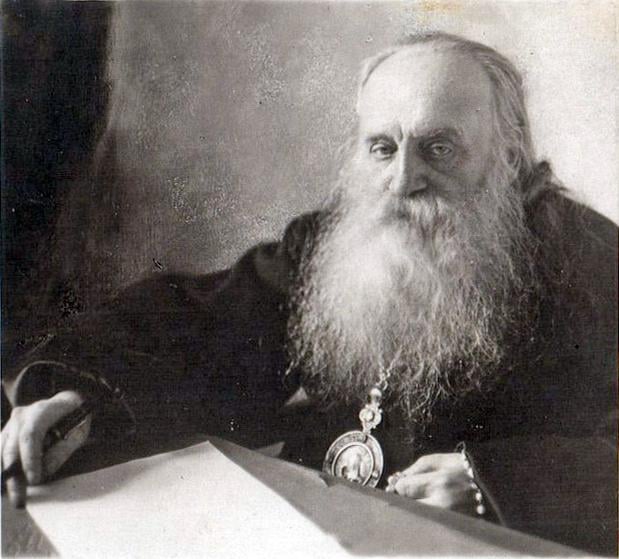
After the Bolshevik Revolution, several exiled Russian clergy founded the Russian Orthodox Church Abroad, which was a separate entity from the Russian Orthodox Church until the fall of communism, when it unified with the Moscow Patriarchate.
Although it cannot be denied that the Church Outside of Russia promoted opposition to Soviet totalitarianism, and sometimes even democratic and Western values, I want to talk about something too little known – its relationship with Moldova, and, more broadly, with Romania.
The first boss of the Russian Church in Exile was Antoniu Hrapovitchi, former Archbishop of Kharkiv, and later Metropolitan of Kiev. In the First World War, when the Russian Imperial Army occupied Bucovina (then part of the Austro-Hungarian Empire), he openly supported the idea of annexing Bucovina to Russia – Among the reasons were those of being able to control the entire Moldavian-Transylvanian space, alongside the Kingdom of Romania, and to be able to obtain both the Faculty of Orthodox Theology in Chernivtsi (the only Orthodox faculty in Central Europe) as a factor of influence, as well as most of the wealth Bucovinine, concentrated in the area that would have otherwise returned to Romania (the largest forests of the Church Fund were in the south, and the oil, salt and iron deposits in the southwest). Moreover, the authors mentioned that otherwise Russia would have lost Bessarabia as well, because following the union of the Romanians from Austria-Hungary with the Kingdom of Romania, “all the claims of the Romanians will refer to Bessarabia”, [iar Rusia]”in the eyes of the Romanians, it will turn from the main enemy into the only enemy”.
The second, more directly related to Moldova, is Anastasie Gribanovski, who was the second boss of the Russian Church in exile, after Antoniu. Before the communist revolution, he was the last tsarist bishop of Bessarabia – he even ran for Patriarch of Russia in 1917, but lost. When he returned to Bessarabia, it had already become part of Romania. The Holy Synod of the Romanian Orthodox Church proposed to Anastasius to keep his position, on the condition that he join the Romanian Orthodox Church, but he refused. The authorities then proposed that he be a head only over the Russian Orthodox in Bessarabia, but again he refused. He also refused to recognize the right of the Romanian Church over Bessarabia, a dispute that continues to this day (Mitropolia of Moldavia vs. Metropolia of Bessarabia).
I said there would be some interesting fun facts.
Where did I get the information from:
https://en.wikipedia.org/wiki/Antony_Khrapovitsky
https://ro.wikipedia.org/wiki/Memoriu_privitor_la_fruntariile_Bucovinei
Fondatorii Bisericii Ortodoxe Ruse din Exil și relațiile lor cu Moldova (și Bucovina)
byu/Confident-Leading412 inmoldova
Posted by Confident-Leading412