
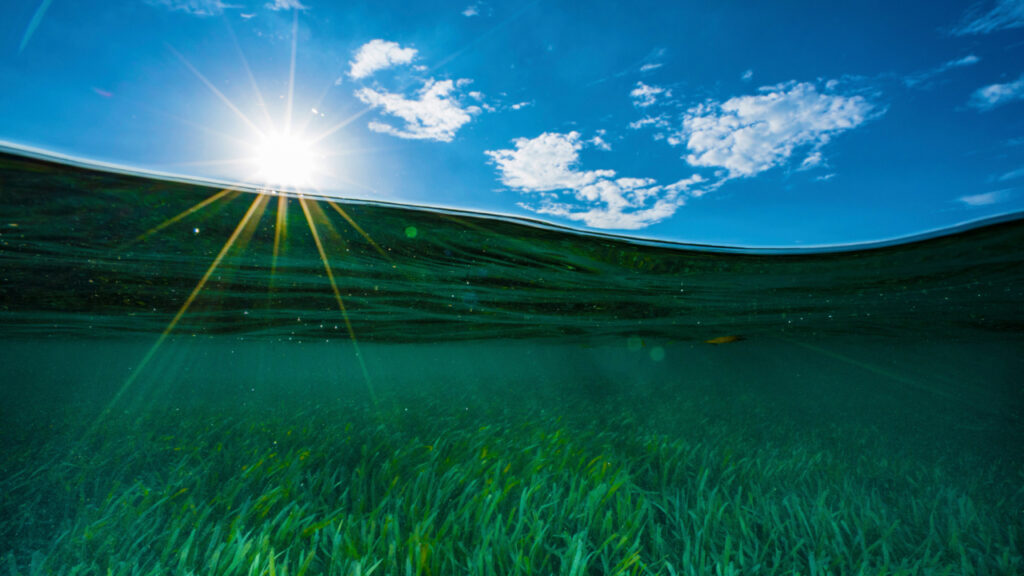
What if I told you the key to solving the climate crisis isn’t just technology or policy, but a whale frolicking freely in the ocean, or a seagrass meadow swaying gently in the current?
For too long, the living fabric of our planet has been invisible to our economic systems, its worth reduced to what can be harvested, extracted, or consumed. But what if nature’s greatest services—storing carbon, cleaning air and water, regulating the climate—had a dollar value we could no longer ignore? One of the world’s top economists is helping us imagine what that would look like.
Last year, my partner Paul Nicklen and I were on an expedition aboard our boat, the SeaLegacy 1. We were exploring Raja Ampat, Indonesia, home to some of the most biologically rich coral reef ecosystems on Earth.
Paul and I founded our nonprofit, SeaLegacy, to leverage the power of photography and storytelling to inspire meaningful action for ocean conservation. On this trip, we wanted to try something new: Instead of photographing the usual charismatic megafauna, we turned our lenses to the tiny creatures barely visible to the naked eye. We thought night dives would be perfect for this.
One night, I had my head buried in a reef, focusing my camera on a shrimp, when I suddenly had the feeling of being watched. I turned around and came face-to-face with a bigfin reef squid.
No larger than a small flashlight, he was curious and unafraid. He fluttered over my shoulder as I turned my lights toward him. When the lights hit him, he got very excited and gave me the show of a lifetime! Octopus, cuttlefish, and squid have specialized cells, called chromatophores and iridophores, that allow them to shift color and reflect light in dazzling displays.