In 2022, the program’s highest point, H-1B visa holders made up roughly 0.269% of all U.S. jobs. H-1B workers are heavily concentrated in early-career tech and STEM jobs. This concentration matters: although H-1B workers represent only a fraction of the national workforce, they are disproportionately employed in entry-level and junior professional roles, where competition for positions is tighter and substitution between domestic and foreign workers is more direct. Although there is no precise data (only income and job titles are reported), multiple sources predict that H1-B visa holders may account for close to 1% of entry-level jobs, significantly higher than the 0.269% total.
TheOnlyZiodberg on
Hmm the 2002 Visa holders is the only point that is far under the 25% mark even tho it is over 32%. Looks like someone wanted to make a point by not having a point.
Edit: indian Visa holders. Its manipulated to make it look like the ‘other’ categorie is way more than it actually is.
weesee2002 on
When did enshitification gain a foothold?
mightymk on
What this data fails to report is that the entry level jobs are driven by students who are hired on OPT and then get a h1b. This analysis will benefit a lot if school admissions by country is also provided. My hypothesis is that we will see a direct correlation between indian origin students in STEM courses who are then hired as entry level workers and are recipients of h1b
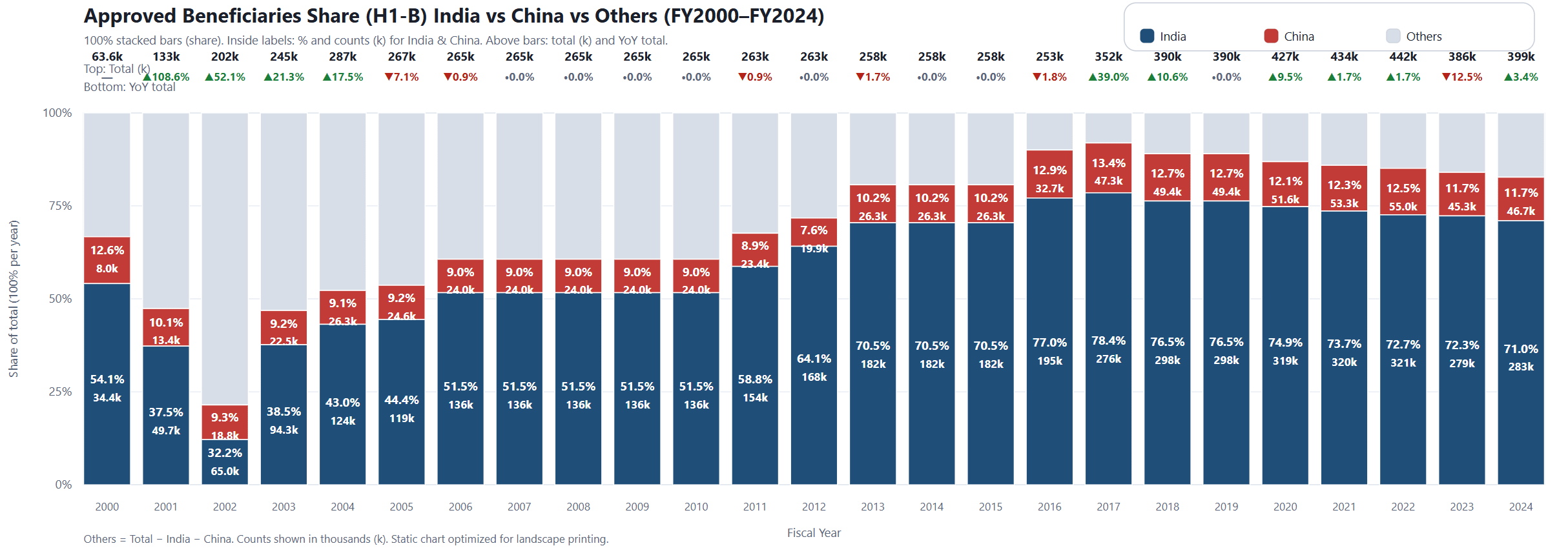

![[OC] Active H1-B Visa Holders in the U.S. by Country of Origin (FY2000 - 2024)](https://www.byteseu.com/wp-content/uploads/2025/12/bdgud69xvs4g1-1536x546.png "[OC] Active H1-B Visa Holders in the U.S. by Country of Origin (FY2000 – 2024)")
5 Comments
Source: [https://www.uscis.gov/](https://www.uscis.gov/)
Tool: JavaScript
In 2022, the program’s highest point, H-1B visa holders made up roughly 0.269% of all U.S. jobs. H-1B workers are heavily concentrated in early-career tech and STEM jobs. This concentration matters: although H-1B workers represent only a fraction of the national workforce, they are disproportionately employed in entry-level and junior professional roles, where competition for positions is tighter and substitution between domestic and foreign workers is more direct. Although there is no precise data (only income and job titles are reported), multiple sources predict that H1-B visa holders may account for close to 1% of entry-level jobs, significantly higher than the 0.269% total.
Hmm the 2002 Visa holders is the only point that is far under the 25% mark even tho it is over 32%. Looks like someone wanted to make a point by not having a point.
Edit: indian Visa holders. Its manipulated to make it look like the ‘other’ categorie is way more than it actually is.
When did enshitification gain a foothold?
What this data fails to report is that the entry level jobs are driven by students who are hired on OPT and then get a h1b. This analysis will benefit a lot if school admissions by country is also provided. My hypothesis is that we will see a direct correlation between indian origin students in STEM courses who are then hired as entry level workers and are recipients of h1b