
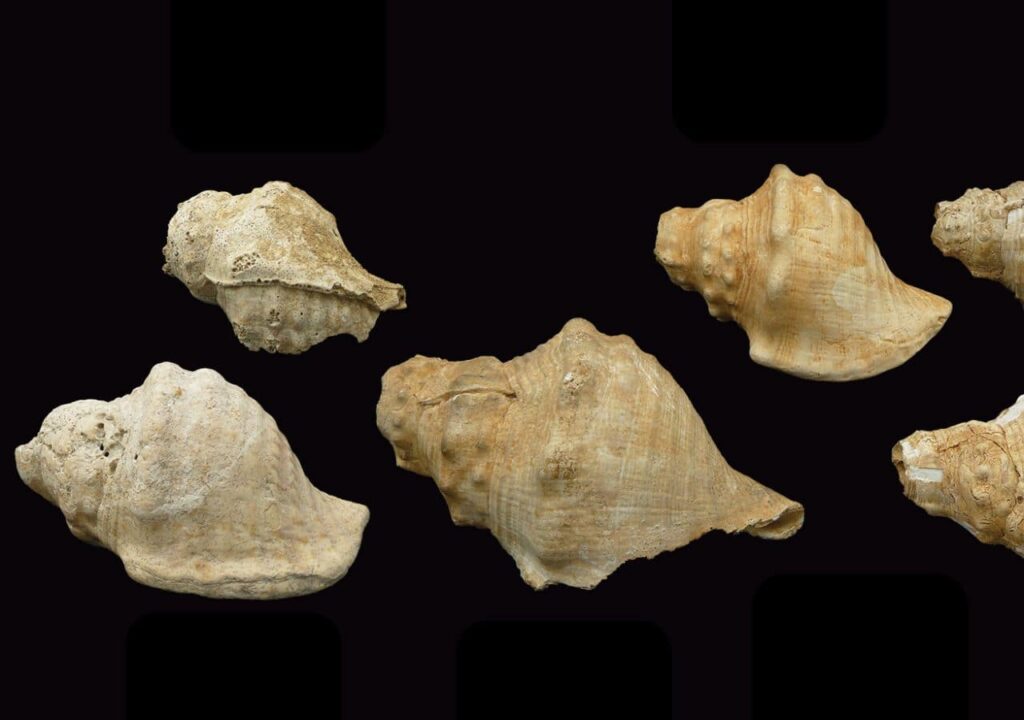
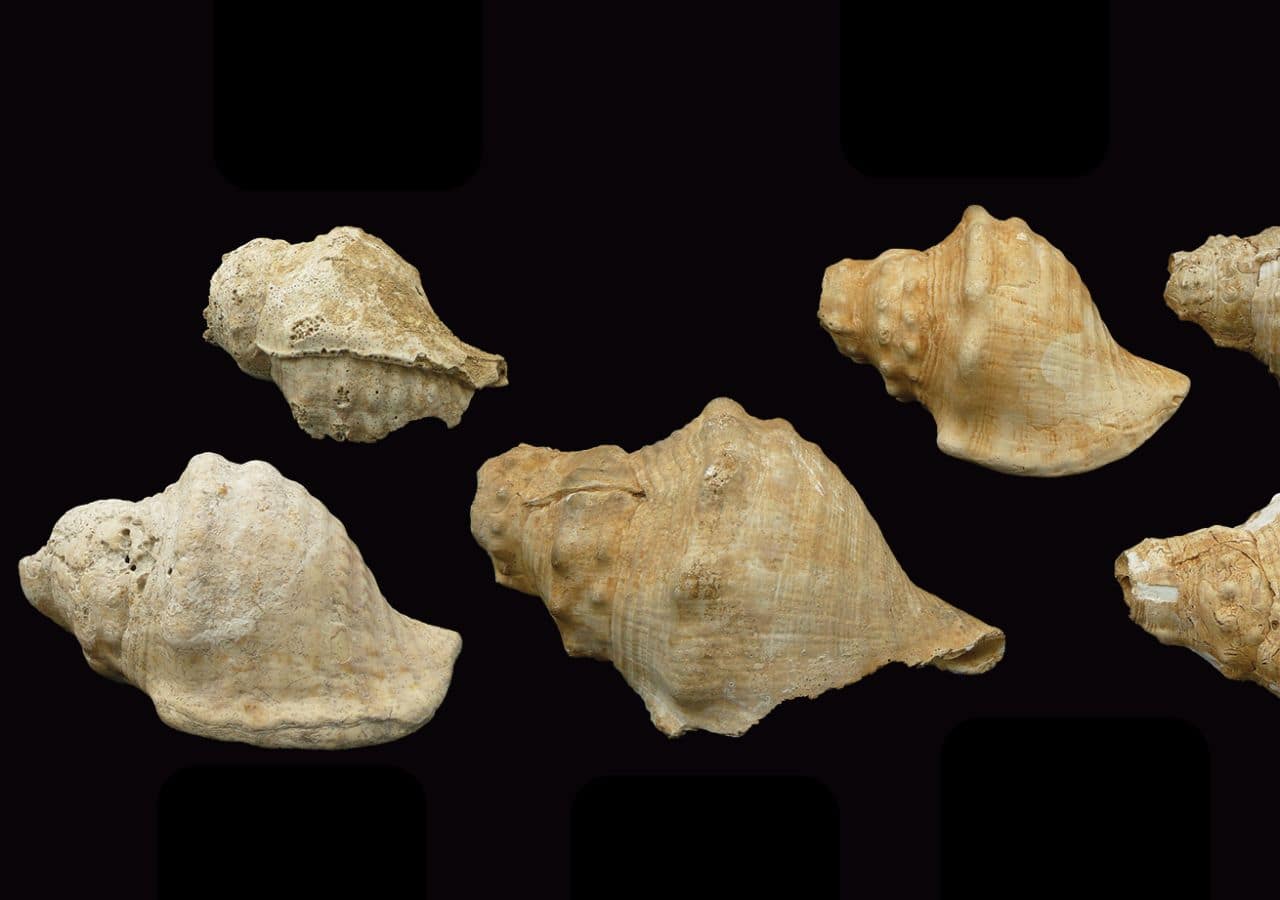
Photographs of Neolithic shell trumpets from Catalonia that still produce sound today. Credit: Miquel López-Garcia / CC BY-NC 4.0
Archaeologists in Spain have identified 12 ancient shell instruments used as trumpets, offering new insight into how Neolithic communities in Catalonia communicated over long distances.
The study, led by Miquel López-Garcia from the University of Barcelona and published in Antiquity, reveals that these modified seashells, dating back around 6,000 years, likely served as powerful sound tools.
The trumpets were made from “Charonia lampas,” a large Mediterranean sea snail. Each shell had its apex intentionally removed, allowing it to function as a wind instrument.
These Neolithic shell trumpets were uncovered at five archaeological sites across the northeastern Iberian Peninsula, with most found in burial pits, domestic refuse areas or abandoned mine shafts.
Shell acoustics point to long-distance communication
López-García and his team analyzed eight well-preserved examples. Controlled acoustic tests showed that seven shells produced sounds exceeding 100 decibels at a distance of one meter (3.2 feet), with the loudest reaching 111.5.
Researchers explained that this level of intensity could have allowed messages to travel over long distances, especially across open terrain or through valleys.
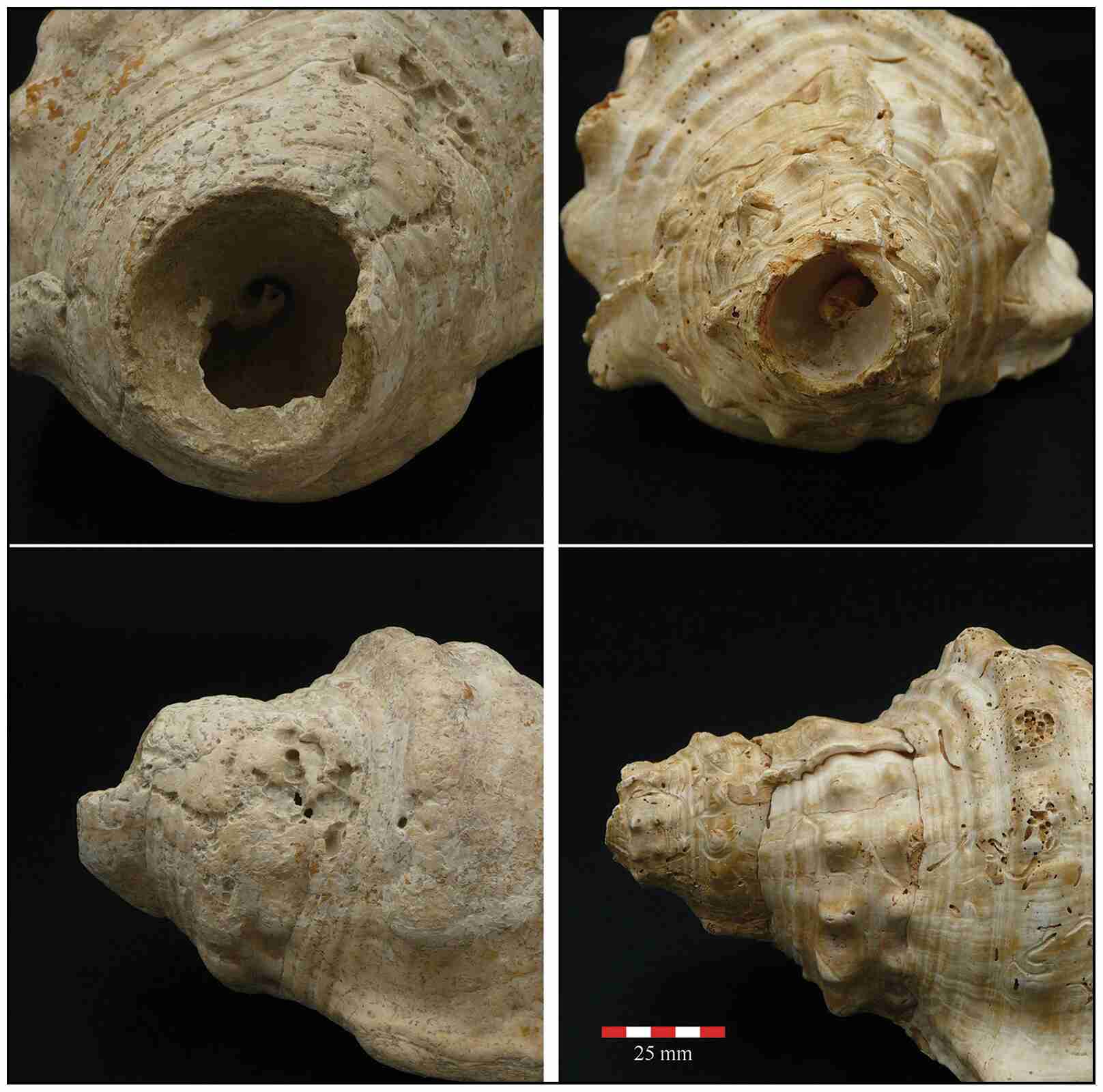 Details of the apical cut from the shell trumpets. Credit: Miquel López-Garcia / CC BY-NC 4.0
Most of the instruments were recovered from sites clustered around the Penedès region and the lower Llobregat River. These locations, rich in Neolithic activity, may have been part of a broader communication network.
Six shells came from the Can Tintorer mines in Gavà, where underground galleries were later repurposed for burials. Others were found at Mas d’en Boixos, Cal Pere Pastor, Cova de l’Or and Espalter.
Sound performance of the Neolithic shell trumpets
The sound tests revealed that the shape and condition of each shell influenced how well it played. Shells with small, smooth openings produced clearer tones and more stable notes.
Larger or irregular openings made the instruments harder to control and reduced tonal quality. Most could generate at least one strong pitch, with a few capable of producing up to three distinct notes.
Though some shells had holes, tests showed these did not function as tone holes. Their presence often lowered sound quality, suggesting the holes were either accidental or used for suspension rather than sound modulation.
While the main function appears to be signalling, López-García notes that expressive playing techniques were also possible. Skilled performers could adjust pitch or vary the tone slightly, hinting at additional musical uses.
The researchers suggest that shell selection may not have been random. The pitch range of 395 to 471 hertz found in most shells implies that medium-sized specimens were chosen for their balance between sound power and portability.
The findings position these Neolithic shell trumpets as some of the earliest known sound tools in Western Europe, used not only to send messages across landscapes but also to shape the sonic world of prehistoric communities.