
Quoting the accompanying text from the authors:
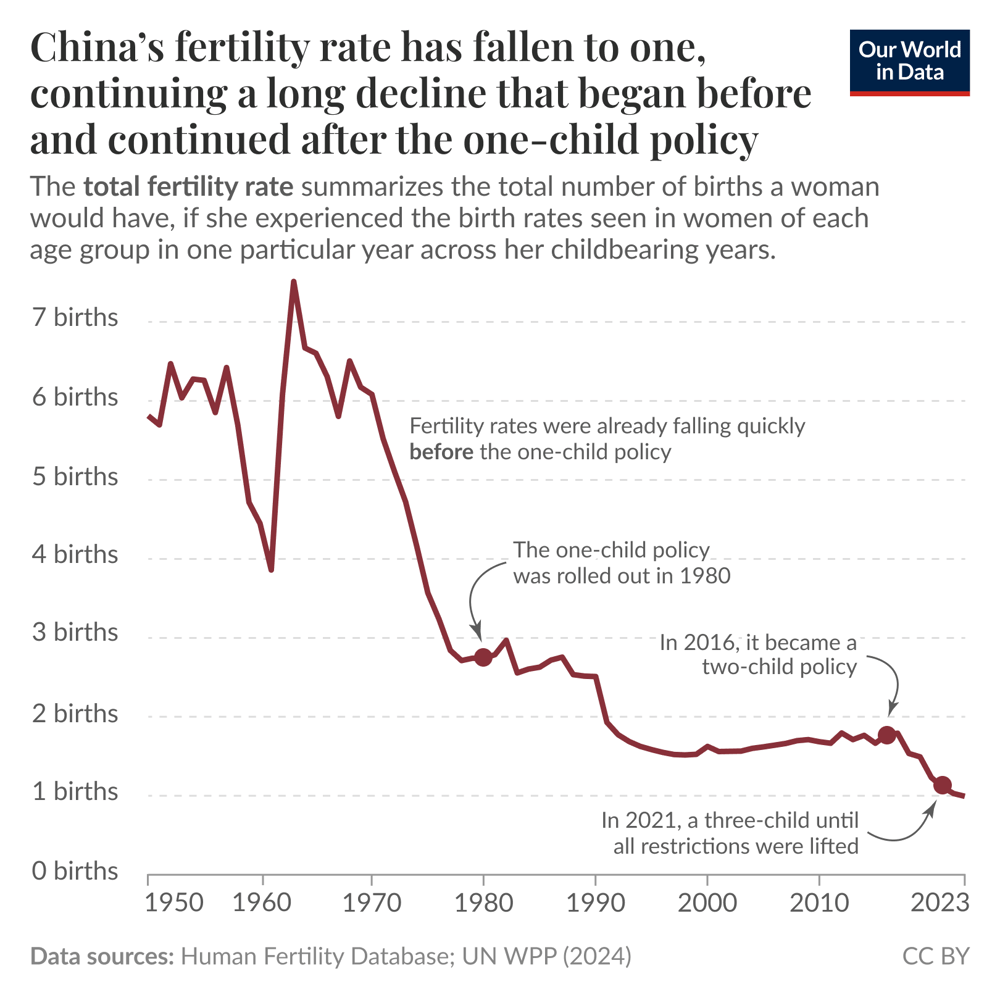
The 1970s were a decade shaped by fears about overpopulation. As the world’s most populous country, China was never far from the debate. In 1979, China designed its one-child policy, which was rolled out nationally from 1980 to curb population growth by limiting couples to having just one child.
By this point, China’s fertility rate — the number of children per woman — had already fallen quickly in the early 1970s, as you can see in the chart.
While China’s one-child policy restricted many families, there were exceptions to the rule. Enforcement differed widely by province and between urban and rural areas. Many couples were allowed to have another baby if their first was a girl. Other couples paid a fine for having more than one. As a result, fertility rates never dropped close to one.
In the last few years, despite the end of the one-child policy in 2016 and the government encouraging larger families, fertility rates have dropped to one. The fall in fertility today is driven less by policy and more by social and economic changes.
This chart shows the total fertility rate, which is also affected by women delaying when they have children. Cohort fertility tells us how many children the average woman will actually have over her lifetime. In China, this cohort figure is likely higher than one, but still low enough that the population will continue to shrink.
Explore more insights and data on changes in fertility rates across the world.
Posted by cgiattino
16 Comments
It’s unbelievable how quickly many countries went from fears of overpopulation to the complete opposite fear.
The wild bit here is that China’s fertility didn’t fall off a cliff because of the one‑child policy so much as the policy jumped on a cliff that was already there. Urbanization, women’s education, and the rising cost of turning a kid into a competitive adult had already pushed birth rates down hard by the late 70s. Now the government is frantically doing the reverse. “Please have three kids, we promise we’re chill now”-style pronatalism. But surveys keep finding that young couples’ main blockers are money, housing, work stress and lack of childcare, not legal limits, so the new policies barely move the needle.
In other words: once people get used to small families in cramped cities with brutal job markets, you can’t just flip a switch and reboot the baby boom, no matter how many slogans you print.
“In 2021, China’s official census report showed a sex ratio of 112 male to 100 female births, compared to a global average of 105 or 106 male to 100 female births.” https://en.wikipedia.org/wiki/Sex-ratio_imbalance_in_China
China has had an unnatural sex imbalance at birth for over 40 years.
China had a high infant mortality during this period https://ourworldindata.org/grapher/infant-mortality?tab=line&country=~CHN
Long term women matter for fertility. As in number of grown women that each grown woman ends up having. Obviously not at the extreme end but in general.
The 1 figure is worse than it would be in a country with less sex selective abortion. And looking back China probably hasn’t been having an adult woman per woman for 40 years.
China is gonna get Japan’ed in 30 years.
This could be a massive problem in 40 years.
I’ve said for decades that the desire to have a child is influenced by social contagion. When people grow up in a culture in which they have prolonged exposure to younger children and are involved in their caretaking, they are more likely to want children themselves. When this early hands-on experience is lacking, they’re less likely. This is why all of the costly subsidies given by wealthy First World countries to encourage childbearing have failed miserably. They’re not tackling the root of the problem.
I think it’s so interesting why this is happening in so many different countries all at once, it’s really hard to explain.
People keep bringing up housing / childcare / work life balance etc but it’s happening in places with radically different levels of all three.
The UN is still using estimates that the birthrate will quickly bounce back to 2.1 and the pop will peak at 11b in 2080.
Imo that’s obviously completely wrong and imo pop might peak at 2040.
They are in serious trouble. Its so far along now that that their net population has been actually falling for the last few years. The fall rate is probably only going to climb and climb for decades.
Its not just China by any means but they are on the leading edge. Its a very troubling problem as it seems to come out of things like contraception and women’s education regardless of the culture or politics of a place, things that for very obvious reasons should not be rolled back.
Its difficult to see a solution, around the world practically everything that could be thought of thats not just totally evil has been tried many times to little effect.
America will prevail in the respectable way it always has 😎
By watching our geopolitical rivals shoot themselves in the foot in insane ways, then discovering the largest supply of whatever resource is most relevant (usually somewhere in the west coast).
1 child is wild. That is not sustainable at all.
You could have predict that the 996 and other policies against people would have this effect.
Uh, isn’t that like societal collapse bad? I can’t remember the number cited I heard, but anything below 1.4 (I think) was really really really bad, and ideally you want higher than even that. 2.1. South Korea sits at .75.
The situation is not unlike climate change: people will not voluntarily change their behaviour patterns, so we are left with technological improvements, taxation, and adaptation to the new normal.
Nothing that anyone has tried fixes the birthrate, and it looks like the only remaining solutions are unethical impingements on people’s rights and freedoms (restricting contraception and abortion, etc.)
I think the only way forward is to ask *why* we need more kids, and the answer is “because old people need stuff after the point that they can work for it”. This includes a functioning economy, so they can buy stuff with their money, and social programs so that they can get the money (if they didn’t save enough)
How’s this for an idea: let social security become an earned benefit. Retirement programs today are a claim on future labour, but the problem is that you earn this simply by paying for the previous generation, NOT for contributing to the generation that will support you in retirement.
People complain about the baby boomers pulling the ladder up behind themselves by raising tuition, lowering taxes, and spending the money on themselves, but subsequent generations are doing the same thing when they vote for future payments and then refuse to have the kids that will make those payments.
Instead, let’s credit people for social security based on the number of kids that they have, and let people without children opt out of social programs or pay a large sum of tax (comparable to the cost of raising children) in order to buy the benefits.
We can’t, and shouldn’t, try to force people to have kids, but like the carbon tax does for climate change, we can try and distribute the costs of costs of not having children more directly to those incurring them.
China being autocratic, how long before they outright ban birth control and sterilization?
What has never made sense to me is how China went from 500 mil in 1950 to 1.3 billion now. Like mathematically should there already be a steep decline in population after several decades of low official birth rates. This means that either the population numbers are wrong, the birthrate was SEVERELY underreported, and likely both. What is the story here?
Don’t jump on me for being a misogynist, but it could be that some countries will allow polygamy. Then wealthy men could have multiple wives and raise the reproduction rate. Perhaps muskrat in the United States embodies that basic idea, much as I detest that man.