
In 2024, the use of artificial intelligence (AI) by teachers varied significantly across Europe, with Albania and Kosovo leading the region while Western European countries typically scored lower.
The use of artificial intelligence (AI) by teachers varies widely across Europe, with some countries following a more cautious approach.
Most teachers use it primarily for preparation, while experts expect its use to increase, but warn that it must be used responsibly, reports the Telegraph.
Artificial intelligence is becoming a part of everyday life. The tools and opportunities offered by leading AI companies have grown rapidly in recent years, reports euronews.
Education is no exception. Authorities, teachers, or researchers show how students use tools like ChatGPT to complete homework, including essays. At the same time, AI also offers valuable support to teachers.
How widely are teachers using AI in Europe? Which countries are ahead? And what do teachers rely on AI for the most?
According to the Organization for Economic Co-operation and Development (OECD) Teaching and Learning International Survey (TALIS), the use of AI by teachers will change significantly in Europe by 2024.
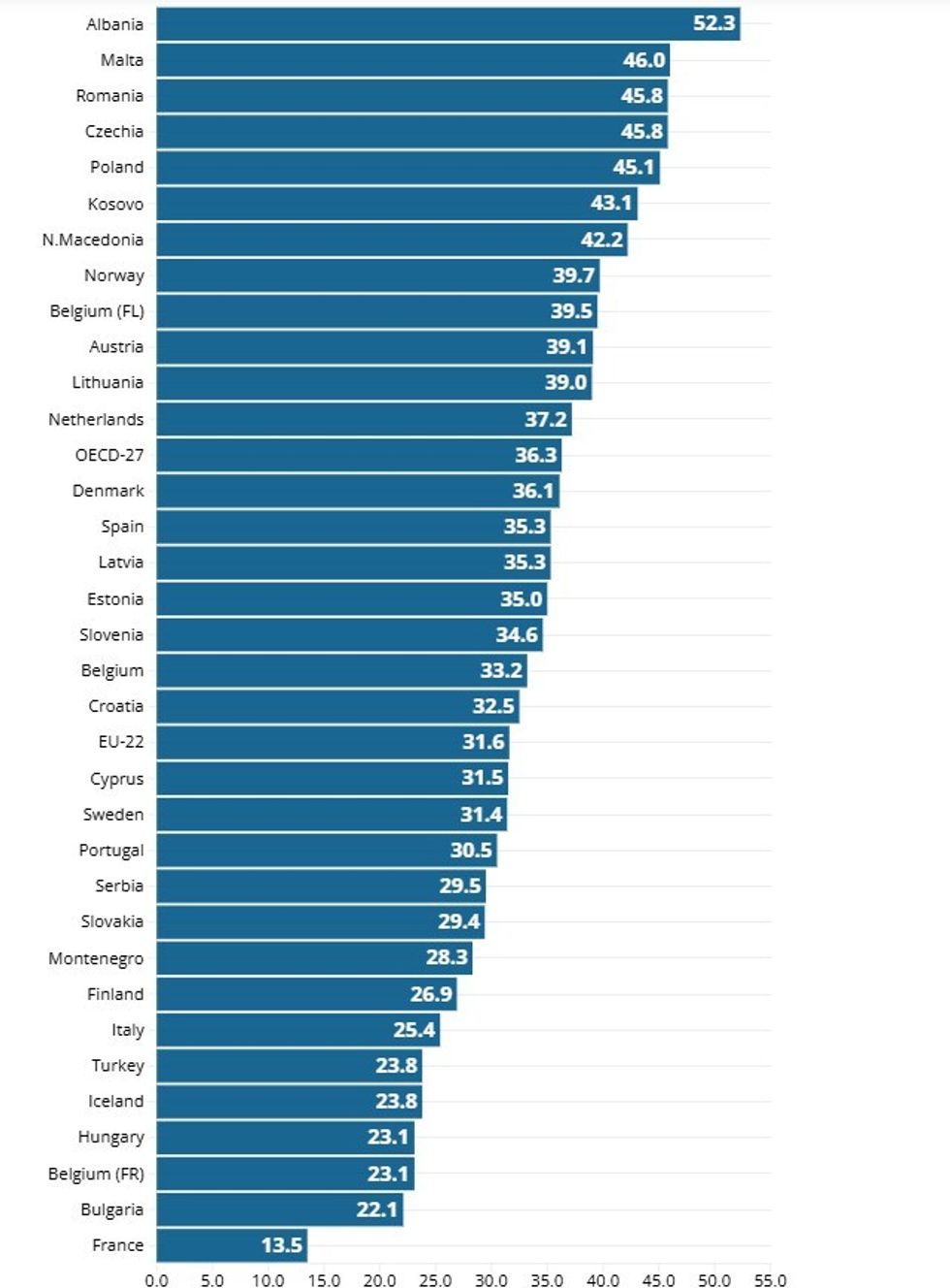
Across 32 countries, the share of lower secondary school teachers using AI varies from 14 percent in France to 52 percent in Albania in 2024. The average is 32 percent in the European Union (EU-22), while in the OECD (27 countries) it is 36 percent.
In the survey, the use of AI includes predictions, decision suggestions, or text generation.
It includes the use of AI in teaching or to facilitate student learning during the 12 months prior to the survey.
Strong regional patterns do not clearly emerge, however, in general, Western European countries tend to have lower use of AI by teachers compared to the Western Balkans and Eastern Europe.
Apart from Albania, the share of teachers who used AI at least once reached two out of five or more in eight countries/economies.
Their percentages were: Malta (46%), Czech Republic (46%), Romania (46%), Poland (45%), Kosovo (43%), North Macedonia (42%), Norway (40%) and the Flemish region of Belgium (40%).
The countries that used AI the least in schools were: Bulgaria (22%), Hungary (23%), the French region of Belgium (23%), Turkey (24%), Italy (25%), Finland (27%), Montenegro (28%) and Slovakia (29%).
Why does the use of AI vary so much?
A spokesperson for the United Nations Educational, Scientific and Cultural Organization (UNESCO) noted that governments have adopted different political policies on AI in education, which could affect the awareness and use of AI by teachers in Europe.
“Some countries have been more proactive in developing national strategies for AI, which also include the education sector, while others have taken a more cautious approach to AI and the use of generative AI in school, setting stricter rules according to the age of students,” the spokesperson told Euronews Next.
Ruochen Li, senior project manager at the OECD, noted that “infrastructure, technological constraints such as firewalls, societal attitudes towards the use of technology in schools, and policies that may encourage or discourage teachers from using AI” could explain the differences between countries.
“We see a strong correlation at the country level between the amount of training provided on the use of AI and its use,” he told Euronews Next.
Ben Hertz and Antoine Bilgin, pedagogical and research managers at European Schoolnet, stressed that the major differences in the use of AI reflect the political environment and educational culture of each country, some of which take a more cautious national stance.
“Access to practical support such as training and infrastructure is also a crucial factor for acceleration. TALIS data confirms that in systems with higher AI usage, teachers are more likely to have received professional learning on the subject,” Hertz and Bilgin told Euronews Next.
For example, France this year began offering national AI training in public schools, following the collection of TALIS data.
“Caution, unclear regulations, and limited infrastructure are factors that may explain slower adoption, especially in a new and controversial field like AI,” they added.
Possible causes for this gap are the availability and quality of training, workload, teacher shortages, personal motivation and curiosity, according to Martina Di Ridolfo, political coordinator at the European Trade Union Committee for Education (ETUCE).
What do teachers use AI for?
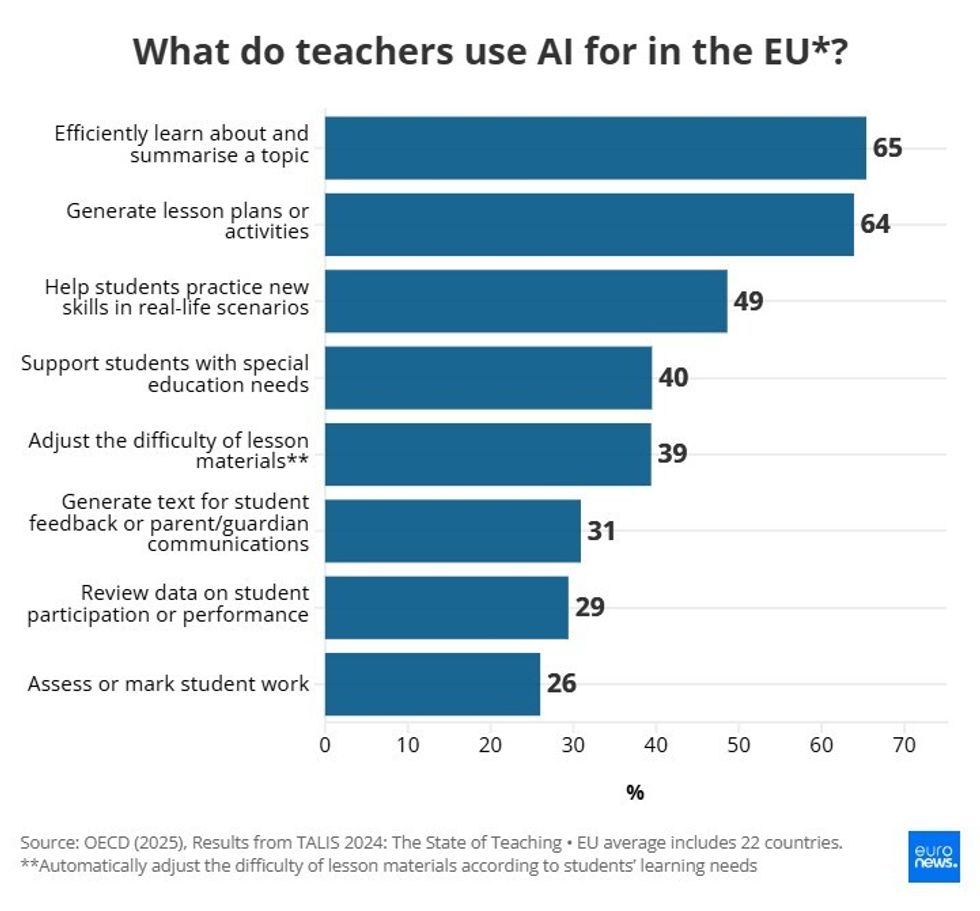
Of teachers who use AI, on average in the European Union (EU-22), almost two-thirds (65 percent) say they use it to teach effectively and summarize a topic, and 64 percent use AI to generate lesson plans or activities.
The two highest percentages indicate that AI is used primarily for teacher training itself.
Other goals and their percentages are:
Help students practice new skills in real-life scenarios (49%)
Support students with special educational needs (40%)
Automatically adjust the difficulty of learning materials according to students’ needs (39%)
Generate texts for student assessments or communications with parents/guardians (31%)
Review data on student participation or performance (29%)
Evaluate or grade student work (26%)
These findings suggest that direct use in the classroom or directed at students is less common.
Teachers mainly rely on AI for their personal preparation, while assessment tasks are the ones that are used the least.
Hertz and Bilgin suggested that many teachers are likely to use AI mainly “behind the scenes” now and in the near future.
Ruochen from the OECD suggested that AI could support teachers in administrative tasks, and this could free up their time and energy for other tasks more directly related to teaching.
What will AI bring to schools in the future?
Experts agree that the use of AI in education is growing steadily and will continue to expand. They also warn that responsible use, clear guidelines, and awareness of potential vulnerabilities must be part of this progress.
Hertz and Bilgin from European Schoolnet noted that over time, AI systems could interact more often directly with students, for example by proposing personalized activities or providing real-time feedback.
“But teachers must remain the primary intermediaries between the learner and technology, to maintain authority, ethical oversight, and the role of guardian,” they said.
UNESCO emphasizes the central role of teachers as the use of AI in education expands.
“AI tools should complement, not replace, teachers, and their use should be consistent with ethical standards and educational objectives, while preserving the autonomy and privacy of teachers and students,” a UNESCO spokesperson said.
Expecting the use of AI to increase among teachers and students, especially with generative tools, Di Ridolfo raised another concern “considering the acute shortage of teachers that we have in Europe, we see concrete risks of de-qualification and loss of professional skills.”
She also drew attention to a limitation of the OECD study: the data does not provide information on the frequency of use. It does not indicate whether teachers used AI regularly or only a few times for testing. /Telegraph/