
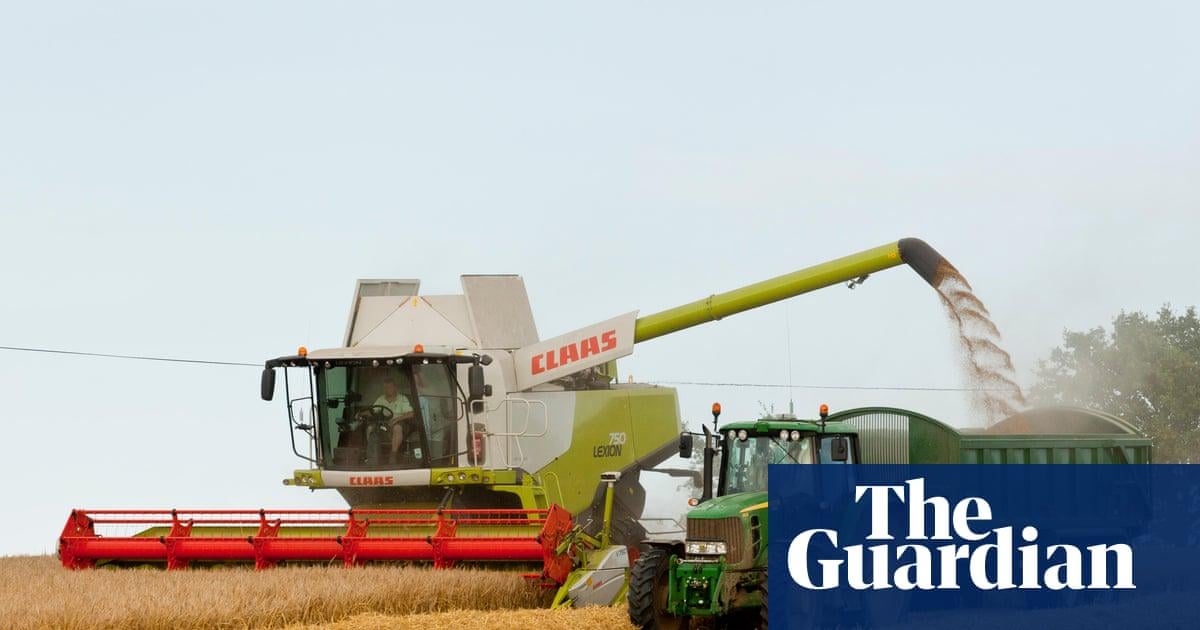
UK farmers lose £800m after heat and drought cause one of worst harvests on record
https://www.theguardian.com/environment/2025/dec/04/record-heat-drought-2025-cost-uk-arable-farmers-estimated-800m-climate-crisis-grain-harvest
Posted by F0urLeafCl0ver
17 Comments
Unsurprisingly when you change the climate bad things happen.
given all the farmers who used to tell us to vote tory, and are now telling us to vote reform, they get exactly what they deserve.
Climate change has happened, voting for parties who will simply pretend is not (and it never was) a viable option.
Only strong Government, who can do more than pretend its not still 1950 will help them.
for balance I will say, there are farmers out there who are smart people and who want to plant crops that can grow, and will sell. Whilst smart farmers will be well researched they need a public who will buy those products. a Government stuck in 1950 will not lead to a general public open to that change.
They could save some money in fuel bills by not driving their tractors to London every 5 minutes to whinge about anything and everything
Don’t worry we’re going to get rid of the problem of poor harvests by paving over all the good farmland to build more houses.
God the braindead comments are obscene here. We are so detached from where our food comes from we have people clapping the demise of those providers
Out of 4 current comments 3 are categorically “Derogatory” verbal attacks on “Farmers”.
Instead of this peculiar behaviour of setting up peer group negative perception of Farmers as a group or industry in the UK, some basic facts on total Revenue Loss:
* Wheat yields for example are about half average expected yields
* Commodity prices in wheat have not correspondingly risen thus offsetting the deficit volume sold
* Higher input prices eg fuel, fertilizer
* Regulatory and Policy contribution eg BPS loss and Governmsnt mishandling of SFI
* Regulatory also reduces optionality for farmers for local supply and price setting
* Both floods previous years and drought this year all impact the above
Conclusions:
1. Bad harvests are a strong indication of climate change, regionally UK and globally.
2. This means food will become a significant priority in the coming years – take note!
3. Government policy appears to be actively ANTAGONISTIC the UK farming industry via a combination of hostile policy, legislation during more extreme times (IHT, BPS, SFI, lower budget in total and more)
4. Consumers need to consider: Buy local, spend more on buying and supporting local British produce.
I feel sorry for those who keep lambasting farmers for holding (or, at least, *working*) rich assets.
I s’pose we could always import more and really pay for our food? Or perhaps the plan is to revert to subsistence farming, with a growing awareness of seasonality?
We should be more circumspect.
It’s almost like we should have tons more reservoirs for when it’s raining
Wonder how many of these farmers who’ve suffered losses are climate change denying Reform supporters?
Oh dear. Well, on the sunnyside they’re farms might end being worth less than the inheritance tax threshold (which is way higher than it is for us plebs) so they won’t have to drive down to London to protest anymore (while illegally using red diesel for the journey).
It’s always something with farmers.
It’s raining too much one year, not enough the other year. In other news, sky is blue and grass is green.
Last season on Clarkson’s Farm “it won’t stop raining, we’re ruined”
Next season on Clarkson’s Farm “it won’t rain, we’re ruined”
That’s why so many farmers around here have submitted their land for housing development.
Same farmers that vote for climate denial to protect their tax dodge?
It’s interesting to note that this will be one of the best harvests we’ll have going forward. The impacts of climate change that have be warned about until, excuse the expression, the cows come home, are now evident and this. does. not. get. better! There is a massive global shock coming since there has been an acceleration in the rate of warming which is likely to push us to a decimating 2C of warming within a decade and 3C by the early 2050s.
We’re now into adaptation territory. Food inflation is likely to be far beyond anything we’ve experienced and yes, the last five years have been dire. Foods which we once thought of as staples will become luxuries. Unless our government start facing the realities of this and actively start planning for real UK food security things will get really ugly.
The article fails to mention that globally, grain production has been ample this year. Wheat prices on the international market touched a five-year low recently.
Putting aside the IHT, subsidy, Brexit discussion for a moment. It seems the root of the problem is that farms run on a 0.1% to 0.5% return on capital and land is massively overvalued for farming.
Normally the price of farmland would fall to a point where it becomes worthwhile to farm but this is not happening – so what is keeping prices so high?
I suspect land prices are being bid up by investors, not farmers. Investors live farm land because:
1) Farming land is a safe, recession proof asset class
2) It is strongly linked to inflation
3) It is very tax efficient vs other assets (IHT, BPR, roll over relief).
4) Qualifies for a range of environmental subsidies
5) When held for a long time, there is potential for huge windfalls if the land can be redesignated for building
All these qualities make it very attractive to super wealthy investors looking to store their wealth long term for future generations. (Remember, a billionaire will get a passive income of around £6m EVERY MONTH – it is actually quite hard for them to know what to do with it all) Their desperate search for safe places to put this wealth is distorting land prices, making farming unviable.
Similar has happened in London where the wealthy buy property for similar reasons and often cannot even be bothered to rent it out, creating a housing shortage while there are plenty of empty properties.
To stop this distortion, the above benefits should be limited to actual farmers, not land owners. We could also discourage buying land as an investment eg. by allowing tenant farmers the right to buy land they have worked for 10 years at a below market rate etc. I’m sure someone smarter than me can figure out a way to do it.
TLDR Wealthy investors are distorting the industry by driving up land prices. We need to drive out the investors not fiddle around trimming tax incentives. Land prices will fall – cash poor farms won’t qualify for IHT, farming will be more profitable.