
Given its geographical location and the influx of cross-border workers, remote work in the Principality is governed by specific rules. Sophie Marquet, partner at CMS Monaco, explained the legal architecture of this ever-expanding way of working to Monaco Tribune.
A legal framework since well before the pandemic
At the end of 2024, according to IMSEE, 6,773 employees were working remotely in the Principality, compared with barely 600 in 2017. It’s a spectacular rise explained both by past health constraints and by the search for a better work–life balance.
As early as July 2016, Law No. 1.429 and its implementing decree (No. 2016-425) laid the foundations for remote working. “At the time, very few companies used remote work,” Sophie Marquet said, who notes that the pandemic triggered “a massive shift to distance working, before companies were able to organise themselves to implement the legal framework that governs remote work.”
 Sophie Marquet, partner at CMS Monaco, specialises in employment law © CMS Monaco
Key Monaco specifics to keep in mind
While the Monegasque framework shares similarities with French law (voluntary and consensual nature, equal treatment and rights for remote and on-site employees), several major differences stand out.
The first key distinction: the obligation to formalise remote work through an addendum to the employment contract. “This is absolutely mandatory in Monaco,” stresses Sophie Marquet. “This requirement is partly due to the need to document precisely the conditions under which an employee works from another territory for a Monegasque company, and in particular to ensure that the allocation of social security contributions between States is respected.”
The second key point: remote work may not exceed two-thirds of the weekly working time. “Three days of remote work per week tends to be the exception. In most cases, the average is more often one to two days,” the lawyer noted.
Lastly, the place of remote work must be clearly stated in the contract. Aside from business travel, employees may not work one day from Nice and the next from San Remo.
The crucial issue of cross-border workers
In a territory of two square kilometres with few resident employees, remote work mainly concerns staff living in France or Italy, although the scheme is also open to Monegasque residents. In May 2021, Monaco and Italy signed an agreement extending remote work to Italian residents, a system that came into force three years later in 2024. Sometimes viewed by companies as a solution to Monaco’s transport challenges, this cross-border context nevertheless requires particular vigilance when it comes to social security contributions and taxation.
The Monegasque system relies on bilateral social security agreements on employment: Amendment No. 6 to the 1952 Franco-Monegasque agreement and the 2021 amendment to the 1982 Italo-Monegasque agreement. These agreements allow employees to remain affiliated to Monaco’s social security funds, provided the legal framework is respected.
Sophie Marquet also warns that employers must assess the tax risks associated with remote work when defining eligible cases: “A Monegasque employer must assess the conditions under which a permanent establishment could be created abroad. In the vast majority of cases, the activity is genuinely carried out in Monaco by a Monegasque company, even with employees working remotely. But the potential tax linkage to France or Italy, for instance, must be considered.” A prior analysis of remote-work-eligible functions is therefore essential.
A practice that is becoming permanent
Unlike in other countries such as the United States, where even tech giants — once champions of hybrid work — have rolled back massively, Monaco appears to have stabilised its remote-work system. “I haven’t had any clients wanting to pull out of remote work. We’re seeing consolidation,” Sophie Marquet said. Companies continue to standardise their arrangements, moving from informal distance working to a structured legal framework where this had not yet been carried out.
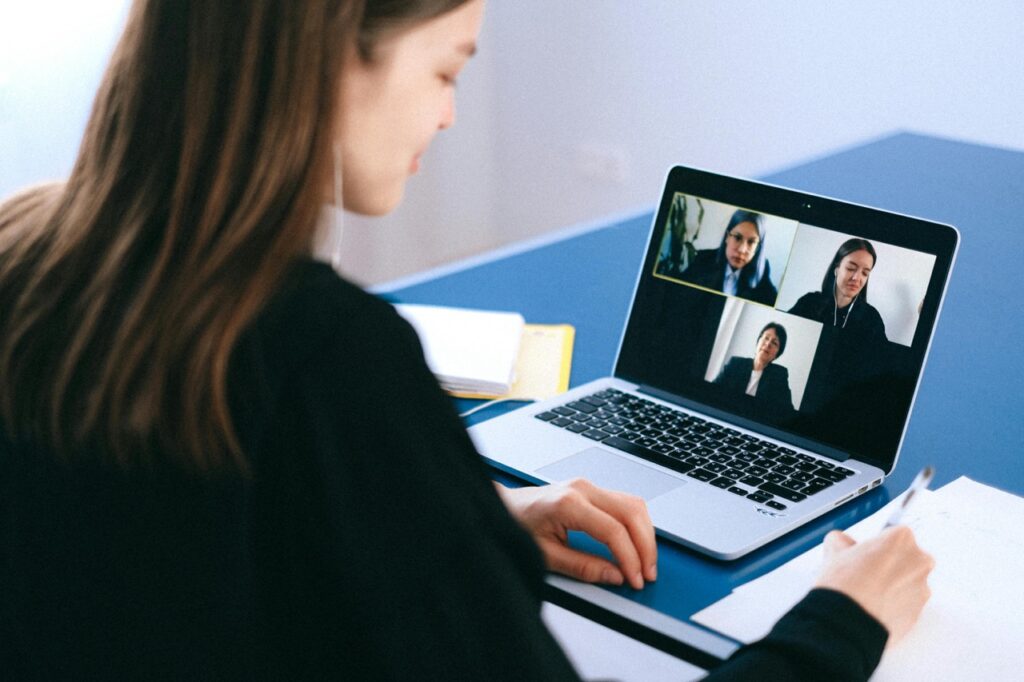
 6,773 employees were conducting remote work in the Principality in 2024, according to IMSEE. © Pexels – Julia M Cameron
A few recommendations for structured implementation
- For companies wishing to formalise remote work, Sophie Marquet recommends first “assessing operational needs and reviewing which functions are suitable for remote work.” She stresses the importance of drafting a framework that is as flexible as possible to allow room for manoeuvre and avoid limiting remote work to overly restrictive conditions. It will then be submitted to employee representatives and approved by the Labour Department.
- For employees, attention should focus on the contract addendum, which must clearly define the conditions for working from home, working hours and the terms for reversing decisions. “Here too, drafting is crucial to ensure that all rights and obligations of both parties are covered, including safety requirements — particularly regarding professional data — while also respecting the employee’s privacy in their new work environment.”
Beyond legal aspects, the challenge is also to maintain collective momentum within companies and to balance the individual benefits of remote work with the essential need for creativity and productivity. To achieve this, both employer and employee must determine which tasks are effectively carried out remotely and which require the social interaction inherent to collaborative work.