

04.12.2025. 17:20h
Last Sunday, more than 20.000 people united on the streets of four cities in Croatia in a march against fascism. Not without incident – in Rijeka, a group of citizens were attacked by masked individuals with firecrackers and sparklers, while in Zadar, red paint was thrown at marchers. No incidents were reported in Pula and Zagreb.
The ruling elite allowed fascism
With the march “United Against Fascism”, the participants are responding to the current situation in Croatian society, the proliferation of neo-fascist ideas, the attack on Serbian cultural events and writers, the situation when a roundtable discussion in Parliament discusses the Jasenovac concentration camp as a place where children went for internships, or the visit of Prime Minister Andrej Plenković to Thompson’s concert, where the Ustasha cry “for the homeland ready” is shouted.
Finally, Defense Minister Ivan Anušić himself stated in Brussels that the protests were “anti-Croatian and pro-Yugoslav”, and that he “even saw Cyrillic”, thus clearly making it clear that this otherwise legally legitimate script in Croatia is actually not desirable.
Irena Burba, president of the “Green Istra” association, which was one of the organizers of the march in Pula, believes that the ruling elite has allowed hatred, intolerance and fascism to seep into the pores of Croatian society.
“Croatia is not isolated from the rest of the world – we see what is happening in America, all that right-wing extremism has spilled over here, and we think that these are someone’s political agendas, and even more so interest agendas. Because, while citizens are bickering on social networks, we still have enormous corruption, theft, a poor healthcare system, problems in education. So, the focus is shifting away from those important things,” says Burba.
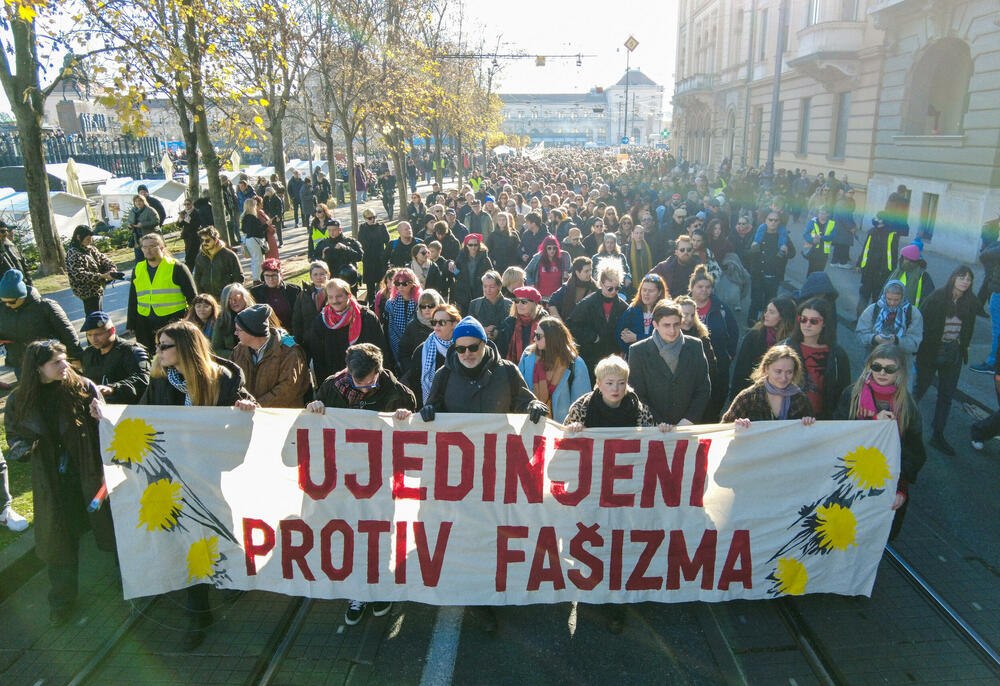
Citizens protest in Zagreb against the rise of fascism in Croatiaphoto: REUTERS
Normalization of right-wing extremism
Analyst Žarko Puhovski told DW that the march showed citizens’ dissatisfaction and frustration, and even fear, which he said was caused by the normalization of right-wing extremism that has been happening in Croatia since last summer. He believes that this is an understandable reaction, although not a reasonable one due to some of the messages, such as the call for a Balkan federation.
He believes that both the left and the right, when it comes to the latter, are ready to insist on marginal phenomena, not on central ones. “Here, Prime Minister Plenkovic, by aligning himself with the right, missed the opportunity when he began his speech on Monday to say that the HDZ is the only barrier to normality. Now we have an outbreak of right-wing comments, including scandalizing the Cyrillic alphabet, which is a legitimate script in Croatia,” Puhovski notes.
He recalls that this was stated by Defense Minister Ivan Anušić, who is calling for young people to do some kind of military service from the beginning of next year. Among these young people, there will probably be a number of people who write in Cyrillic, but that apparently did not occur to him, Puhovski recalls.
However, as he adds, the left-wing political option is not immune to stupidity either. “On the other hand, they insist on advocating for a Balkan federation, which is also stupid, because it is truly a failed idea. But such things are found at all protests in all countries of the world. The organizers of the march simply were not able to remove that banner from sight and then it turned out that they insisted on that – instead of the key issue, which is the normalization of right-wing extremism that calls for the NDH,” says Puhovski.
Reverse chronology
Despite the attacks in recent weeks in Croatia, Puhovski believes that the fear of right-wing extremism in Croatia is “exaggerated, but not invented and there is a reason for it.”
“I can say that some reactions are overstated in my opinion, but it happens that attackers in Split prevent a group of children and elderly people from Novi Sad from demonstrating a folk dance. And that an exhibition in Vukovar starring a Serbian woman is unacceptable in November. Now November, as in some kind of Islamic calendar, has become a ‘holy month’. So we no longer have holy days related to the fall of Vukovar, but we have a holy month, and soon there will probably be a holy year of piety and it will probably not be possible to do anything that someone would consider an offense to the victims. What is sadly specific to Croatia is a kind of reversed chronology,” says Puhovski.
He states that, judging by the public atmosphere, Croatia is more in 1991 today than it was ten years ago. “Ten years ago, no one would have thought to declare an entire month a month in which such and such things should not be done, nor would anyone dare to publicly say that the mere fact that someone is a Serb offends the Vukovar majority. Why?”, Puhovski asks rhetorically.
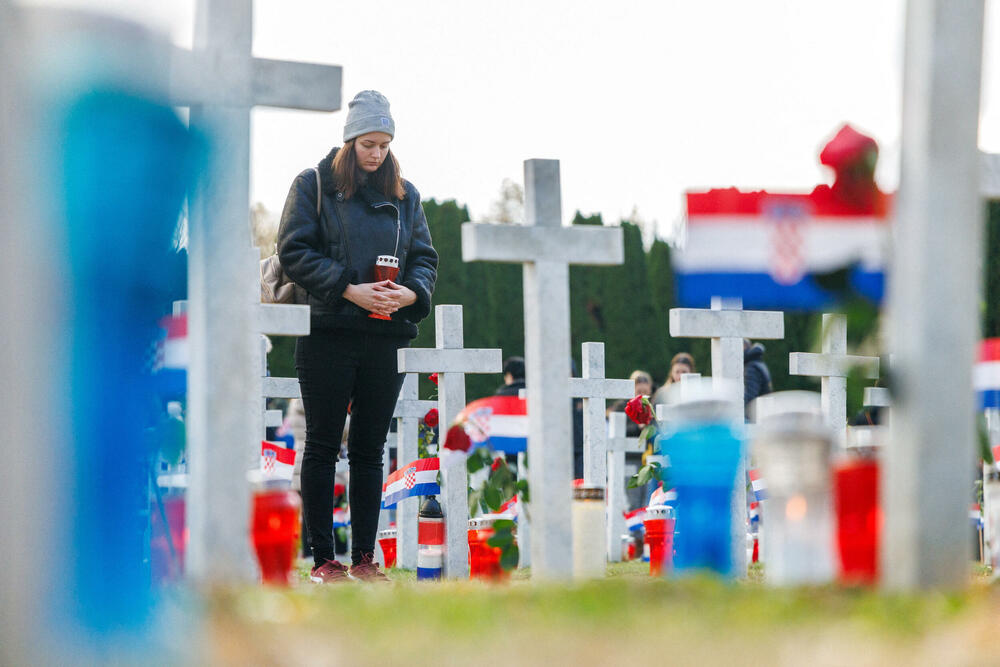
photo: REUTERS
His answer is: because the atmosphere of approaching the events of the nineties is reproduced. On the one hand, this is reinforced by official propaganda, so every day a victim from the war is mentioned on the public service. And at the same time, this corresponds with the strengthening of militaristic hysteria in Western Europe, so Croatia suddenly found itself at the level of the most developed countries from its backwardness.
“We haven’t had this militaristic hysteria for years, because we were tired of war. Now it’s suddenly appearing, and from the highest places – from Brussels, Berlin, London. This gives a boost to local actors who care about constantly insisting on the heroic past and the war,” explains Puhovski.
Istria “the most correct in the entire region”
Commenting on the fact that Pula and Istria stand out from other parts of Croatia when it comes to tolerance towards minorities, not only national ones, Puhovski assesses: “After the 1950s, when the Italians were expelled, Istria had a tradition of peaceful coexistence between the Slovenian and Croatian population. Then a lot of people from Serbia and Bosnia and Herzegovina moved in, and from the 1970s, tolerance spread to the Italian population, which had not been the case before.”
According to his judgment, the Italian minority in Croatia today has a higher reputation than the Croatian majority, because it is the only minority whose school members of the majority nation want to go to.
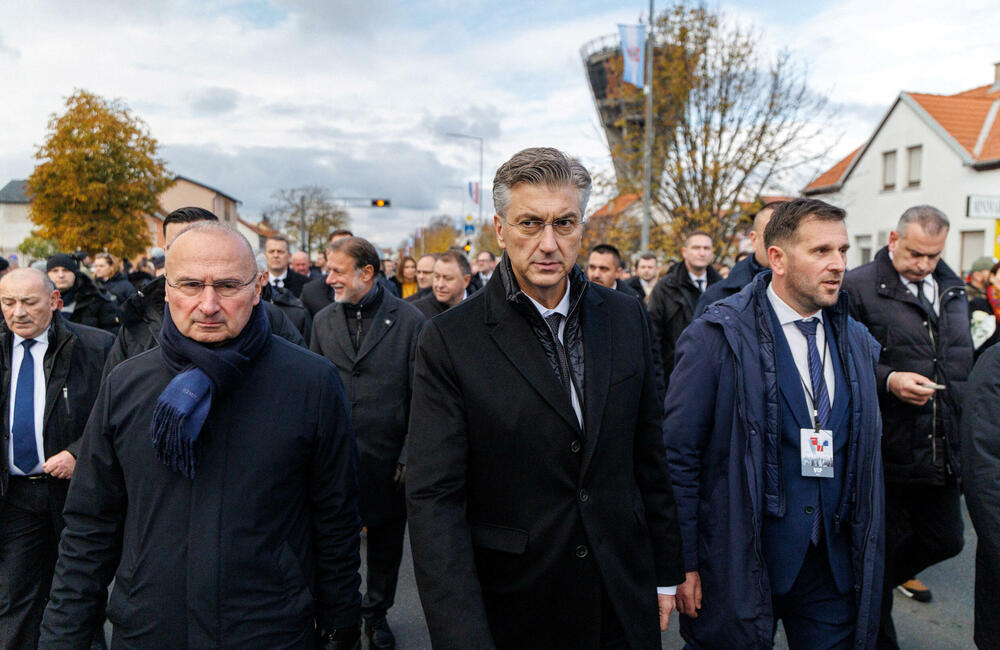
Plenković and Minister of Foreign Affairs Gordan Grlić Radmanphoto: REUTERS
Actor Rade Šerbedžija, one of the participants in the Pula march who himself was a victim of nationalist hysteria at the beginning of the war in the 1990s, which is why he lived abroad for a while, says that in his experience, Pula and Istria are “the purest and most correct in the entire region” when it comes to all this nationalism and chauvinism.
The growth of neo-Nazi ideas is commented on by the increase in unhappiness in the world, when people justify their own failure with their nationalism and hatred towards people of a different religion, upbringing, and mentality.
“Istria has always stood out from the rest of Croatia. Istria remembers not only those Italians who were fascists, Istria remembers the Italians who were neighbors, best friends. Istria is used to multiculturalism. The mass of Istrians speak Italian, so that’s not something bad, it’s something good, noble. People in Istria have a developed cosmopolitanism, which I particularly like and that’s why I have my house in Istria,” Šerbedžija told DW.


News