
The Republic of Kosovo remains committed to advancing its civil emergency architecture by investing in logistical capacities, modern technology, and professional capacity building. This is being done through the TAFF 1 and TAFF 2 projects.
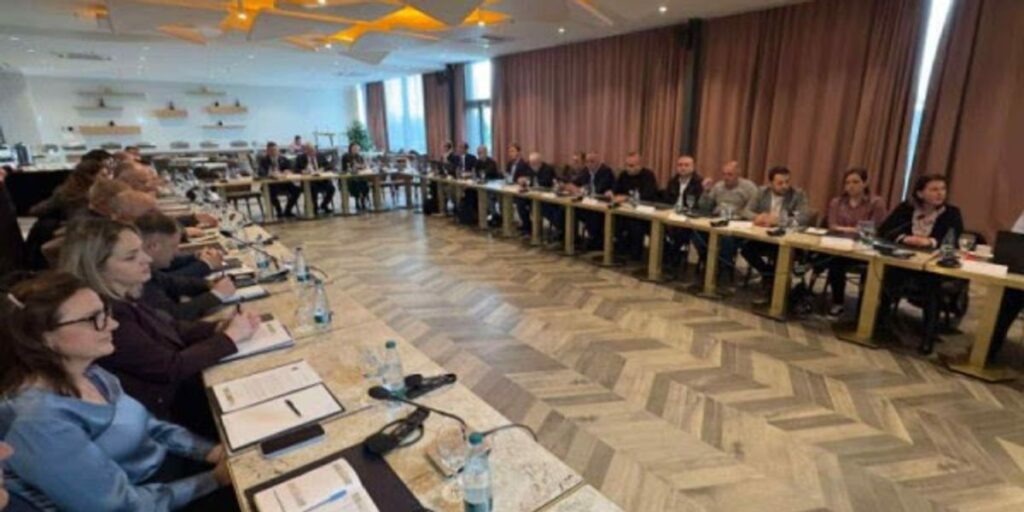
This was stated by the acting Minister of Internal Affairs, Xhelal Sveçla, at the one-day workshop organized by the Emergency Management Agency of the Ministry of Internal Affairs, and supported by the European Commission and with the assistance of the World Bank and the Global Fund for Disaster Reduction and Recovery (GFDRR), KP reports.
The workshop addressed topics on improving understanding of disaster risk, impact-based forecasting and early warning, and advancing national preparedness for disaster risk management and wildfires in Kosovo.
Acting Minister of Internal Affairs, Xhelal Sveçla, emphasized that the TAFF 1 and TAFF 2 projects contribute to building capacities for risk management and disaster response.
“The Republic of Kosovo remains committed to advancing its civil emergency architecture by investing in logistical capacities, modern technology, building professional capacities and strengthening inter-institutional cooperation…
As a government, we are committed to strengthening coordination between the central and local levels, because effective disaster coordination starts with the community, with citizens… This integrated approach strengthens inter-institutional cooperation and extends support from risk recognition to full operational readiness…
These strategic initiatives are making a significant contribution to building Kosovo’s capacities in risk management and disaster response. National preparedness is the foundation of every state, it is a policy that affects the well-being, security and sustainable development of the country. It is an investment in protecting lives, the environment, the economy. Kosovo is committed to creating a sustainable system,” he said.
The Director of the Emergency Management Agency, Genc Metaj, stated that the two TAFF 1 and 2 projects mark a step forward in modernizing the country’s emergency system with European standards.
“We are taking a step forward in modernizing and harmonizing our systems with European standards and in improving disaster risk. Through these projects, we are advancing in increasing the professional capacities of institutions at the central and local levels in improving planning, coordination and harmonization with EU standards and the European Civil Protection Mechanism, as well as in modernizing the warning system.”
“These projects are extremely important for our country, enabling us not only to increase knowledge, but also to build best and sustainable practices in the field,” Metaj declared.
The TAFF 1 and TAFF 2 projects are funded by the European Commission – DG ECHO and implemented by the World Bank in cooperation with the Global Facility for Disaster Risk Reduction and Recovery (GFDRR).