
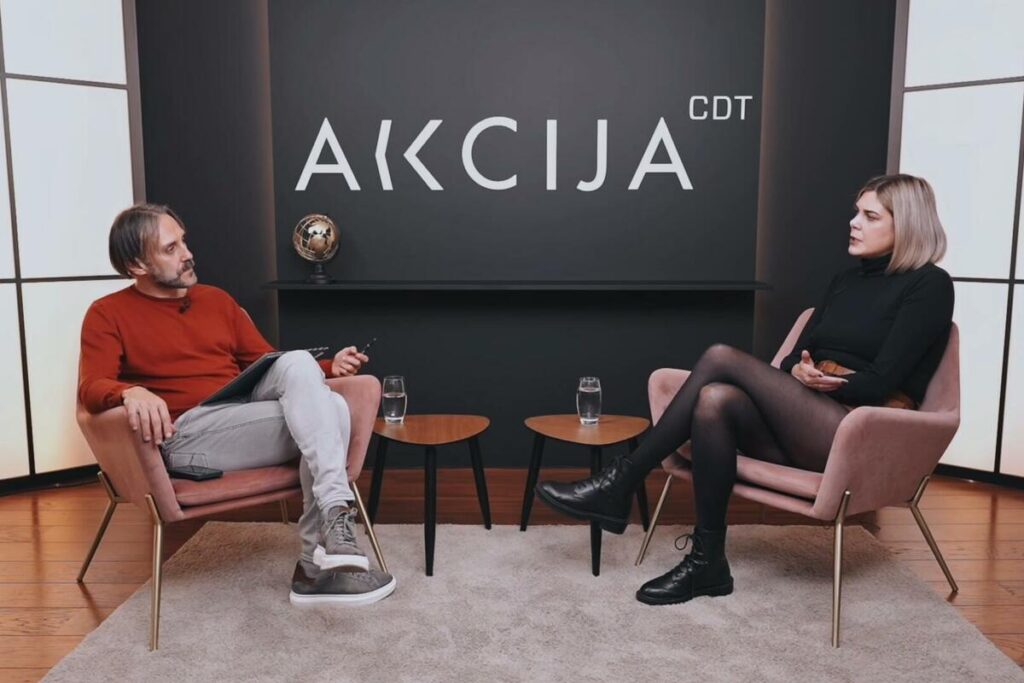
Thousands of people gathered in four cities across Croatia for protest marches organized by the “United Against Fascism” initiative to express concern about hate speech and the rise of violence in society. She spoke about the motives, atmosphere, and process of organizing the event for the “Action” podcast of the Center for Democratic Transition (CDT). Vedrana Bibic, one of the organizers of the initiative.
Bibić also pointed to the increasingly present anti-migrant narrative spreading across Croatia, which has resulted in the expansion of misinformation about migrants, foreign workers moving to Croatia, which inevitably affects the perception of the domestic population about this population.
“We decided, after a summer in Croatia that was horrific, that it was time for the so-called silent majority to take to the streets, for people to show that they are fed up with violence and the Ustashaization of the state. This summer, after Thompson’s concert at the Hippodrome and after the government allowed the ‘For the Homeland Ready’ salute to spread and relativize the Ustasha movement, the defenders gained wings and decided to ban various literary events and festivals,” says Bibić.
According to her, an atmosphere has been created in which “if you are against violence, you are considered to be against the Croatian state.”
When asked how they managed to gather so many citizens in four cities, Zagreb, Zadar, Rijeka and Pula, Bibić explains:
“Through persistent work, over 30 associations and individuals came together to see what to do. These are people who had experience in organizing. We realized that a mass protest was the most important thing, to show that it is not a division into the extreme left and the extreme right, but into people who want violence on the streets, doing it either from the parliamentary benches or physically – and the rest of society that wants to live normally.”
He adds that it was important for them to encourage people who were initially afraid to take to the streets.
“We rolled up our sleeves and worked within working groups for a few weeks, sometimes for 12 hours, sometimes missing our regular jobs.”
Bibić emphasizes that massification does not happen by itself.
“Solidarity needs to be organized. Everyone who is not involved in volunteer work thinks that it is enough to invite people via Facebook to come. The work requires a lot of logistics and operational work by a large number of people and a lot of compromises. In the end, you are more concerned with technique than content.”
Bibić also warns of the growing intolerance towards migrants and workers from abroad, which is increasingly present in Croatia, emphasizing that a huge problem is misinformation, which is associated with the anti-migrant narrative.
“There’s a lot of fake news. On one side, the right-wing conspiracy theory that Muslims will come and conquer Europe, and on the other side, the European right has almost the same narratives. Our people have left the country and there’s no one to work, so the narrative of ‘why aren’t people working’ doesn’t work.”
In addition, he says, stories are being spread about alleged attacks by foreign workers on Croats.
“A story comes out that someone attacked a grandmother, then a denial is released from the police, but the first news remains. So the fear of something different remains.”
Bibić, a Hajduk Split fan, also comments on the atmosphere in the stadiums, regarding the question about the chant “Kill the Serb” at the Croatia-Montenegro match.
“We are all Split and we are all Hajduk. Ultras culture is interesting and terrifying. As for Torcida, it is a small fan group of young people poisoned by right-wing narratives, who have nothing to cling to except Hajduk, and in one moment they became more and more right-wing.”
But he reminds us that a much wider community comes to the stadium.
“Between 15 and 20 people come to Hajduk matches. The rest of the fan community is very diverse and there are many vocal leftists among them. Some of them have devised a democratic self-association governance model. That community is too large and growing, and the number of women among its members is also growing.”
“The key idea is to gain money, power and authority,” Bibić points out, speaking about the revision of history, which is present both in Montenegro through the actions of the church and in Croatia through right-wing narratives.
He explains that similar nationalist narratives are emerging across the region, but that in Croatia the manipulation of memories from the 90s is particularly strong.
“It is repeated that Dubrovnik was attacked under the five-pointed star and an attempt is made to equate anti-fascism with Serbian aggression against Croatia – and this succeeds very well. Yugoslavia is like a Baba Roga. Whenever people talk about Yugoslavia, people are scared, and on the other hand, the memory of real life inside Yugoslavia is erased.”
He also cites an example from recent protests.
“Among the 15.000 people gathered at the marches in Croatia, there was a flag of the Socialist Republic of Croatia. And now the media and politicians are riding on the idea that this is a new ‘Log Revolution’ and that we want to bring Yugoslavia back. Such provocations pass, but we try to ignore them.”
Finally, Bibić talks about further activities within the Initiative.
“The plan is to continue working, to empower other cities, to work within media spaces, small actions on the streets, but also larger future protests, and to network with progressive unions. There are many plans, but we have to stop and think. We will definitely have some more actions by the summer.”

News