
It has been a quarter of a century since Serbia set membership in the European Union (EU) as the country’s strategic goal, and even 11 years since accession negotiations officially began. The long road towards Europe is certainly one of the factors influencing citizens’ Euro-enthusiasm – and some of the latest polls have shown the lowest support for Serbia joining the EU in the last ten years.
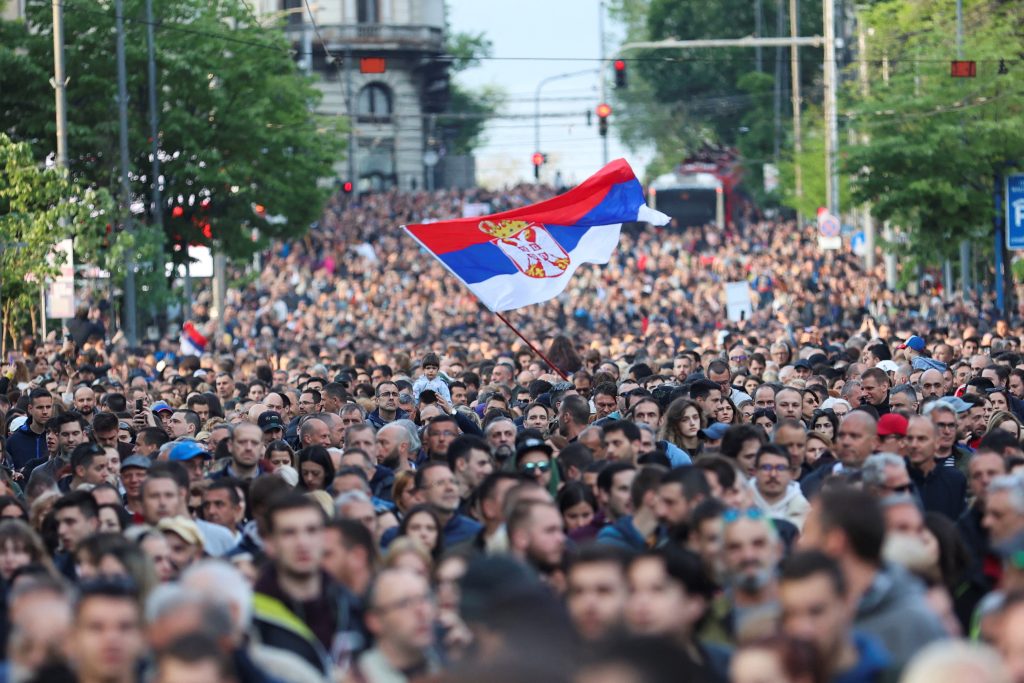
What is interesting, though, is that a certain degree of Euroscepticism is increasingly visible among young people as well. That is shown by the newly published study “Youth at a Crossroads – a shift to the right and the European dilemma”, carried out by the Evropski pokret u Srbiji (European Movement in Serbia – EPuS). According to its results, young people in Serbia have a strong desire for change in society and are not ideologically extreme. And while a large share of them does not trust Serbia’s European path, they still hope that the state will join the EU. However, they criticise the Union for its stance on protests in Serbia.
“Many things that are normal in the EU wouldn’t succeed here”
Asked about their attitudes toward the EU, respondents say that they do not reject Europe outright, but insist there is a difference between Europe as an ideal and as a geopolitical actor. They say they do not trust Serbia’s European path, arguing that – in their judgement – the EU remained silent for too long about the protests in Serbia and failed to support them in time.
The results also show that among young people in Belgrade, Novi Sad, Kragujevac, Niš and Novi Pazar there is great dissatisfaction with the current political environment, and distrust in institutions and traditional media. In smaller towns, young people mostly trust only local media, while others rely on social networks and emphasise the importance of direct information sources. Some of the more striking statements that emerged: “Even if the government is removed – that’s only the beginning,” “This can’t go on, something needs to happen,” and “Many things that are normal in the EU wouldn’t succeed here.”
Young people viewed the widespread university blockades across Serbia “both as a political and as a national project”, even though they did not necessarily see them as political protests. One of the main obstacles to political engagement among youth, according to the study, is the lack of their representation in formal politics. As their biggest personal concern, young people listed economic hardship and job insecurity in Serbia.
It’s not only the Serbian authorities to blame – the EU also shares responsibility
One of the authors of the study, Uroš Popadić, programme manager at EPuS, told NIN that many young people were born during the period of European integration in Serbia – for them, the issue rarely has significant emotional weight, and they do not feel the process is advancing.
“Young people we talked to across the country believe that the slow pace of integration is not only the fault of our government but also of the EU,” he said. “Everyone agrees that we have to deal with our burning problems ourselves first, and only then deal with the EU.”
When asked whether young people in Serbia have enough information about the EU, or whether some of their views are distorted, he said that information often comes second-hand. “Young people do have access to information about the EU, but it is generally hard to find – or it has already been filtered or altered by someone’s opinion. Our study showed that young people mostly receive information through social media and second-hand sources, so direct information from the EU, presented in a way that resonates with them and via channels they follow, is rare,” Popadić said.
According to EPuS project manager Časlav Jovičić, among young people there remains a positive sentiment about joining the EU – but also a feeling of disappointment when it comes to the long duration of Serbia’s path to the EU and the EU’s response to student protests in Serbia. “When we talk about the decline in enthusiasm among young people for the EU, we need to ask what exactly we mean, because young people are no less enthusiastic about living by European standards – but they are less enthusiastic about the integration process, which seems unclear, outdated, and, at the end of the day, as though there is a lack of enthusiasm from both sides of the negotiations. In every city where we talked to young people – Belgrade, Novi Sad, Kragujevac, Novi Pazar and Niš – there was a positive sentiment about EU membership, but also disappointment about the EU’s slow response to student protests and the length of the integration process,” Jovičić told NIN.
Why are there no EU flags at the protests?
Since the student protests began in Serbia more than a year ago, citizens have often demanded that Brussels clearly position itself regarding developments in Serbia. In order to bring the situation to the attention of European officials, students under blockade ran from Serbia to Brussels – and reached Strasbourg by bicycle. The student uprising was even discussed in the European Parliament. The Marta Kos, European Commissioner for Enlargement, has repeatedly said that the students’ demands are the same ones the EU wants from the authorities in Belgrade during membership negotiations.
“These include rule of law, the fight against corruption, public procurement, media legislation and electoral law. And frankly, I like to say that I am the biggest supporter of the demonstrators, because if Serbia is serious about its EU path – and they tell me it is – then it will have to keep its promises,” Kos said in April.
There has been repeated public debate in Serbia on why there are no EU flags at the protests. Some believe its absence reflects the EU’s lack of support for the protests, while others argue that the blame lies with the EU itself – that because of its, as some see it, lenient stance toward the regime in Belgrade, support for membership is actually decreasing.
It should be recalled that support for EU membership among Serbian citizens has also been shown to decline in the most recent Eurobarometer. That survey, published in September by the European Commission, revealed that 33 percent of Serbian citizens support EU membership – the lowest level of support among candidate countries. According to those results, as many as 45 percent of Serbian citizens do not believe the country will ever become part of the EU, 26 percent think membership will take five to fifteen years, while only 10 percent believe it can be achieved within the next five years.
(NIN, 05.12.2025)
https://www.nin.rs/drustvo/vesti/96673/istrazivanje-o-mladima-i-eu