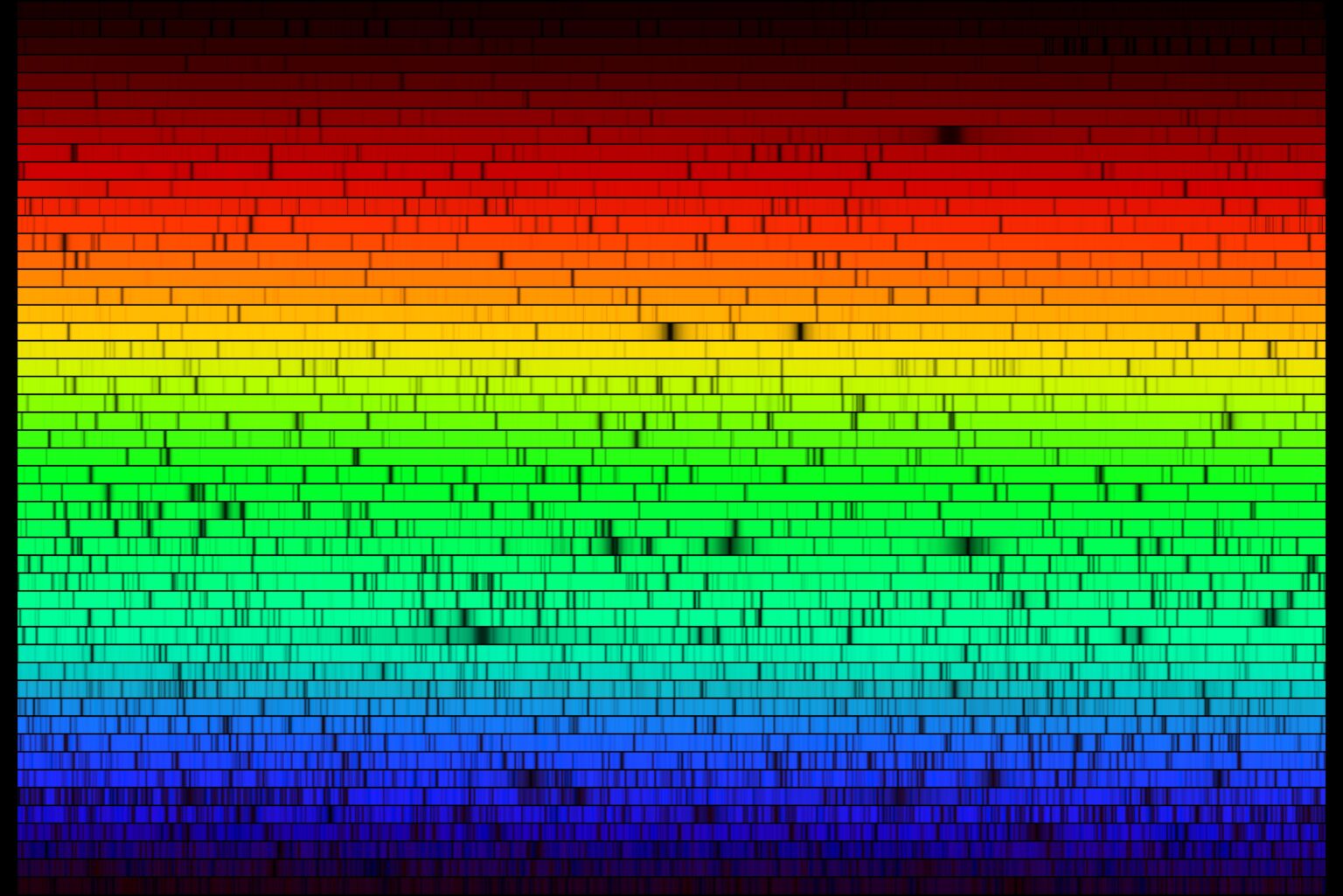
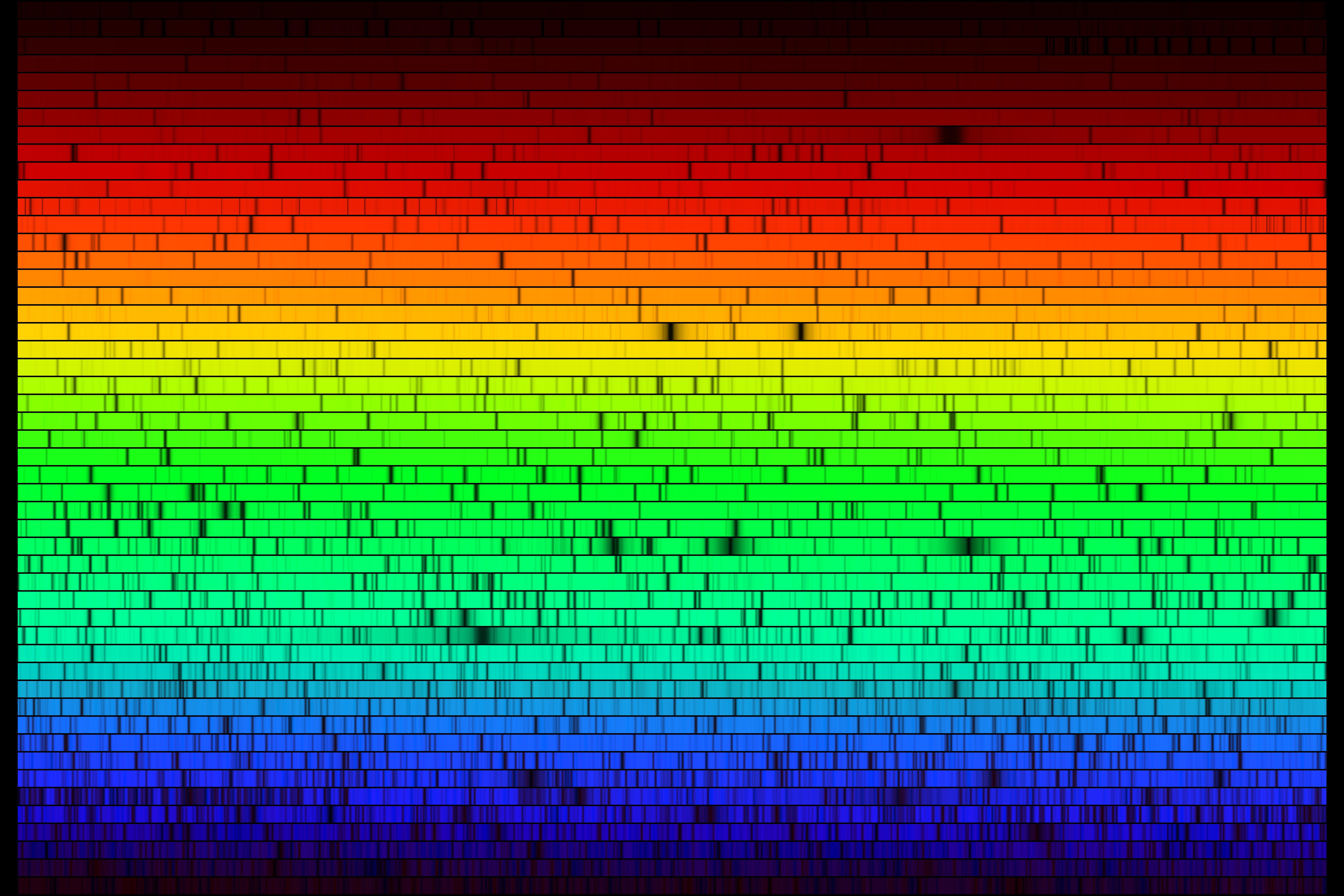
Explanation: It is still not known why the Sun’s light is missing some colors. Here are all the visible colors of the Sun, produced by passing the Sun’s light through a prism-like device. The spectrum was created at the McMath-Pierce Solar Observatory and shows, first off, that although our white-appearing Sun emits light of nearly every color, it appears brightest in yellow-green light. The dark patches in the featured spectrum arise from gas at or above the Sun’s surface absorbing sunlight emitted below. Since different types of gas absorb different colors of light, it is possible to determine what gasses compose the Sun. Helium, for example, was first discovered in 1868 on a solar spectrum and only later found here on Earth. Today, the majority of spectral absorption lines have been identified – but not all.
High res image from here, text from this post is below link:
A high-resolution version of the spectrum of our Sun, this image was created from a digital atlas observed with the Fourier Transform Spectrometer at the McMath-Pierce Solar Facility at the National Solar Observatory on Kitt Peak, near Tucson, Arizona (‘Solar Flux Atlas from 296 to 1300 nm’ by Robert L. Kurucz, Ingemar Furenlid, James Brault, and Larry Testerman: National Solar Observatory Atlas No. 1, June 1984). The images shown here were created to mimic an echelle spectrum, with wavelength increasing from left to right along each strip, and from bottom to top. Each of the 50 slices covers 60 angstroms, for a complete spectrum across the visual range from 4000 to 7000 angstroms. The Sun is a G2 star, and this image covers the same wavelength range in the same format as the spectrum of Procyon, type F5, and the spectrum of Arcturus, type K1 (or K2). Note: NSO/Kitt Peak FTS data used here were produced by NSF/NOAO.
The_Celestrial on
Wtf put it back please! /s
swingadmin on
The good news is we match the spectrum of K1 and F5 solar masses
The bad news is we have to send Ryan Gosling ~~Reynolds~~ to the nearest star to save our own
Brylock_Delux on
I’m not versed in this at all so forgive my ignorance, but if only specific colors are reflected off of something for us to be able to see it, would this be a factor? That was my first thought when I read its captured from on Earth and not space, so wouldn’t it be possible some of these missing parts are being filtered by our atmosphere? If thats not the case, how is the tool used to capture this able to bypass this?
Potentially silly question as a colorblind person;
Are all the horizontal bars the same color from left to right, or is the color slightly changing as we move along a bar? I assume it must be the latter otherwise I don’t understand how parts of a bar but not the whole bar are missing, but it could be that the horizontal axis represents some other kind of information, so I’m not sure…

18 Comments
Image from here, text from APOD post below link:
[https://apod.nasa.gov/apod/ap251207.html](https://apod.nasa.gov/apod/ap251207.html)
The Sun and Its Missing Colors
Image Credit: Nigel Sharp (NSF), FTS, NSO, KPNO, AURA, NSF
Explanation: It is still not known why the Sun’s light is missing some colors. Here are all the visible colors of the Sun, produced by passing the Sun’s light through a prism-like device. The spectrum was created at the McMath-Pierce Solar Observatory and shows, first off, that although our white-appearing Sun emits light of nearly every color, it appears brightest in yellow-green light. The dark patches in the featured spectrum arise from gas at or above the Sun’s surface absorbing sunlight emitted below. Since different types of gas absorb different colors of light, it is possible to determine what gasses compose the Sun. Helium, for example, was first discovered in 1868 on a solar spectrum and only later found here on Earth. Today, the majority of spectral absorption lines have been identified – but not all.
High res image from here, text from this post is below link:
[https://noirlab.edu/public/images/noao-sun/](https://noirlab.edu/public/images/noao-sun/)
A high-resolution version of the spectrum of our Sun, this image was created from a digital atlas observed with the Fourier Transform Spectrometer at the McMath-Pierce Solar Facility at the National Solar Observatory on Kitt Peak, near Tucson, Arizona (‘Solar Flux Atlas from 296 to 1300 nm’ by Robert L. Kurucz, Ingemar Furenlid, James Brault, and Larry Testerman: National Solar Observatory Atlas No. 1, June 1984). The images shown here were created to mimic an echelle spectrum, with wavelength increasing from left to right along each strip, and from bottom to top. Each of the 50 slices covers 60 angstroms, for a complete spectrum across the visual range from 4000 to 7000 angstroms. The Sun is a G2 star, and this image covers the same wavelength range in the same format as the spectrum of Procyon, type F5, and the spectrum of Arcturus, type K1 (or K2). Note: NSO/Kitt Peak FTS data used here were produced by NSF/NOAO.
Wtf put it back please! /s
The good news is we match the spectrum of K1 and F5 solar masses
The bad news is we have to send Ryan Gosling ~~Reynolds~~ to the nearest star to save our own
I’m not versed in this at all so forgive my ignorance, but if only specific colors are reflected off of something for us to be able to see it, would this be a factor? That was my first thought when I read its captured from on Earth and not space, so wouldn’t it be possible some of these missing parts are being filtered by our atmosphere? If thats not the case, how is the tool used to capture this able to bypass this?
Are these not Fraunhofer lines?
Can’t have shit in the solar system smh
This is why the sun is green btw
Old firmware. Needs to be running Corona 2.0
It’s worth reading the article about [Fraunhofer lines](https://en.wikipedia.org/wiki/Fraunhofer_lines) here.
Isn’t this the plot for Project Hail Mary?
Can’t have shit in the solar system
Acronyms, initialisms, abbreviations, contractions, and other phrases which expand to something larger, that I’ve seen in this thread:
|Fewer Letters|More Letters|
|——-|———|—|
|[APOD](/r/Space/comments/1pghl5d/stub/nsr5frq “Last usage”)|NASA’s Astronomy Picture Of the Day|
|[FTS](/r/Space/comments/1pghl5d/stub/nsr5frq “Last usage”)|Flight Termination System|
|[NSF](/r/Space/comments/1pghl5d/stub/nsr5frq “Last usage”)|[NasaSpaceFlight forum](http://forum.nasaspaceflight.com)|
| |National Science Foundation|
Decronym is now also available on Lemmy! Requests for support and new installations should be directed to the Contact address below.
—————-
^(3 acronyms in this thread; )[^(the most compressed thread commented on today)](/r/Space/comments/1pffx60)^( has 23 acronyms.)
^([Thread #11961 for this sub, first seen 7th Dec 2025, 14:01])
^[[FAQ]](http://decronym.xyz/) [^([Full list])](http://decronym.xyz/acronyms/Space) [^[Contact]](https://hachyderm.io/@Two9A) [^([Source code])](https://gistdotgithubdotcom/Two9A/1d976f9b7441694162c8)
This explains why I can’t find the right color to paint my kitchen.
Can we run an anti-poleron analysis of the spectral pattern and defragment the remains to decode the hidden message?
Looks like the sun has some stuck pixels- try turning it off and back on again.
Might want to hide this before Trump tries to ban it.
Looks like the sun needs to be defragged
https://i.imgur.com/SQRqvs0.gif
Potentially silly question as a colorblind person;
Are all the horizontal bars the same color from left to right, or is the color slightly changing as we move along a bar? I assume it must be the latter otherwise I don’t understand how parts of a bar but not the whole bar are missing, but it could be that the horizontal axis represents some other kind of information, so I’m not sure…