
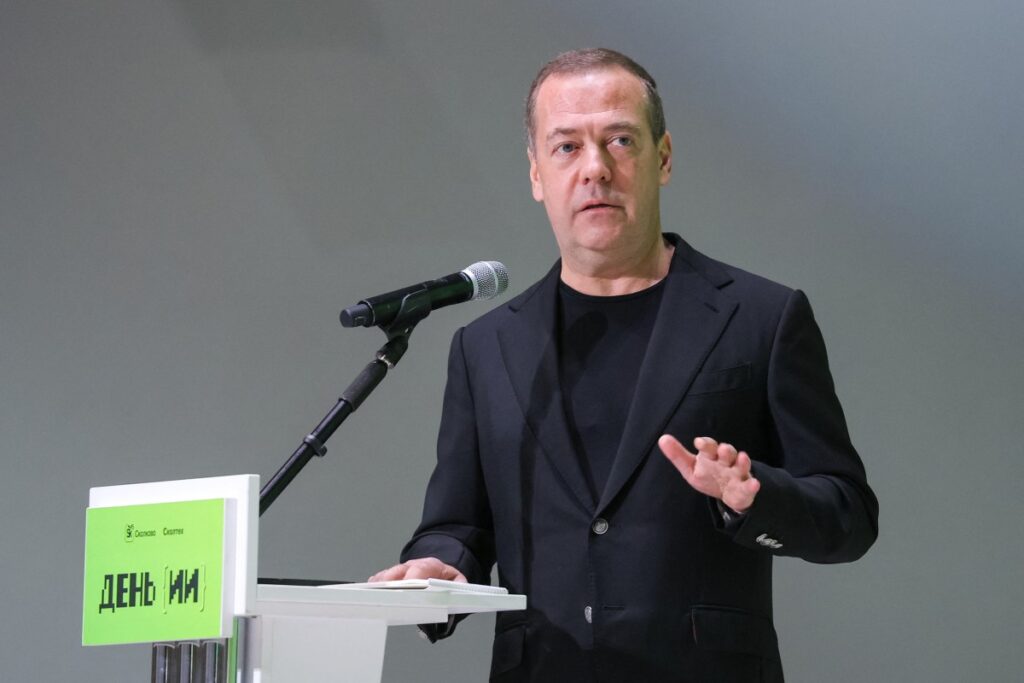
Russian Security Council Deputy Chairman Dmitry Medvedev hailed the new National Security Strategy document, published by the Trump administration last week, as having “echoes” of Moscow’s own views.
“The strategy unexpectedly echoes what we have been saying for over a year: security must be shared and sovereignty respected,” Medvedev, a former Russian president and prime minister, wrote on his Max messaging profile. “Now, a window of opportunity for dialogue has been opened.”
Newsweek reached out to the White House by email on Sunday afternoon for comment.
Why It Matters
The administration remains under scrutiny over President Donald Trump’s working relationship with his Russian counterpart Vladimir Putin as Russia and Ukraine remain in gridlock after months of attempted negotiations to end Russia’s invasion of the Eastern European nation that began in February 2022.
European allies were critical of a proposed peace plan the Trump administration published last month, which would have significantly reduced Ukraine’s armed forces and handed Russia territory it does not currently control. The plan was reportedly crafted with limited input from Ukraine, which deeply upset Kyiv and the wider European community.
What To Know
The administration released a 33-page National Security Strategy document that laid out Trump’s vision for how America will proceed with international concerns in relation to national security.
The document, usually released once each presidential term, heavily focuses on Western Hemisphere operations, with intent to limit or eliminate drug trafficking and migration, with reprisals of the Monroe doctrine asserting U.S. influence over the hemisphere.
Key among the various points laid out by the administration is “a core interest of the United States to negotiate an expeditious cessation of hostilities in Ukraine,” and trying to decrease the risk of Russian confrontation with other European countries.
It also stresses a need to “re-establish strategic stability to Russia,” which would “stabilize European economies,” also suggesting that Europe overall is in decline as “it is far from obvious whether certain European countries will have economies and militaries strong enough to remain reliable allies.”
Medvedev, writing on the Russian state-controlled messenger app Max, praised the document as “not a friendly embrace, but a fairly clear signal” that the U.S. is “ready to discuss security architecture rather than impose endless and meaningless sanctions.”
Chiefly, Medvedev noted that the document for the first time in many years does not refer to Russia as a “threat” but as a participant in the dialogue on stability.
Kremlin spokesperson Dmitry Peskov in an interview with Russia’s state news agency Tass on Sunday called the document “largely consistent with our vision” and “a positive step.”
What People Are Saying
Senator Mark Kelly, an Arizona Democrat, last week wrote on X: “Donald Trump’s National Security Strategy puts his family’s and friends’ business interests with our adversaries, like Russia and China, over promises to our allies. If implemented, this plan would weaken U.S. influence across the globe and undermine our national security.”
Senator Eric Schmitt, a Missouri Republican, wrote on X: “America is back to practicing a foreign policy rooted in strength, restraint, and national interest, not Wilsonian fantasy. The new National Security Strategy marks a clear return to a distinctly American tradition: Realism.”
Ukraine’s former Economy Minister Tymofiy Mylovanov wrote on X on Sunday: “Trump’s National Security Strategy confirms what Europe refuses to see. The US now prioritizes Russia ties and seeks to divide the continent, FP. Europe faces two adversaries — Russia in the east, Trump’s America in the West.”
What Happens Next?
Peskov said that Moscow would continue to study the document before making broader statements, the BBC reported.