
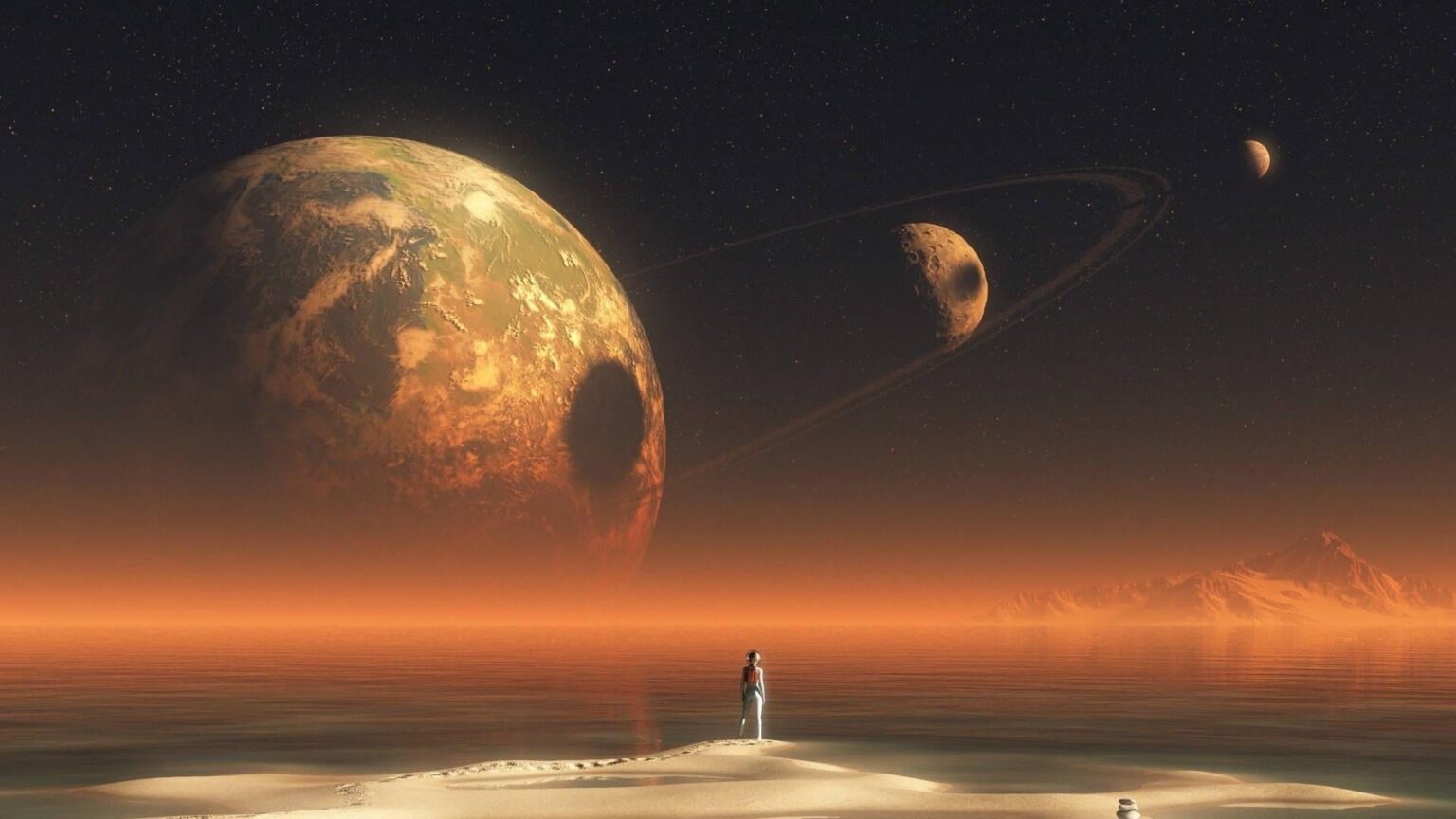
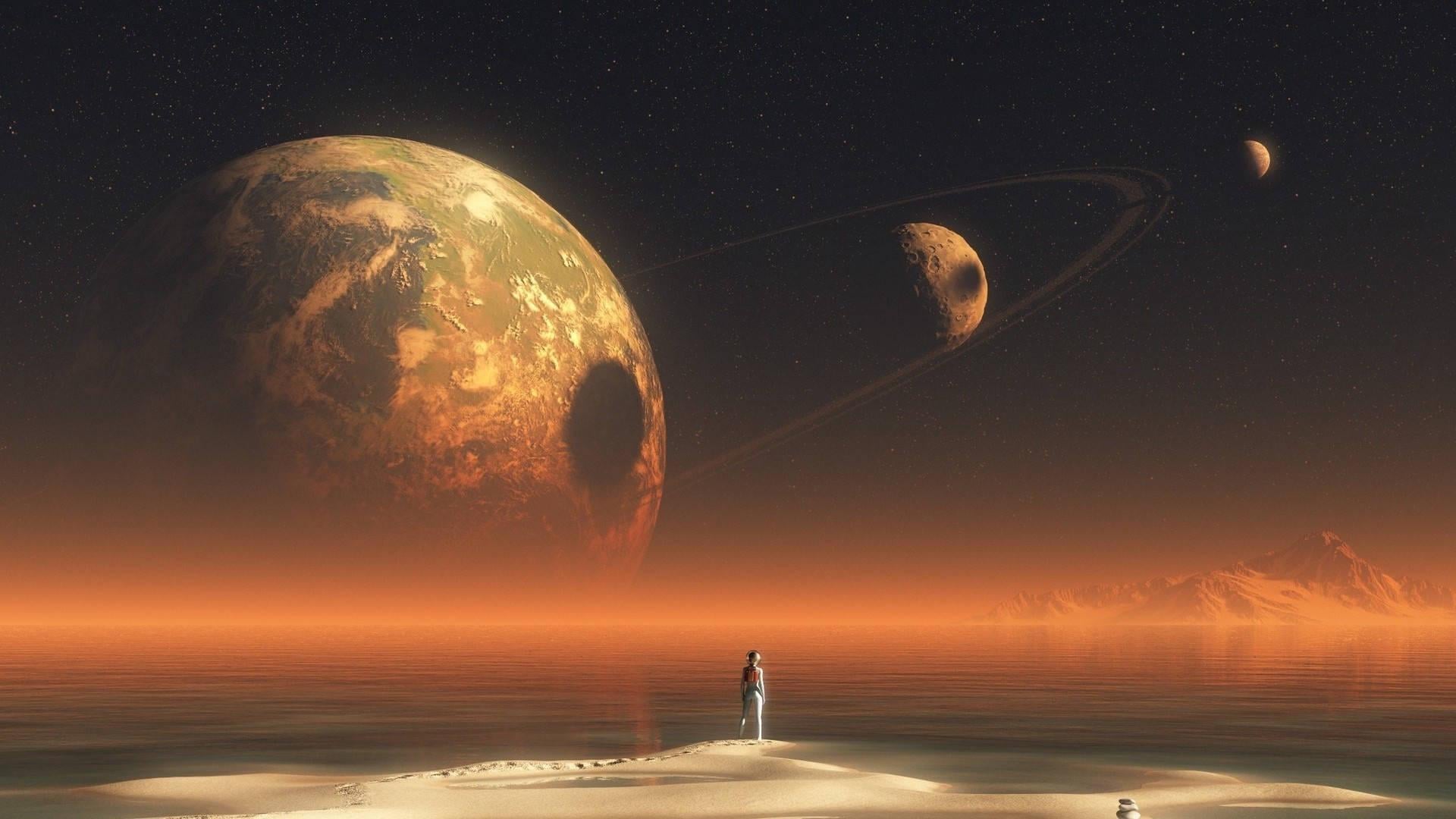
I am writing fiction, and I want my planet to have another planet loom large in the sky,
but I want it to be at least informed by reality. Is it possible for a real planet to have this effect without the two planets e.g. being so close they destabilize each other's orbit?
Hope you can help, I haven't had any luck figuring it out.
Thank you.
https://i.redd.it/agxc8x8huw5g1.jpeg
35 Comments
Perhaps you could have your setting be a large moon?
If the planet you’re on is a moon it’s possible
Closest you can get is something like Jupiter’s moons. The second planet wouldn’t always be close, but periodically visible.
2 worlds in orbit around the Sun like that would not be able to be that close without wrenching each other. They also would not orbit each other.
If you’re fine with your planet being a moon of the one you see in the sky, that would work. You can look up what Jupiter/Saturn looks like from their moons for an idea of what that would look like. It could be a super earth rather than a gas giant and still potentially be stable depending on the relative masses. Our moon is unusually large relative to Earth and it works fine for us
Probably not. Roche limit.
Probably not. Roche limit.
If you are on a moon, yeah, it would be possible. Would still have a huge impact.
It’s possible but you’re probably gonna have to make your subject planet a moon instead, and the big planet looming on the horizon might need to be something like a gas giant so it can be large enough to fill a lot of the sky while not being too dense to be a pretty unrealistic orbit or some crazy tidal forces wreaking havoc on your world’s geography (which might even happen anyway)
Here is a real life example: a simulated view of Jupiter from the surface of its moon Europa:
https://science.nasa.gov/missions/europa-clipper/europa-clipper-resources/simulated-view-from-europas-surface-artists-concept/
I think you’re looking for Binary Planet Systems.
The only way it could be that close would be if it was a binary planet, i.e. two similarly sized planets that orbit a common point. The moon in that picture is WAAAAAY too close though.
The actual closest distance is decided by the Roche limit: [https://en.wikipedia.org/wiki/Roche_limit](https://en.wikipedia.org/wiki/Roche_limit)
You might be able to set up a binary planet system
If they are locked together so the effects are muted
If the planet is big enough and close enough it could appear to look like that.
In addition to Roche limit, It’s more about mass rather than size. You could have a mars sized moon a bit closer than the current moon which would appear much bigger in the sky without all the catastrophic events. That said, any planetary body closer or bigger than the moon would create massive tides.
One would have to be orbiting insanely fast. Presumably you’d also be on the smaller of the two, the one that is doing the orbiting. Which would mean it’s likely tidal locked, and the average windspeed would also be insane.
But only if you choose to apply the rules of physics.
This image is like what you would see from Pandora. Alas, if there is zero air, then yes it would look like this, but if you have a breathable atmosphere, then you’ll barely see any of this unless the timing is just right with the lighting from the sun.
The Planets would probably need to be fairly far away, or have unusual low mass, and in either way also need to be (almost) tidally locked if there shan’t be devastating tidal events that keep the surface uninhabitable.
Something about chaotic eras and stable eras.
Wouldn’t this also be a time issue? Maybe the planets are doomed to collide soon, but you have enough time for your story?
Planetary collision?
It doesn’t *need* to be a natural phenomena – you could have some kind of passive force keeping them in place, and your characters might even know thay it doesn’t make sense, thry just don’t know the cause.
There’s a cool description of a moon orbiting a gas giant with other moons in one of Peter F. Hamilton’s books that sticks with me today: the terror one feels everyday when the planet rises and it feels as if the whole moon is falling into it, nearly the entire sky taken up. I had never considered how scary that would be to witness a planet rise on such a moon.
This is Roche effect territory
I think it could be a binary or double planet where two large bodies exist, basically a planet with a similar sized moon where they rotate around each other and the star.
Ain’t no problem like a three body problem!
I don’t think a planet, but definitely a moon orbiting a gas giant. There could even be moons orbiting Jupiter and Saturn that do have views like this, although most of them don’t have atmospheres.
He wants to ask out that other planet, but he hasn’t worked up the courage yet
The Earth and Moon is a double planet system. Just understand that geosynchronous orbits are not what you think they are yet.
Realistically speaking? Yeah. I play Stellaris so I space jam
‘Very bad things’ are about to happen in that picture – those objects are way too close to not be molten.
A ring of volcanos on the planet’s equator and a lava moon might be cool if you McGuffin it in… Or maybe the planet is a Dyson sphere – not enough mass to melt the moon with gravitational forces and/or the planet actually orbits the middle moon!
Stand on a moon orbiting that planet.
absolutely cannot recommend Space Engine enough for stuff like this:
r/spaceengine
https://spaceengine.org/universe/
What do you mean? Like in the picture here with 2-3 planets close by, close enough that they’re in orbit with each others? Or just 1 planet and the planet you’re on? If just 1 planet and the planet you’re on, then yes, that’s possible, but it’s not possible to have 3 planets in a joined orbit, that’s basically the 3 body problem which isn’t stable and leads to impossible living conditions, and very likely a merger of two of the planets causing a two planet system.
There’s a whole sci-fi novel about such a 3 body problem.
As others write, if it all orbits a star, which is a fair assumptions, then we’re dealing with a disturbed orbit that would probably make it impossible for a 2 planet orbit to exist in a stable state. And of course, if they’re close to each other, then there are tidal forces.
As others have said the planet should probably be a gas giant. However the other moons in the picture should be very much smaller. A system with such large moons so close together wouldn’t be stable.
The easiest scenario for something like this is having a moon the size of a terrestrial planet in orbit of a gas giant. There are a couple consequences of this setup. One is that almost certainly the moon would be tidally locked to the planet, meaning that half of the moon would see the *very* large planet hang in the same position in the sky constantly while the other half would never see the planet at all. Additionally, instead of having a normal “day” the day would be dictated by the orbital period, with one orbit roughly translating to one day (rotation relative to the Sun). At the same time throughout an orbit/day the appearance of the giant planet would go through phases just like our Moon does. It also would be fairly common for there to be an “eclipse” period where the moon passed through the shadow of the planet for a few hours during the middle of the day. Interestingly, because of this setup if you were on the planet facing side of the moon you could look in the sky and see what “time” it was just through observing the phase of the planet and you could easily figure out your local longitude and latitude just by observing the position of the planet in the sky. Generally in these setups the day length would be considerably longer than Earth’s day length (not counting the gap of darkness during the eclipse period).
Also, this kind of setup is a potential “out” for star systems that might otherwise find it difficult to host a habitable planet. Smaller stars tend to be much dimmer, so orbiting a smaller star while keeping close enough to it to retain liquid water means being fairly close, for a lot of very small stars (red dwarfs) this makes being tidally locked *to the star* basically an inevitability. But you can have the same scenario with a giant planet as an intermediary, the habitable world becomes a moon that is tidally locked to the planet instead of the star, so it still experiences a day/night cycle. On top of that the moon would experience some protection from solar flares or CMEs from the strong magnetic field of the gas giant. Both of these effects could shift the plausible habitability zone for smaller stars farther down the mass range, allowing for habitability in a system that with just a lone terrestrial planet would be either borderline habitable or not habitable. It’s probably not enough to protect a habitable moon’s atmosphere from being stripped off by a superflare from an unruly red dwarf star though.
its fiction dude, if science nerds can pick away at it, well at least you know they bought copies.