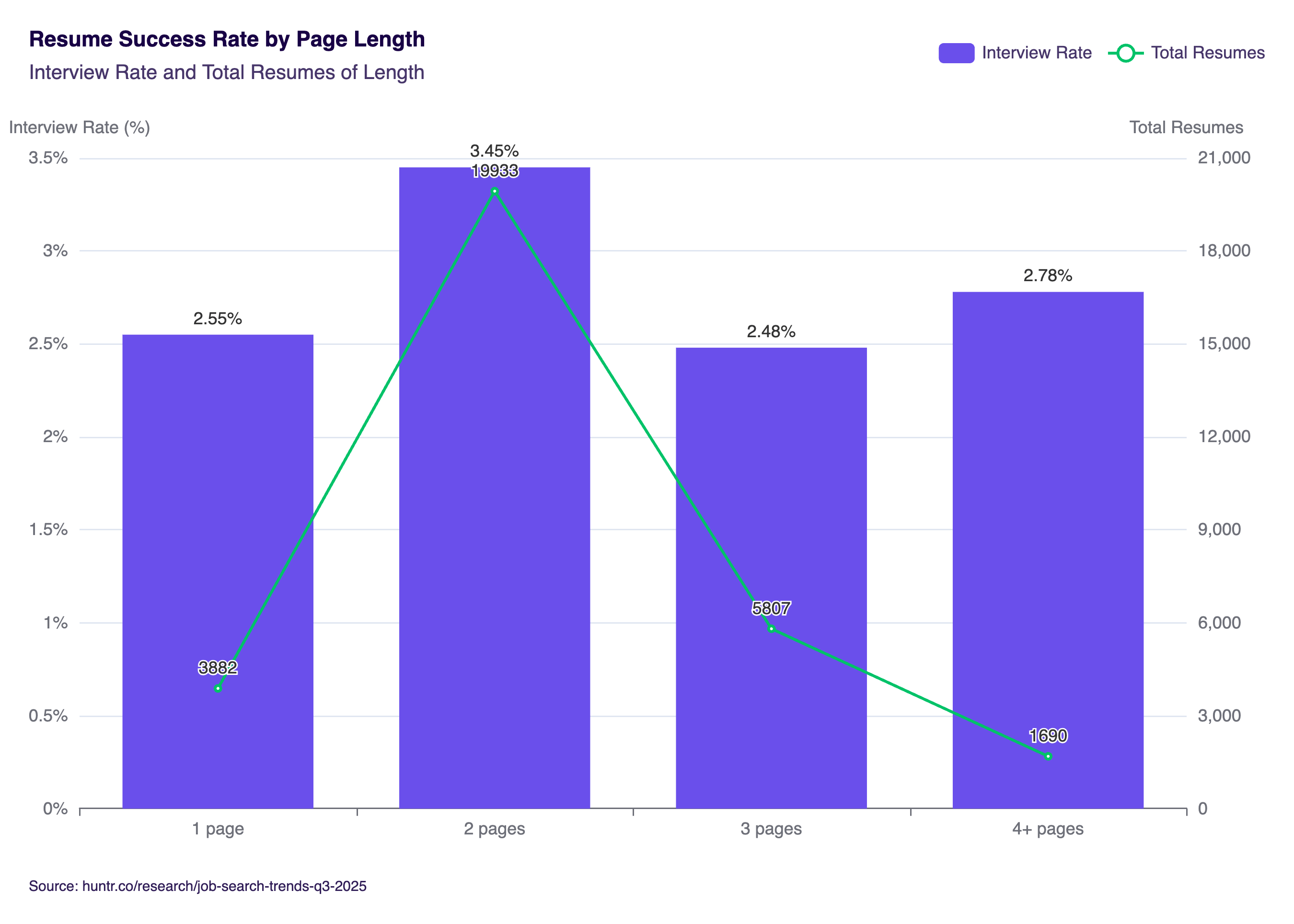
[OC] Ending the “1-page resume rule.” We analyzed 31,312 resumes submitted in Q3 2025 and found that 2-page resumes consistently perform best in getting interviews.
Posted by nomadicsamiam

![[OC] Ending the “1-page resume rule.” We analyzed 31,312 resumes submitted in Q3 2025 and found that 2-page resumes consistently perform best in getting interviews.](https://www.byteseu.com/wp-content/uploads/2025/12/mtgi4jcfi06g1-1536x1097.png "[OC] Ending the “1-page resume rule.” We analyzed 31,312 resumes submitted in Q3 2025 and found that 2-page resumes consistently perform best in getting interviews.")
[OC] Ending the “1-page resume rule.” We analyzed 31,312 resumes submitted in Q3 2025 and found that 2-page resumes consistently perform best in getting interviews.
Posted by nomadicsamiam
21 Comments
Any stats to determine significance?
Having more 2-page resumes than the other categories combined to begin with gives me pause
What can you even fit into one page resume?
Were all 4 types sent to the same job position?
The difference is only ~1% though. Considering the large number of resumes analyzed, that isn’t really a significant increase.
I’m more surprised that the longer resumes (>2 pages) did nearly as well as the 1 and 2 page resumes.
Still, this is interesting data to see.
If you have enough experience that it doesn’t fit on one page, you are going to be more qualified than someone who doesn’t
I would not hire you for a data analysis role if you jump to this conclusion based on this so-called analysis, regardless of how many pages your resume is.
Does this control for the level of experience for the candidate or role? How do we know this isn’t just the effects of entry-level roles being exceptionally competitive (and thus a lower interview rate), and perhaps their applicants are more likely to have a one-page resume?
There are so many confounding factors here, there’s no way you can come to any meaningful conclusion from that data. Here are just a few off the top of my head:
– People with longer resumes tend to have more experience, more experience usually leads to higher interview rate
– People with longer resumes tend to have PhDs: in addition to experience/education sections, they also have publication/conference/talks sections. They also are typically applying for different roles than people without PhDs. Those roles may naturally have different processes when it comes to filtering candidates and interviews
For example, current CS/ML PhDs are super in demand at tech companies, particularly those with degrees from top schools + with publications in top journals. They probably have longer resumes and probably hear back from companies more often compared to (for example) a new grad SWE with a 1-page resume. But it’s not the resume length that’s driving this discrepancy, it’s literally everything else.
Unless you account for these factors, your analysis is likely incorrect and misleading.
I have a feeling if you controlled this for years of experience it would quite drastically alter the conclusion.
The vast majority of applicants with no experience are going to be making one page resumes which I imagine impacts that interview rate.
You have 6 times the volume of a 2 page resumes over the 1 page resumes and you’re saying one category is **consistently** outperforming another? Lol.
Do you think 4+ pages outperforms the 1 page resumes as well?
If you have 10 years of professional experience, you’ll likely need 2 pages.
3 would be the absolute max but only for very specific industries that would want publications or something similar listed as well. Sometimes that can just be added as an Additional Document in the application though.
I’ve never had a one-page resume.
I think it’s a good rule to be mindful of, but as a developer, even without work experience, projects and skills can easily be most of one page.
Keep it concise, keep it clean, but if you absolutely must use a second page, then it shouldn’t kill your chances
Or people with longer resumes have more work experience and are further in their career, leading to better interviewing results?
I dont think the key takeaway is to make sure to have more than one page even if you don’t have quality relevant additions.
I always thought the ideal number of pages depends on the industry / position. I was under the impression that 2 pages is standard for software, for instance.
You put all the important stuff on the first page, and the less important details on the second page.
The recruiter looks at the first page, and if they are interested, they check the second page to see more details.
At least that’s how it works in my imagination. Not sure how it works in practice.
Do tech people even get recruited via submitting CV’s anymore? I thought it was all through LinkedIn nowadays.
ITT: angry people with 1, 3 and 4 page resumes
How did you get the test data?
Was a cover page included as one of the pages in the resume or separated?
Was this controlled for keyword matching frequency?
Was this matched for human vs automated reviewer?
I’m sure there are other more obvious covariables to control for that need to be covered.
Well it’s probably selection bias. The people with 2 page resumes today probably have more experience.
If new grads start filling up their resumes with junk, not good
We were hiring a while back and got one that was almost 20
And you better believe they fudged the formatting to cram even more in on top
I have no idea why they would even attempt that
Given the lack of error bars, there might literally be nothing to conclude here other than ‘resume length doesn’t matter’