
Over the past few years, AI technologies have developed at such a rapid rate that staying across developments in AI is not just a strategic advantage but an operational necessity to ensure competitiveness. Leading the charge are two revolutionary forms of AI: generative AI (genAI) and agentic AI.
Read more: ALSC DS Europe editor’s blog
At the ALSC Digital Strategies Europe conference, industry leaders discussed the latest in AI, data integration and supply chain visibility.
GenAI refers to models that create new content, such as text, software code, images, designs or simulations, based on patterns learned from large datasets. This includes large language models like ChatGPT and DeepSeek. Agentic AI, on the other hand, refers to AI systems that don’t just generate outputs but can plan, take actions, use tools and interact with systems to achieve goals with minimal human input.
At Automotive Logistics & Supply Chain Digital Strategies Europe, experts from the likes of BMW and SEAT revealed how they have been taking advantage of next-generation AI to improve supply chain operations and how this technology can be scaled up to maximise the benefits.
Staying ahead of the curve
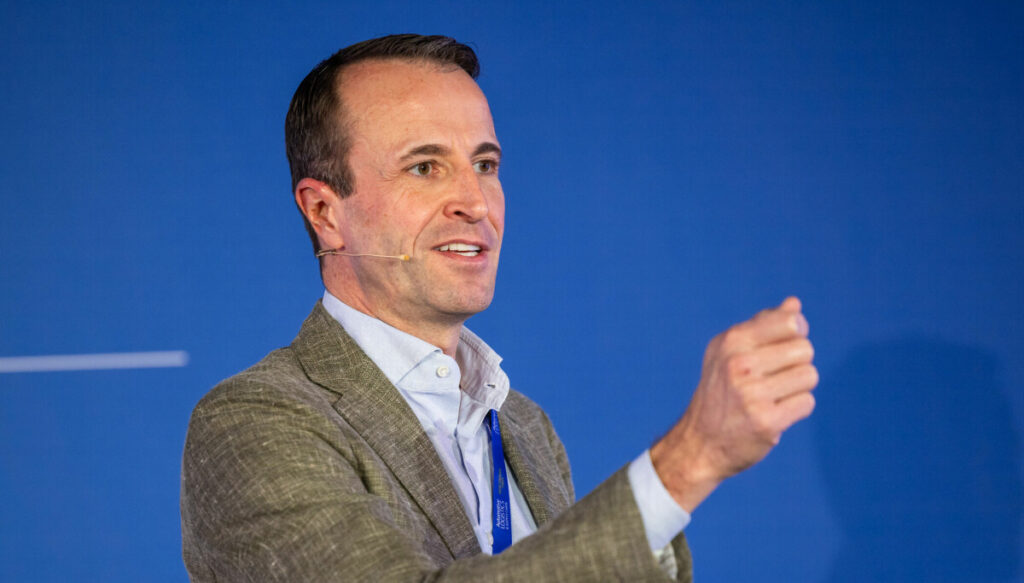
In his keynote presentation at the conference, Oliver Ganser, vice president of digitalisation of the purchasing and supplier network at BMW Group, spoke about how as BMW’s “Neue Klasse” seeks to propel the company into the future, so too must its behind-the-scenes processes.
“If we just continue as we do today, it’s too little because it’s incremental,” he said. “We have to take two steps further, what we usually feel comfortable with, and that’s key.”
Watch: BMW’s Oliver Ganser on transforming supply chains with agentic AI
BMW’s Oliver Ganser discusses how the future of the automotive supply chain will be shaped by humans alongside genAI and agentic AI, rather than in opposition.
He shared his view that investing in AI technology is essential to remaining competitive in today’s market. “The question is what are your peers from your other market participants doing in that field?” he said. “I do not want my core market participants to take a leapfrog that I cannot follow. So either I’m in or out, but this technology has the chance to bring you the next level or to bring you ten levels back.”
Ganser touched on some of the advantages newer OEMS have in this regard as a result of starting with a clean slate rather than having to transition away from legacy systems and more traditional ways of working. For example, he noted that when presented with a new volume scenario, newer OEMs from China could have an answer as to feasibility within as little as 90 minutes – a process that might take more traditional OEMs days. “That’s the level we have to think about – how fast can we react in our supply and value chain in the future?” he added.
BMW’s AI roadmap
Planning is an important part of ensuring future-readiness through the adoption of AI technologies. At ALSC Digital Strategies Europe, BMW and SEAT each shared their respective AI roadmap. Ganser outlined BMW’s three-step approach to generative AI, beginning with a stage where it can experiment. Here, BMW had a use case and was able to “play around” in a sandbox to test if it “sticks” and learn from it. At this stage, AI implementation was voluntary and sat “on top of something” existing.
Watch: ALSC Digital Strategies Europe 2025 Day 1 Wrap up
Christopher Ludwig, chief content officer at Automotive Logistics and Ultima Media provided a summary of the key themes discussed at ALSC Digital Strategies Europe Day 1.
Following on from this comes core process integration – a stage that BMW entered into at the beginning of the year. This process involves “significantly” incorporating generative AI as a “must” in BMW’s core processes, aiming to integrate AI agents not just as support, but as core drivers of processes. “It’s important that there’s no process without an agent,” Ganser said.
Looking beyond this stage, BMW will focus on agent-based organisational redesign. It intends to fundamentally reshape the organisation “from the bottom” to build it as an AI-orchestrated enterprise. Ganser acknowledged radical examples like companies claiming they could be “the first billion-dollar company with only one person” – highlighting the potential for dramatically reduced fixed costs, capital expenditure (CAPEX), and operational expenditure (OPEX). “That’s something where we have to compete in the long run,” he said.
To facilitate this transformation, BMW has developed a standardised AI platform. This platform consolidates all software and interfaces into one workplace, eliminating the need for employees to navigate multiple systems. The key innovation is introducing a middle layer with a user interface where employees can interact via a prompt bar, effectively making the agent “your buddy” and integrating it into the daily workflow.
SEAT’s AI roadmap
In addition to Ganser’s insight into BMW’s plans for the future, the conference provided the perspective of some other OEMs and their own AI roadmaps. One of these perspectives was that of Rafael Sanchez Aviles, manager of customer-driven supply chain at SEAT.
Recap blog: Insights from ALSC Digital Strategies Europe 2024
Leaders from BMW, VW, Audi and more gathered at ALSC Digital Strategies Europe 2024 in Munich, where experts discussed digital solutions for sustainable, resilient and co-creative supply chains.
Planning is crucial to SEAT’s future-readiness through AI adoption. Avias outlined a comprehensive roadmap that is designed to transform SEAT’s technological capabilities and organisational culture. The journey began with the HAi project – a company-wide programme aiming to combine human expertise and artificial intelligence that SEAT discussed at the ALSC Digital Strategies Europe event in 2024. This programme was designed to accelerate AI use across five key pillars: people, technologies, data, governance, and business processes.
Recognising the technological challenges in its logistics department, SEAT developed a nuanced approach. With an average employee age of 40 and limited tech-savviness, it created “Digital Accelerator Teams” (DAT squads) that blend IT and logistics expertise. These teams implemented comprehensive training programmes across the entire company, addressing technological fears and building AI understanding.
Watch: ALSC Digital Strategies Europe 2025 Day 2 Wrap up
Christopher Ludwig, chief content officer at Automotive Logistics and Ultima Media provided a summary of ALSC Digital Strategies Europe Day 2.
The roadmap progressed through strategic stages of digital transformation. From 2021 to 2023, SEAT focused on IT democratisation, introducing no-code systems that allowed employees to build automated processes themselves. Between 2023 and 2024, it emphasised hyper-automation, training staff to use low-code platforms and create “citizen developers” who could streamline workflows.
Currently, SEAT is at a stage in its roadmap which concentrates on AI integration and proof-of-concept implementations. It is piloting innovative projects across its supply chain including; accurate stock ordering using historical data and customer interactions; precise delivery estimation leveraging GPS and supply chain information; and a “test manager” platform for inbound logistics that coordinates dispatchers and can predict supply chain disruptions.
Critically, SEAT maintains a human-in-the-loop approach, similar to BMW. Agents support rather than replace employees, with humans retaining ultimate control and verification capabilities. The strategy aims to create an automated tool that supports decision-making, reduces manual effort and optimises key performance indicators like stock reduction and cost management.
By 2025, SEAT aspires to become a more efficient, productive and customer-centric company, with AI agents serving as collaborative partners in achieving strategic objectives. “What we are trying to do at SEAT is to accelerate our digital path and to help us just to go forward in our understanding of the situation and how can we have all the team involved in this an AI roadmap,” Aviles commented.
Register now – Building the automotive supply chain of 2026 by embracing opportunity in a more dynamic market
Gain a data-driven outlook on the automotive supply chain in 2026 as industry experts explore network redesign, predictive digital tools, mixed powertrain logistics, workforce planning and emerging growth opportunities in a dynamic global market.
What these roadmaps suggest for the industry
Across the AI roadmaps of BMW and SEAT, clear themes emerge: both view AI not as a bolt-on technology but as a long-term organisational transformation. Each roadmap begins with experimentation and capability-building, progresses towards deeper process integration, and ultimately aims for agent-driven operations.
Yet neither sees this as a purely technical shift. Cultural readiness, skills development and human-in-the-loop governance are treated as foundational pillars. Whether through BMW’s structured “operating models” or SEAT’s “Digital Accelerator Teams” and “citizen-developer” programmes, both companies frame AI adoption as a balance of ambition and discipline.
It is clear that in the near future, a people-centric approach is still necessary for OEMs, and success will come from aligning AI with business needs, redesigning processes around agent participation and preparing the workforce – both culturally and technically – to work alongside these systems.