
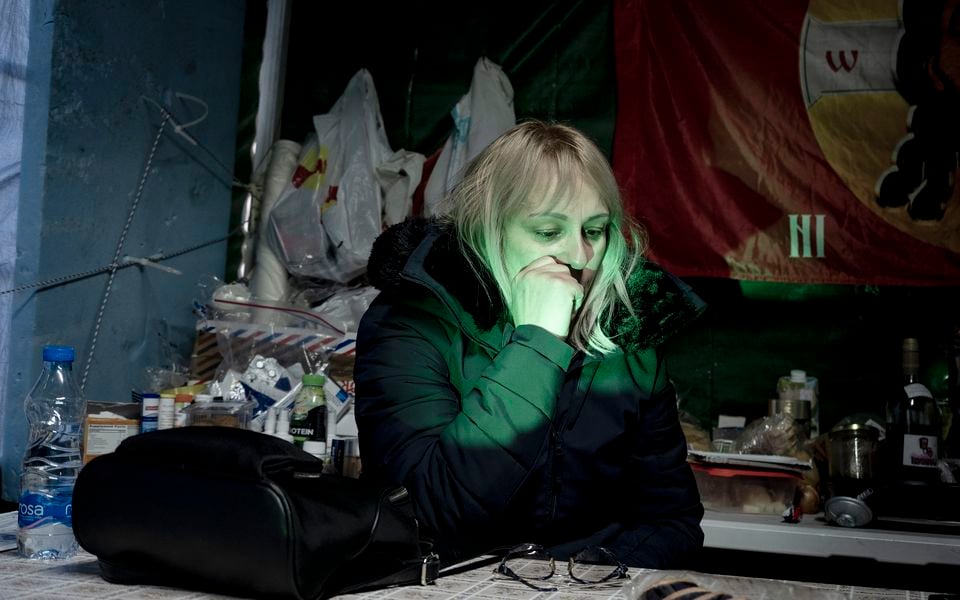
Dijana Hrka, mother of Stefan, who lost his life in the Novi Sad tragedy, sits in her tent set up in the center of Belgrade. When she learned of Panos Ruci’s hunger strike – the father of Tempe crash victim Denis Ruci – she sent him a letter of support. ‘Only someone who has lost a child can understand me,’ she says. [Enri Canaj]
BELGRADE – The time is 11.52 a.m. Residents, students, even drivers step out of their cars and stand motionless at a Belgrade intersection, observing 16 minutes of silence – one minute for each life lost. The monotonous sound of the traffic light keeps the rhythm in a ritual repeated month after month. Every day, at this very hour, they mark the moment a year ago on November 1, 2024, when a scar was etched into the country’s political history: The concrete canopy of the renovated Novi Sad railway station collapsed, killing 16 people, most of them young.
A student-led mass movement emerged, shaking Serbia to its core. Thirteen months later, Belgrade’s center is still simmering with political tension. But the main confrontation has moved to the square between the parliament building and the presidential palace. Along the avenue, now cordoned off with barriers, political opponents have pitched their camps: two rows of white plastic tents face each other. The first tent, at the start of one row and almost professionally organized, belongs to supporters of Serbian President Aleksandar Vucic. At the start of the opposite row stands a tent belonging to a woman – Dijana Hrka, mother of Stefan, who lost his life in the Novi Sad tragedy at the age of 28.
 The area where the pro-government and anti-government camps ‘meet’ in the square in front of the Parliament in Belgrade, which has remained blocked for months. [Enri Canaj]
Flowers and courage
Kathimerini meets Hrka on a cold morning at the start of the week. In her hands she holds a red plush heart – a gift left outside her tent earlier. “I receive so many gifts,” she says. Some, like bouquets of flowers and a card that says “We need you,” she keeps close. The love of the people – especially the young, whom she calls “the kids” – gives her strength to carry on.
Hrka raised her two boys alone. She had endured the hardships of the Yugoslav wars and always believed that everything could be fixed. A professional cook, she gave birth to Stefan at 20, saying she was raising a child as optimistic as herself. Stefan loved to explore the city on his bicycle and had “the most beautiful smile and the most beautiful eyes in the world.” The day she lost him was the worst of her life. When she went to identify him, she could barely make out any of her son’s features in his shattered body.
The only thing she hoped for was justice. “I expected the system to do its job: the police, the judiciary, the prosecutor’s office – to do their duty.” But what she saw, she says, was the president making statements while offering excuses. “I realized he was lying. He was trying to manipulate us.” Seeing the students take to the streets gave her courage. At first, she sent them messages of support; later, she joined them in the protests.
 Belgrade residents observe 16 minutes of silence at a central intersection in the city in honor of the victims of the 2024 Novi Sad train station disaster. [Enri Canaj]
When a year had passed since the accident and nothing had changed, she decided to take more drastic measures. “I got the idea to go on a hunger strike.” That was when she first entered this tent.
Having endured hunger during the war, she faced the ordeal with remarkable courage, drawing a crowd around her that filled the square. Even the president called her on the phone, she says, telling her he was not responsible for resolving the issue. The only ones unmoved were her “opponents,” who seized every opportunity to wage psychological warfare against her. She recalls the hardest moment: when the tents opposite hers began blasting cheerful traditional songs over loudspeakers – songs about a mother and her son. “When I saw that the state leadership didn’t care whether I lived – not just me, that human life in general meant nothing to them – I decided to end the hunger strike.”
She announced the end of her hunger strike to the assembled crowd, but promised she would not easily relinquish her “stronghold.” Now, she spends many hours each day in the tent, where she eats, meets people, and sometimes sleeps.
“I’m an economist, but I am here as a volunteer. I make tea and coffee for the supporters,” says Lidija, who greets those coming to support Hrka with a warm drink. Pointing to the white tents across the way, she makes it clear that their president is not her president, adding, “Only when he leaves will we be able to breathe freely.”
 ‘I’m an economist, but I am here as a volunteer. I make tea and coffee for the supporters,’ says Lidija, who greets those coming to support Hrka with a warm drink.
Within the movement, there is ongoing speculation about whether Stefan’s mother will enter politics. When asked, Hrka firmly denies it, explaining that the media had distorted her words when she jokingly suggested she might run against Vucic. Her primary goal is to establish an organization in Stefan’s name to help children. Yet she leaves a door open, noting that if the people need her, she will step forward. “I will be there with my people because my people were with me.” One of her key demands is the call for early elections.
The only time she relaxes and smiles is when I compliment her meticulously done nails – a volunteer had painted them while they sat together a few nights ago. “This kind of solidarity is amazing. I just wish we were as dynamic as in Greece,” she adds, expressing admiration for the massive rallies Greeks organized over the Tempe railway disaster. When she learned of Panos Ruci’s hunger strike – the father of Tempe crash victim Denis Ruci – she sent him a letter of support. “Only someone who has lost a child can understand me,” she says.
Even as our conversation ends, she doesn’t take a moment’s rest. She steps out of the tent and speaks to the media gathered outside, commenting on the results of local elections in a municipality that voted just the day before.
“I feel lucky to be able to cover historical moments,” says Tamara Stojanovic, one of the journalists present. As a reporter for the TV station N1, she has covered all the rallies organized by the movement. When I ask about Hrka’s influence, she says she believes the mother inspires people, and may have even changed the perspective of some citizens who had been afraid to take to the streets. “There is a lot of tension between supporters of the two political camps,” Stojanovic explains. This polarization directly affects her life and work, as she faces intense political pressure, while pro-government media do not hesitate to post photos of her and her colleagues online, commenting on their reporting.
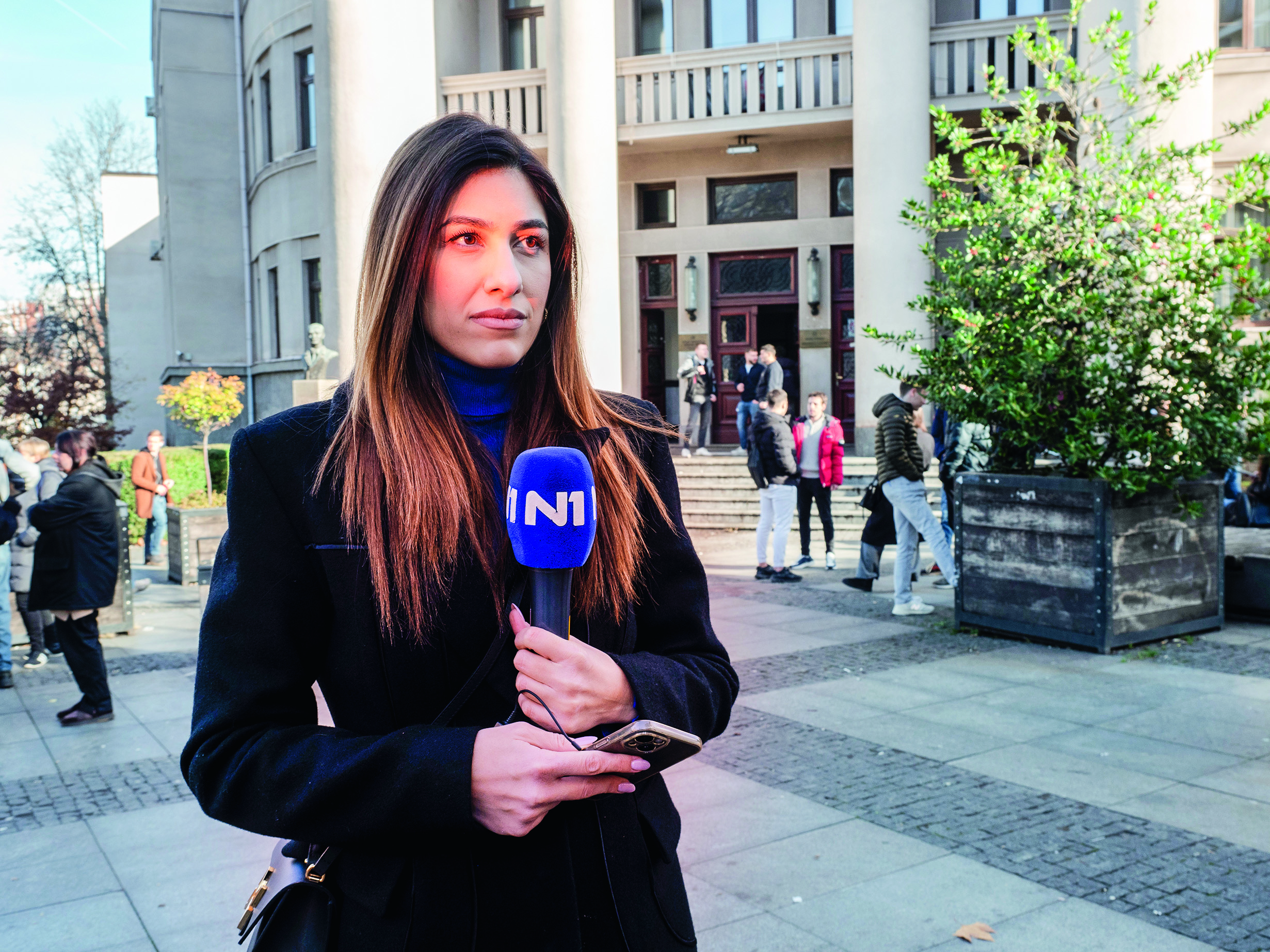 ‘I feel lucky to be able to cover historical moments,’ says Tamara Stojanovic, one of the journalists present. As a reporter for the TV station N1, she has covered all the rallies organized by the movement. [Enri Canaj]
The ‘guards’
Walking through the pro-government camp, it quickly becomes clear that we are not welcome. “Here we support the president. The students’ right to study. But no photos,” says a stern man as he approaches us, noting our presence in the group of roughly 50 gathered there. On the other side, two men of similar build – self-described war veterans – stand guard at Hrka’s tent, claiming they are there to protect their “sister.”
Srdjan Cvijic, political scientist and president of the International Advisory Committee of the Belgrade Center for Security Policy (BCSP), says the government has used the presence of these men to portray Hrka and her supporters as nationalists and pro-Russian. “It is a challenge for the president how to handle Dijana Hrka, because a grieving mother is a figure who commands respect even among his own electorate.” Cvijic notes that her presence gave momentum to the movement at a moment when it was losing steam. Yet, he identifies a core problem: the lack of a viable alternative, as the anti-government wing is essentially fractured.
Hrka herself says she will remain in the tent a little longer. After that, she plans to take on other initiatives, though “it is still too early to speak” about them. The vigilance of her activism helps her, among other things, to cope with the sharp pain of loss, which resurfaces when she is alone. But it is not her personal tragedy that drives her. “I believe that one day it will be better for all of us, especially for our children, and in the face of that, nothing feels impossible.”