
Introduction: A Heating Market Powered by Innovation
In an increasingly fast-paced world, one kitchen appliance has quietly become a global necessity—the microwave oven. Once viewed as a simple tool for reheating leftovers, today’s microwave ovens have evolved into powerful, multi-functional cooking systems equipped with smart sensors, grilling features, energy-efficient technologies, and even AI-enabled capabilities.
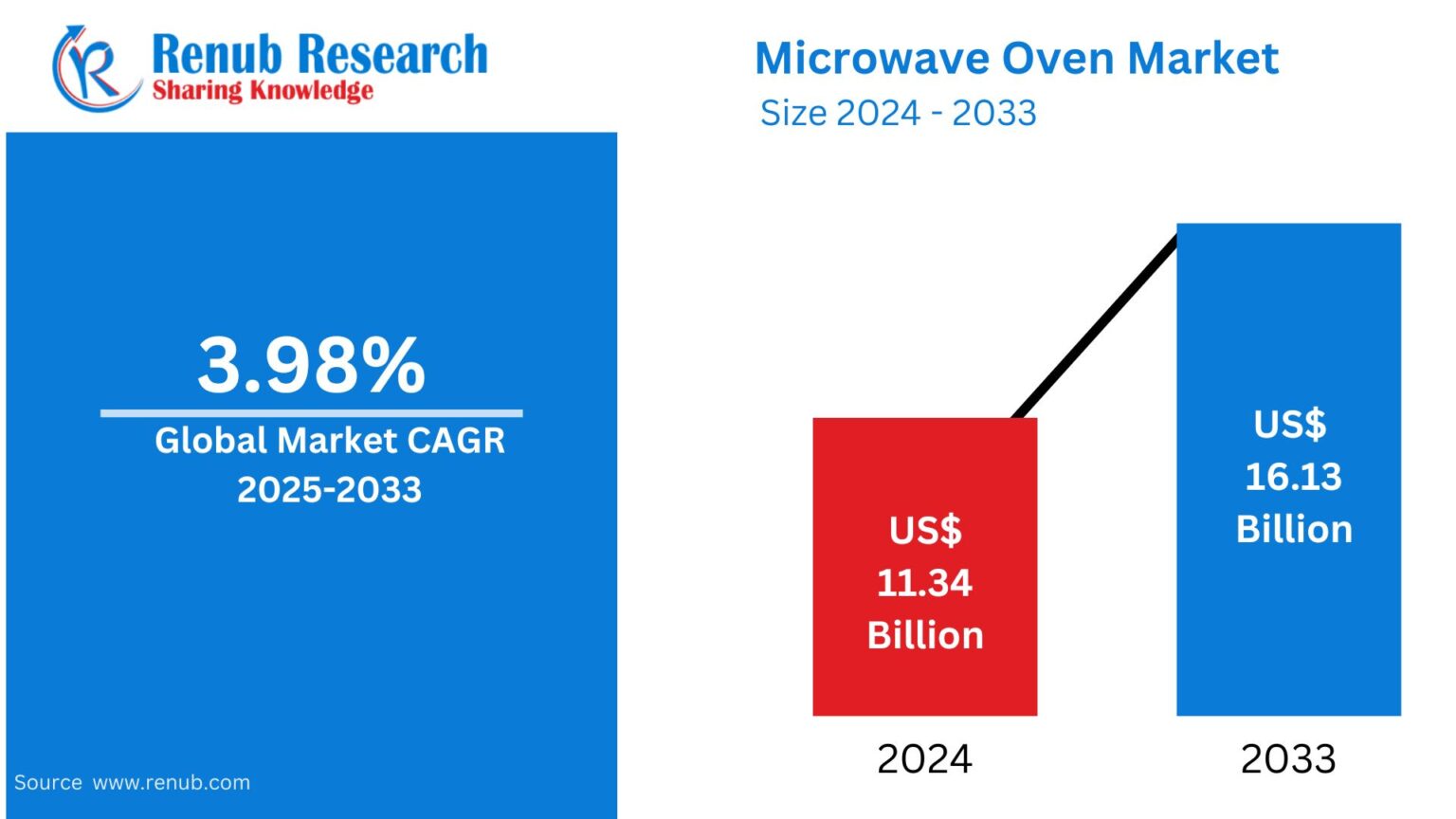
According to Renub Research, the global microwave oven market is set to grow from US$ 11.34 billion in 2024 to US$ 16.13 billion by 2033, representing a steady CAGR of 3.98% during the forecast period (2025–2033). The industry’s expansion is fueled by rising disposable incomes, the shift toward modern kitchen appliances, and technological innovations appealing to both households and commercial foodservice operators.
From small city apartments to sprawling smart homes, microwave ovens have cemented their place as essential tools for modern living—making cooking faster, simpler, and more efficient than ever before.
Understanding the Microwave Oven Advantage
A microwave oven works by using microwave radiation to heat food from the inside out. The microwaves cause water molecules within the food to vibrate rapidly, producing heat that cooks food evenly and efficiently. This technology enables:
✔ Quick reheating
✔ Fast defrosting
✔ Faster and energy-efficient cooking
✔ Versatility through convection, grilling, and smart sensor functions
What started as a convenience gadget has evolved into a multi-purpose appliance that now supports thousands of households, offices, university dorms, hotels, and food service kitchens worldwide.
Key Market Drivers: What’s Powering Global Demand?
1. The Need for Fast and Convenient Cooking
The world is cooking less but eating more frequently—a shift deeply influenced by busy schedules, dual-income families, and changing social norms. Microwave ovens address the modern demand for:
Quick meal preparation
Hassle-free reheating
Time-saving defrosting
Multi-functional cooking for smaller kitchens
Urban consumers, particularly in fast-growing markets, value the speed and effort savings microwaves offer. As lifestyles become even more fast-paced, demand for compact, high-efficiency appliances continues to rise globally.
2. Rapid Urbanization and Rising Disposable Incomes
Regions like Asia-Pacific, Latin America, and parts of the Middle East are witnessing unprecedented rates of urbanization. As homes become smaller and lifestyles more hectic, compact, multi-functional appliances like microwave ovens become essential.
Higher disposable incomes also encourage households to upgrade to premium microwave models featuring:
Convection functions
Grilling capabilities
Smart controls
Multi-stage cooking
For middle- and upper-income consumers, microwave ovens are no longer luxury items—they are practical necessities.
3. Technological Advancements and Smart Cooking
The evolution of smart home ecosystems has fully reached the kitchen. Today’s smart microwave ovens offer:
Wi-Fi connectivity
Voice controls (Alexa, Google Assistant)
Touch-screen interfaces
Smart sensors for precise cooking
AI cooking guides
Energy-efficient operation
Some models can detect food type, adjust cooking automatically, prevent overcooking, and send alerts directly to smartphones.
One standout innovation arrived in 2023, when Samsung introduced its Bespoke AI Oven, featuring a built-in AI camera that recognizes ingredients and provides personalized cooking recommendations.
These advancements are redefining the cooking experience, appealing to younger, tech-savvy consumers and contributing significantly to market growth.
Market Challenges: Obstacles the Industry Must Navigate
1. Intense Market Competition
The microwave oven industry is crowded with global giants and emerging low-cost brands. Companies like Samsung, LG, Panasonic, Whirlpool, and Midea are under pressure to:
Maintain competitive pricing
Offer differentiated features
Meet regional preferences
Continually innovate
Price-sensitive consumers often choose budget models, affecting the sales of premium, high-tech solutions.
2. Sustainability and Environmental Concerns
As global awareness of environmental impact rises:
Electronic waste management
Energy efficiency
Recyclable components
Product longevity
have become major considerations.
Consumers favor brands that prioritize sustainability, pushing manufacturers to adopt eco-friendly materials and comply with stricter global regulations—raising production costs and reshaping competitive dynamics.
Smart Technology: A Game Changer for the Microwave Oven Industry
The integration of AI and connectivity has elevated microwave ovens into the realm of smart appliances. Modern features include:
Customizable cooking presets
Auto-cook programs
Real-time smart diagnostics
Overheat prevention
Smartphone alerts
Smart recipe guidance
In 2023, Samsung’s Bespoke AI Oven and Xiaomi’s smart MIJIA multipurpose oven showcased how advanced sensors and AI recognition can transform meal preparation. These innovations appeal strongly to millennials and Gen Z consumers who appreciate convenience paired with cutting-edge tech.
Regional Market Outlook: Country-Level Growth & Trends
United States
The U.S. remains one of the strongest markets globally, driven by:
Busy lifestyles
High demand for convenience cooking
Strong adoption of smart home appliances
A growing frozen and ready-to-eat food culture
With a well-established retail and e-commerce ecosystem, microwave ovens have near-universal accessibility. Workforce trends—particularly the rise of women in employment—further accelerate demand.
Industry Note:
In January 2022, Whirlpool sold its historic Cleveland, Tennessee campus, continuing its modernization and logistics upgrades across the U.S.
Germany
Germany is a leader in Europe’s microwave oven market, characterized by:
Demand for eco-friendly and energy-efficient appliances
Strong preference for premium brands
Smart kitchen system integrations
Compact, multifunctional appliances for urban homes
In July 2023, Küppersbusch launched a graphite-finish compact microwave tailored for small European kitchens, highlighting Germany’s push toward high design and efficiency.
China
China dominates the Asia-Pacific market due to:
Rapid urbanization
A growing middle class
High demand for ready meals
Deep penetration of e-commerce platforms
A strong manufacturing ecosystem
Chinese brands like Midea and Xiaomi offer feature-rich microwave ovens at highly competitive prices, expanding market reach.
In June 2023, Xiaomi launched its smart MIJIA multipurpose oven, further boosting innovation in the domestic market.
United Arab Emirates
The UAE is one of the fastest-growing Middle Eastern markets, driven by:
High-income households
Expanding hospitality and foodservice sectors
A multicultural population favoring convenience meals
Luxury home appliance trends
In September 2024, LG Electronics introduced a sleek built-in microwave oven designed for premium kitchens, signaling the region’s shift toward integrated cooking systems.
Brazil
Brazil leads South America’s microwave oven market thanks to:
Rapid urbanization
A rising middle class
The popularity of quick meal solutions
Increased dual-income households
Affordable microwave models are in strong demand, making Brazil one of the most promising growth areas in Latin America.
Industry News: Innovations & Strategic Moves by Key Players
Leading companies in the global microwave oven market include:
Illinois Tool Works Inc.
Sharp
LG Electronics
Whirlpool Corporation
GE Appliances
Panasonic Corporation
Samsung Electronics
Midea Group
Recent Developments
Kraft Heinz (Sept 2023)
Launched the innovative 360CRISP microwave platform enabling crispy-textured foods directly from the microwave. This technology debut began with LUNCHABLES® Grilled Cheesesies.
Whirlpool (Aug 2023)
Unveiled a 20L solo microwave with 21 auto-cook menus, defrost function, LED display, and compact energy-saving design.
LG Electronics (Aug 2023)
Introduced energy-efficient home solutions supporting the ‘Net-Zero House,’ reinforcing commitments toward sustainability.
These updates reflect a clear industry direction toward smarter, greener, more consumer-friendly appliances.
Market Segmentation
Type:
Grill
Solo
Conventional
Application:
Commercial
Household
Structure:
Built-In
Countertop
Power:
Up to 700 W
701–900 W
901–1000 W
Above 1000 W
Distribution Channel:
Online
Offline
Countries Covered:
North America, Europe, Asia-Pacific, Latin America, Middle East & Africa.
Final Thoughts: The Future of Microwave Cooking
The microwave oven market is steadily expanding—not through dramatic leaps but through consistent evolution driven by global lifestyle changes. As consumers demand faster cooking, healthier heating options, and smart home integration, manufacturers continue to innovate with AI, connectivity, energy efficiency, and premium design.
By 2033, microwave ovens will be more than kitchen appliances—they will be connected culinary partners capable of learning user preferences, automating recipes, and integrating into broader smart home ecosystems.
With strong global demand, rising technological sophistication, and a push toward sustainability, the microwave oven industry is heating up for a dynamic decade ahead.