
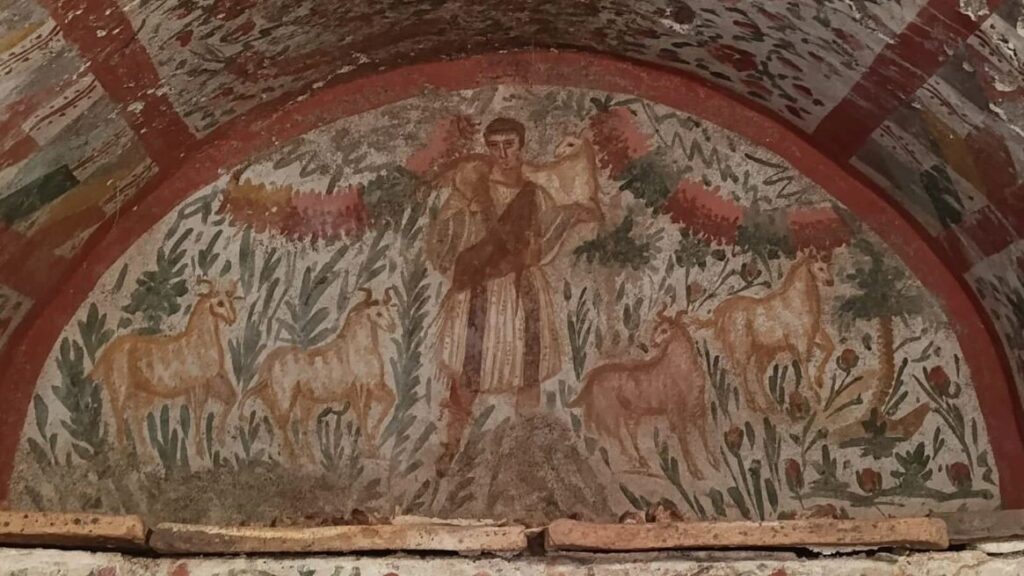
NICAEA, Turkey — One week after Pope Leo XIV’s visit to Nicaea (İznik), an underground tomb was uncovered in the Hisardere Nekropolü, revealing an extraordinary archaeological discovery. The significance lies not in the tomb itself but in the artwork inside — a painted “Good Shepherd” figure believed to be the only known example of its kind ever documented in Anatolia.
The Hisardere Nekropolü served as a shared burial ground for both wealthy families of Nicaea and lower-income residents between the 2nd and 5th centuries AD. Among the excavated structures are the distinctive terracotta-roofed chamber tombs for which the city is known.
The newly uncovered tomb, found during the 2025 excavation season, is notable for its remarkably preserved wall paintings. It is aligned along a north-south axis, with its southern wall heavily damaged, while the eastern, western, and northern walls remain largely intact with fully preserved frescoes.
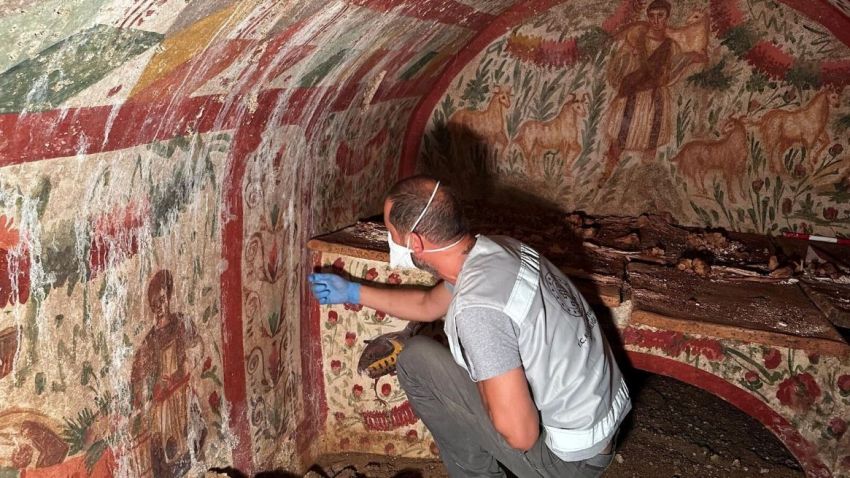 An archaeologist works on the frescoes found in the tomb in Nicae (İznik), Turkey (Image: Turkish Culture and Tourism Ministry)
These three walls, along with the fresco-covered ceiling, stand out from other tombs in the region due to their detailed human figures. A clay-tile-covered klinē occupies the northern side of the chamber, marking where the deceased would have been laid.
On the northern wall behind the klinē, archaeologists uncovered a striking scene of the Christ the Shepherd, an exceptionally rare depiction in Anatolia. The fresco shows a youthful Jesus dressed in simple robes, carrying a horned goat across his shoulders, with pairs of goats positioned symmetrically on either side. This artwork represents one of the rare images of Christ wearing a Roman tunic and offers important insight into early Christian art and iconography in Anatolia.
It is the first tomb in the Hisardere Nekropolü to feature a portrayal of Jesus, marking a significant addition to the region’s archaeological and religious heritage.