
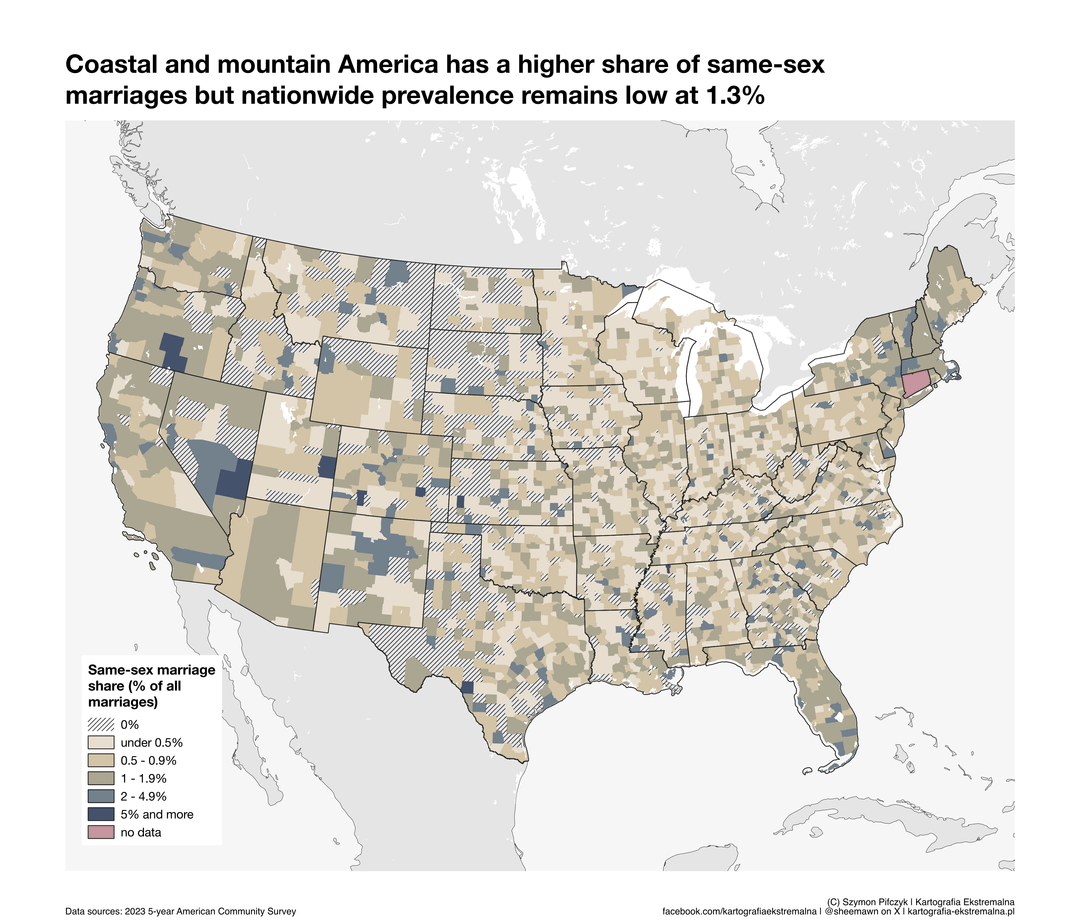
In the US, 1.3% of married couples are same-sex according to the 2023 ACS data. Unsurprisingly, the gayest areas include major cities such as DC, San Francisco and New York City, thought there are a few smaller counties where more than 5% of marriages were estimated to be same-sex. In many rural counties, no marriages were same-sex.
Among counties with at least 50,000 marriages, the least same-sex ones were Warren Co., OH (exurb of Cincinnati) and Hamilton Co., IN (suburb of Indianapolis that includes Carmel).
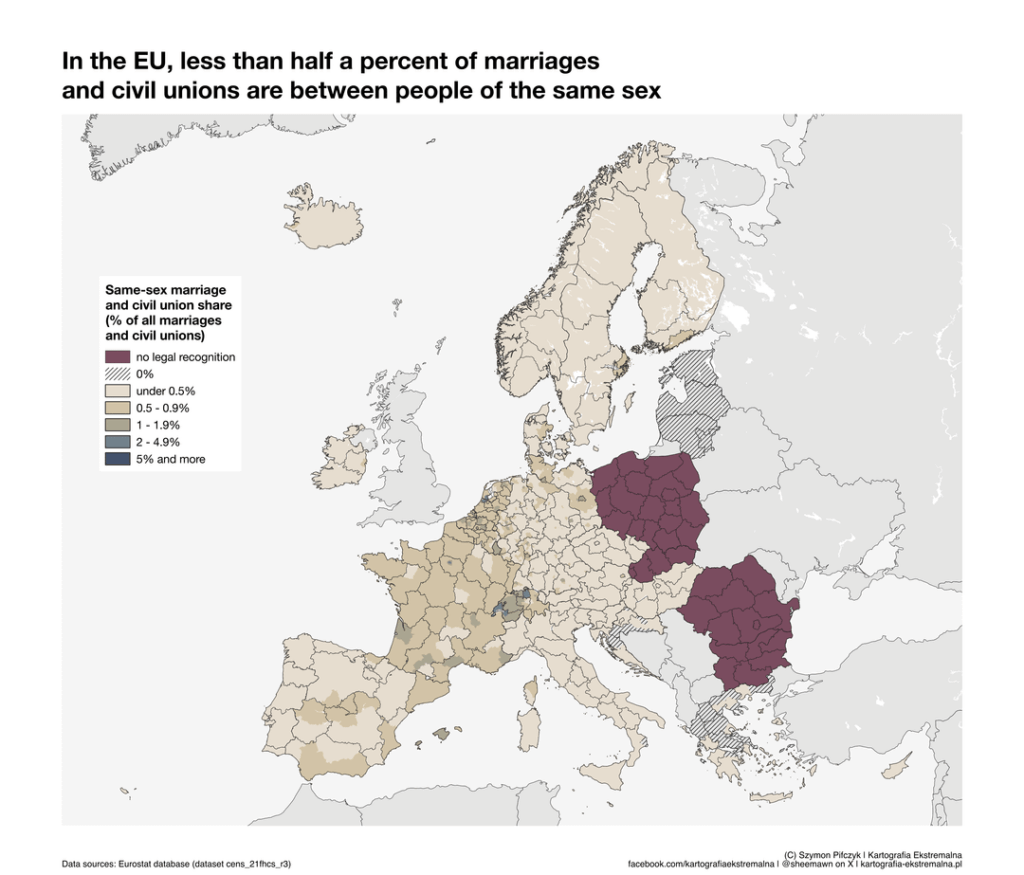
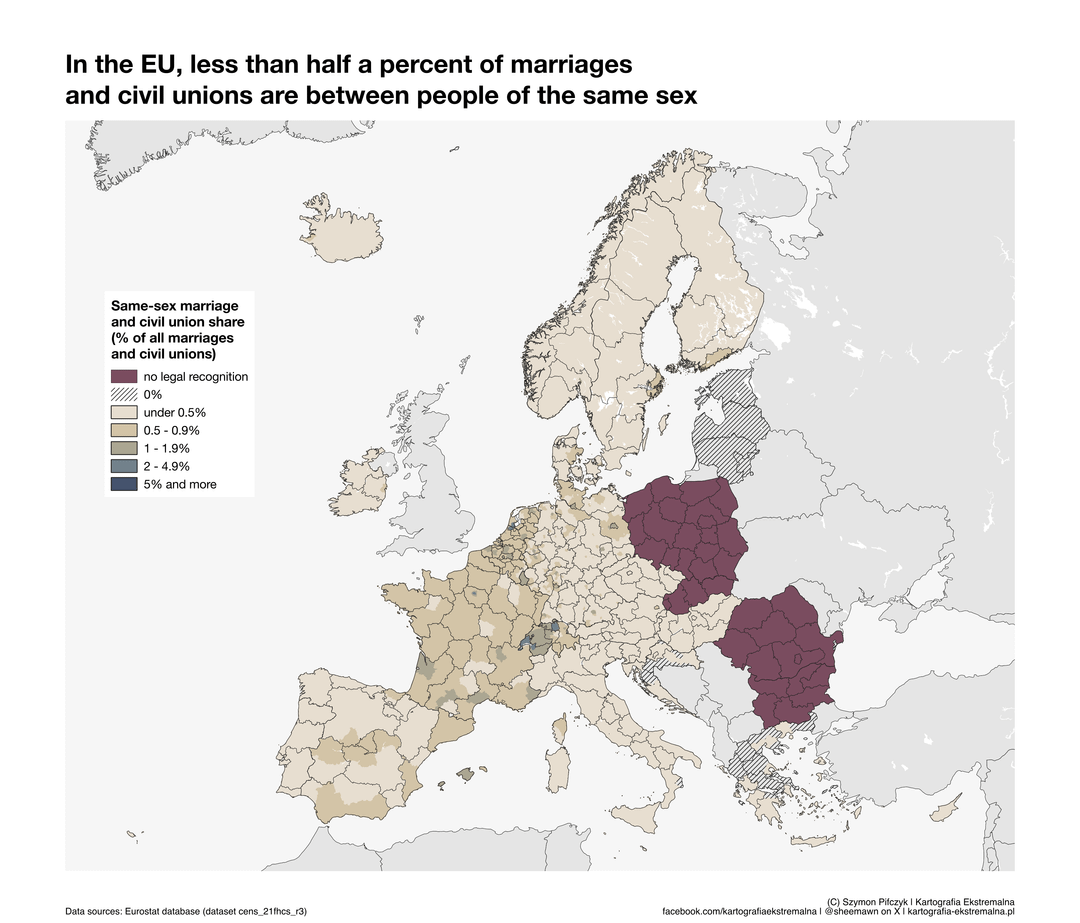
Incidentally, in these US counties, the prevalence of same-sex marriages was the same as the EU's average – 0.4%. In the EU, Paris is the gayest city, with 3.7% of marriages or civil unions there being same-sex. Amsterdam is second (2.1%) and Cologne third (1.6%). Outside of the EU but still in the EEA, Switzerland has a surprisingly high share of same-sex couples: 1.5% on average, with 2.5% in Zurich and over 2% in Vaud and Basel.
Some EU member states still do not recognize same-sex marriages or civil unions. These are: Poland, Romania, Bulgaria and Slovakia. Excluding them, same-sex marriage or civil union prevalence rises slightly in the EU, to 0.46%, but is still nowhere near the US prevalence.
Sources: for the EEA data is from Eurostat, dataset cens_21fhcs_r3. For the US, source is 5-year 2023 American Community Survey, dataset B09019.
Posted by szyy
32 Comments
My guess is marriage is more common in the U.S., period.
People who already get health care are less likely to pair up for health insurance.
There are a lot of societal/economic conventions that an American might need through marriage, that Europeans don’t.
Why is it so high in Switzerland, is it because it just was legalized there and or due to the high expat population or is it something else?
Why use such shitty colours
So…Americans are gay?
What is a civil union in this context? I think in some country that means a marriage that doesn’t use the name of marriage for sensibility purposes, is this correct?
But it also makes sense, the US tends to require a lot more formality when it comes to the recognition of couples by the state, meanwhile in much of Europe (and of course South America) such formalities are not always needed, so big formal marriage is not as popular and people just live together without waiting to get the blessing of the state, knowing their rights and all. My speculation of course, but it makes sense rhat the factors that lead straight couples to choose that path are even more attractive to same sex couples.
I think this happens also because queer folks just don’t care about marriage as much as straight people do. I’m not from the eu but that’s the sentiment amongst my friends and we’re all gay.

Atrazine is banned in the EU. Duh
Good
Its still illegal in Eastern EU
The people who get married in Europe tend to be more socially conservative, while everybody gets married in the U.S., to include those who tend to be more socially progressive, like same-sex couples.
In support of this theory, the rate of same-sex preferences is only slightly higher in the U.S. A quick Google search says about 9% in the U.S. compared to 6-7% in Europe.
‘More common’ doesn’t look like a good comparison method, you’re not taking into account a lot of factors the most obvious to me the fact that in many countries of EU the laws changed so many years later
Brokeback had one hell of an influence I guess, god damn.
Thank God
Why is nobody talking about Connecticut randomly not having data.
What’s the percentage of representation in TV, movies, games and other media though?
Romania mentioned!!🇷🇴🇷🇴🇷🇴🇷🇴🇷🇴🇷🇴
Generally marriage is not such a big thing in Europe as in the US.
Me and my partner have been living together for 11 years, not married and not planning to get married anytime soon.
There’s so much coping in this comment section, I know the United States might put an outwardly conservative image, especially with our current administration, but the average individual American, even among conservatives, doesn’t really care about gay marriage anymore. Of the LGBTQ lineup, the L and the G are the easiest concept for most folks to grasp.
Connecticut joining the No Data gang with Greenland, Western Sahara, and North Korea brings me some delight.
I dont think it means much, the US has a much stronger ”marriage” culture narrative than other countries have.
A lot of Europeans don’t get married. There are no benefits to it. In Sweden, everyone pays their own taxes, there is no “married filing jointly”. Also, they have their own medical insurance, so marriage is not a benefit.
Can’t speak for all of the EU. But where i live marriage in general isn’t very popular.
Doesn’t feel like the best comparison, but I can’t put my finger on why. You do some level of subsetting at one point to keep only EU regions where it is legal.
I think I’d rather see the graph normalized to something like “number of same sex marriages per 50,000 marriages” rather than an overall percentage.
I think it would also be more reasonable to restrict the analyses to “similar” regions; major cities, rural areas, etc. some of this feels like there is a confounding factor not being accounted for. It just seems… unlikely… that some populations are more gay than others. Maybe this could benefit from some modeling where marriage and homosexuality rates are considered.
In the US it is easier to adopt if married. Is this the same in the EU?
In the US many essential services such as health insurance are connected to formal marriage status, preventing unmarried partners from being included in workplace health coverage, and without a public healthcare system, official marriage frequently becomes a practical requirement. European countries don’t require you to show a marriage certificate to afford a hospital visit so it’s easier to have a relationship without legal ties.
This seems to be more about for which marriage is more important. In most of Europe marriage is a dying institution, whereas it’s still strong in the US.
Gay people in Europe don’t need to get married to get health insurance
What I take from this: “In the EU, Paris is the gayest city”
What’s up with those counties north of Vegas, and the random counties in Utah and Montana having a lot of gay couples?
<Paris is the gayest city
Everything I need know