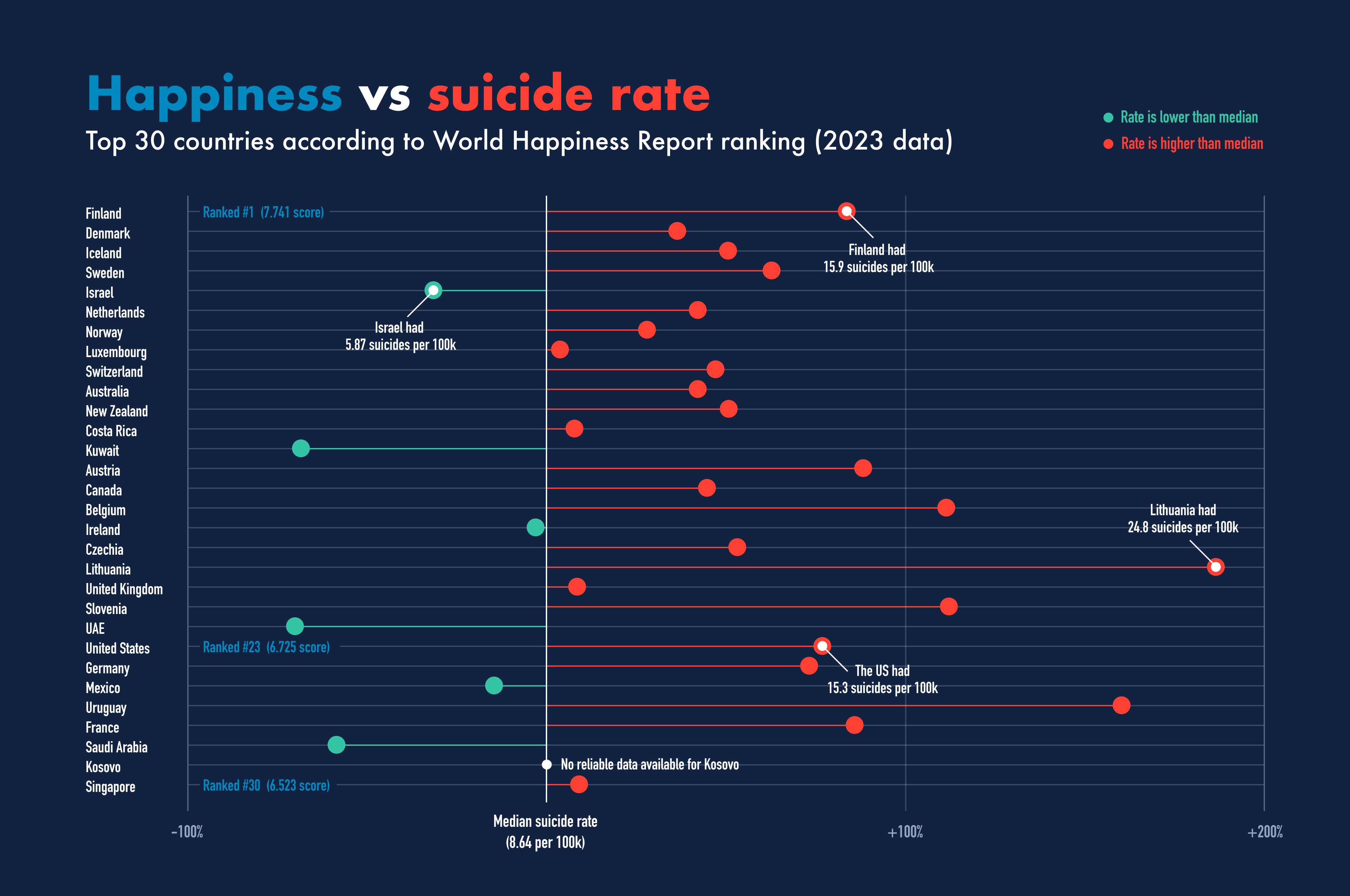
Countries with the top 30 happiness scores from the World Happiness Report and their suicide rate.
Posted by randomusername3OOO

![[OC] Happiness index versus suicide rate by country](https://www.byteseu.com/wp-content/uploads/2025/12/uh5xcy389l6g1-1536x1020.png "[OC] Happiness index versus suicide rate by country")
Countries with the top 30 happiness scores from the World Happiness Report and their suicide rate.
Posted by randomusername3OOO
32 Comments
i mean unless zero people off themself you can always make this graph and half the countries will always be in the red
I’d guess by the chart title that we’d be graphing happiness too, but guess not
wild how the nordics rank super high in happiness but sit above median on suicide – classic reminder that reporting accuracy, cultural openness about mental health, and alcohol/sunlight all play bigger roles than ppl expect
Could you do this with the countries sorted by distance from the equator?
Interesting correlation between low reported suicide rates and highly religious countries where family members would have a strong cultural incentive to lie about whether a death was a suicide or an accident.
Where is the happiness scale in the happiness vs suicide chart?
Looking at countries on the left, this entire graph is garbage.
From the graph you could conclude any of the :
– Northern countries suicide more, probably due to lack of sun
– Very religious countries suicide less, either because suicide is shameful and underreported by the families, either because people are afraid to go to hell if they suicide.
So you’re saying suicide is the key to happiness
The happiest countries have questionable uhh.. well.. anyways, 2 of them are monarchies so I’m sure *every citizen is totally content* and theres no error in reporting
Feeling pretty unhappy myself.
Turns out if all the unhappy people kill themselves the average happiness goes up
Not that many suicides in UAE. But lots of tall buildings, lots of labor abuses, and lots of “accidents”.
Happiness is a vague, fuzzy, culturally-tied concept. Pretty much every survey that measures it and compares it across countries is noise.
It doesnt surprise me that the relationship to suicide rate is all over the place.
The country at the bottom of this graph even proved this point by doing their own survey where they came out at number one.
As I recall, the first thing they taught us during our undergraduate Sociology course was about Durkheim’s 1897 study of suicide. In particular, we focused on how unreliable the stats probably were because they relied on coroners’ reports and suicide is often very difficult to accurately classify. Indeed, cultural/religious influences may exert a lot of pressure on officials to not classify deaths as suicide. The whole thing is regarded as an object lesson in how official statistics are often compromised from the get go.
Is it correct to assume that these are ordered by happiness ranking, that the top country is 1st in happiness, the bottom is 30th, etc?
(I shouldn’t have to be guessing at this, BTW)
Uruguay seems like a odd outlier to me.
It seems like nations with strong ties to a religious tradition are somewhat protected from high suicide rates. Maybe Uruguay isn’t as Catholic as I think it is.
No surprise that religious countries have less suicides… or less reported suicides.
what this shows is the countries that are not doing a good job counting the suicides
Suicide rate is an objective measure, happiness is a subjective measure. Turns out, there is little to no correlation. Who knew.
wtf how could anyone possibly fail to make this a scatterplot?!?!?
The “World Happiness Report” is a joke. It measures “life satisfaction” – meaning, given your circumstances, how satisfied are you with your life – not happiness. By that metric, a homeless person getting three hots and a cot in prison would rank high on the “happiness” scale. Living in Uganda and having both your hands would be a 10.
Nordic countries aren’t “happy” because they’re so gleeful, but because Socialism has given everyone everything they’re ever going to get. What the World Happiness Report actually measures is the difference between the heights you’re able to achieve in your society versus your personal opportunity to achieve it. Americans are often rated quite unhappy because we dizzying heights we could possibly achieve, but most of us lack the opportunity to do so. Nordic countries don’t have nearly as many opportunities (less than 1/5th the number of new businesses for instance) so it’s much easier to reach as high as you’re ever going to get. The high suicide rate is just a perfect reminder that that’s not enough for a lot of people.
Does this data include legalized forms of suicide like Canada’s MAID (medical assistance in dying), which now constitutes a substantial fraction of all deaths in the country?
Does this include assisted suicide for the terminally ill and which of the countries listed allow it?
I have some questions regarding the data. What does median represent here? Is it the median suicide rate for the 30 countries presented or worldwide? Why is Kosovo included, but there is no data avaliable?
Meh. Need to control for income, inequality, elevation (one of the biggest predictors of suicide), etc.
I have a feeling this is fairly cultural. Given most of these countries are European or western culture, and most of those are extremely high aside from Uruguay, and other countries are lower or around average is very interesting. Something about western culture makes people want to kill themselves 🤔
I really like this graph OP! It’s clearly showing some structuring, but that’s part of what makes it a nice visual tool. Opens a lot of discussion and further dissection of the data to understand reporting and definition of suicide, cultural attitudes towards suicide/suicidal people (open vs hiding), culture attitudes towards happiness reporting or the metrics incorporated into that obviously subjective measurement, resources available to people in that country who are struggling, stratification of experience within different groups within each country, etc.
What I would like to see is some way to distinguish midline “noise” from signal. Maybe something like a least squares, or a shaded interval that includes those values essentially on the diagonal vs those that are outliers in one direction or the other.
Based on a comment you have in thread, I also think that the center line (average suicide rate) should be computed from a more global average than just the average of these 30 countries. That will allow you to interpret whether there actually is suicide rate inflation with happiness index or if the median is simply being pulled towards zero by the presence of low outliers.
I mean, regardless of where you fall on the Israel/Middle East conflict, I’m a little surprised to see Israel so high in happiness… given the sort of constant threats from neighboring countries and Iran.
https://preview.redd.it/8tg37s5ekl6g1.jpeg?width=421&format=pjpg&auto=webp&s=f50f1139c2c577d43f1a089b0d0e1a4f5c11b5ef
Can’t report that you’re unhappy if you’re dead.
So apparently Icelanders don’t do suicide at all
Would like the see this with Clinton associates removed*