
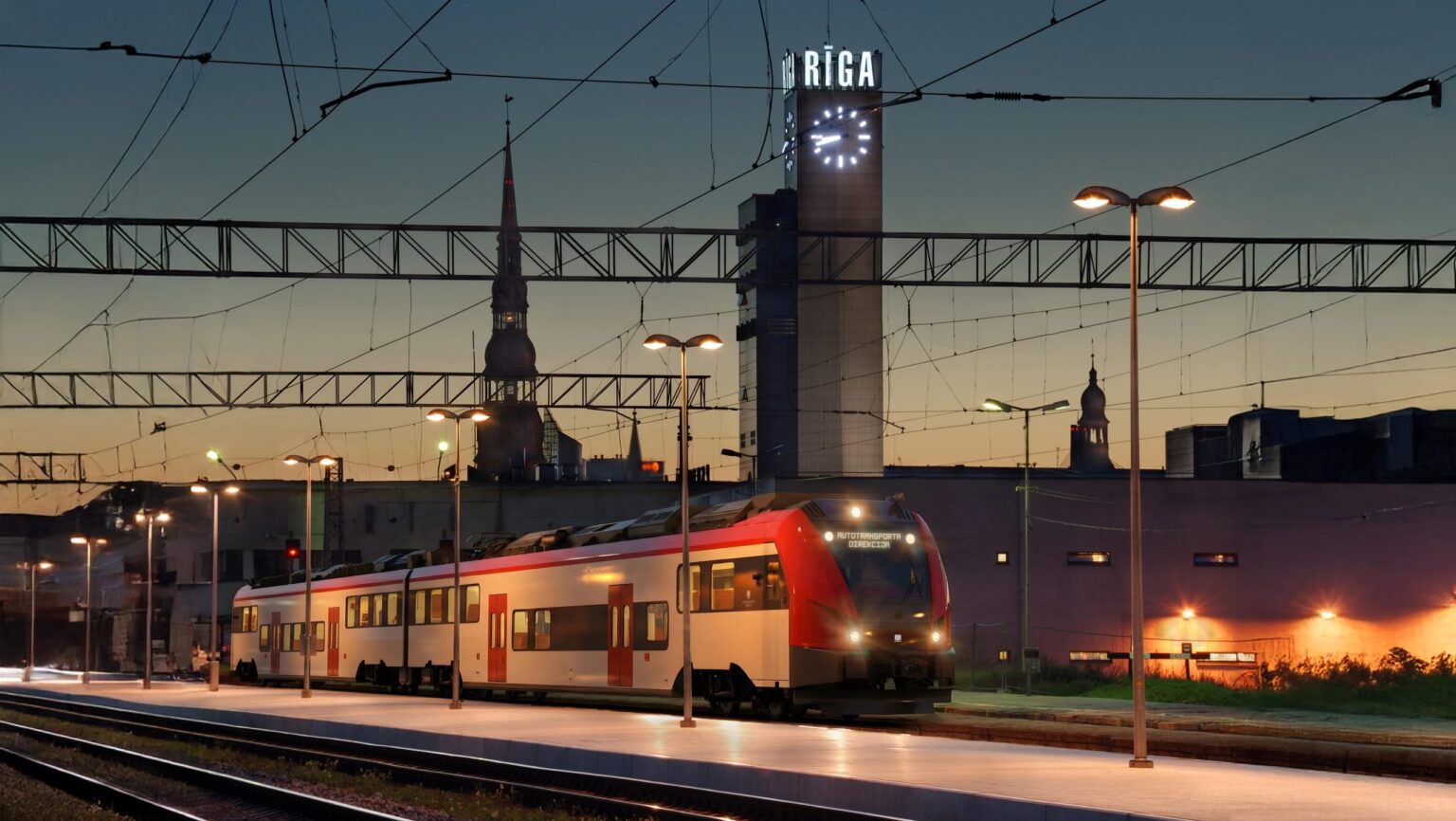
Latvia has awarded Czechia’s Škoda Group a contract to supply up to 16 battery electric multiple units (BEMUs) for regional transport, with the total contract worth nearly €160 million. With nine trains already locked in, the first trains are set to hit the tracks in 2029.
Latvia has awarded Czechia’s Škoda Group a contract to supply up to 16 battery electric multiple units (BEMUs) for regional services, in a deal worth nearly €160 million. The base order covers nine trains valued at €89.4 million, financed through the European Union Cohesion Fund and national funding, with the first units due to enter service in the first half of 2029 and all base-order trains delivered by the end of that year.
Latvia’s state-owned public transport authority, Autotransporta direkcija (ATD), which is responsible for organising regional bus and rail services, signed off on the order on Thursday. Beating competing bids from Spain’s CAF and Stadler Polska, Board Chairman Jānis Lapiņš hailed the Škoda signing as a “significant investment” in the country’s rail network, which he described “as the backbone of public transport.”
Replacing ageing diesel fleets on key corridors
The new BEMUs will operate on primarily non-electrified routes, mainly along the corridors to the southern city of Daugavpils and the northern town of Cēsis, where dedicated charging infrastructure will be installed. Today these lines are served by 23 diesel trains built between 1980 and 1992; the nine new BEMUs will replace part of this fleet, while an option for seven additional trains could allow most of the diesel units to be withdrawn and services extended to destinations such as the towns of Rēzekne and Valmiera.
- Type: Battery Electric Multiple Unit (BEMU), 2-car sets.
- Operation: Dual-voltage – 3 kV DC and 25 kV 50 Hz AC.
- Gauge: 1,520 mm (compatible with 1,524 mm).
- Size: Length: 56,540 mm; width: 3,430 mm; height: 4,560 mm.
- Maximum speed: 160 km/h under catenary, 120 km/h in battery mode.
- Capacity: 188 seats in total, including 24 seats in 1st class.
- Accessibility & layout: Low-floor design with 600 mm entry height above top of rail, with dedicated spaces for wheelchair users.
- Bicycle provision: 8 bicycle spaces in the low-floor area (4 vertical, 4 horizontal).
- Passenger amenities: Air conditioning, power sockets and USB-C charging points.
- Contract value: Base order – €89,409,387 for the first 9 BEMUs; full framework value – nearly €160 million including an option for 7 additional units, spare parts and training.
- Delivery and operation: First 9 units scheduled for delivery by 2029, with initial units due to enter service in the first half of 2029.
The two-car BEMUs will be the first Škoda battery trains designed for 1,520 mm gauge and are based on the manufacturer’s latest single-deck regional platform for the Baltic markets. They are dual-voltage units for 3 kV DC and 25 kV 50 Hz AC, with a maximum speed of 160 km/h under the wires and 120 km/h in battery mode. Each unit will offer 188 seats, including 24 in first class, with a 3+2 layout in standard class and 2+2 in first. A low-floor design with an entry height of 600 mm above the rail and dedicated wheelchair spaces is intended to meet the latest European accessibility standards and to speed up boarding.
Better acceleration than diesel?
Thanks to higher acceleration compared with the current diesel stock, ATD expects journey times to be cut by as much as 15–25 minutes on some routes, making rail more competitive with private cars. On-board amenities will include air conditioning, reduced noise and vibration levels, power sockets and USB-C charging points, and a modern passenger information and announcement system. Provision for cyclists is also being significantly upgraded: where the existing diesel trains typically offer just three cycle spaces and a high floor, the new BEMUs will provide eight bicycle spaces in the low-floor area, four in a vertical position and four horizontal.
Read more: