
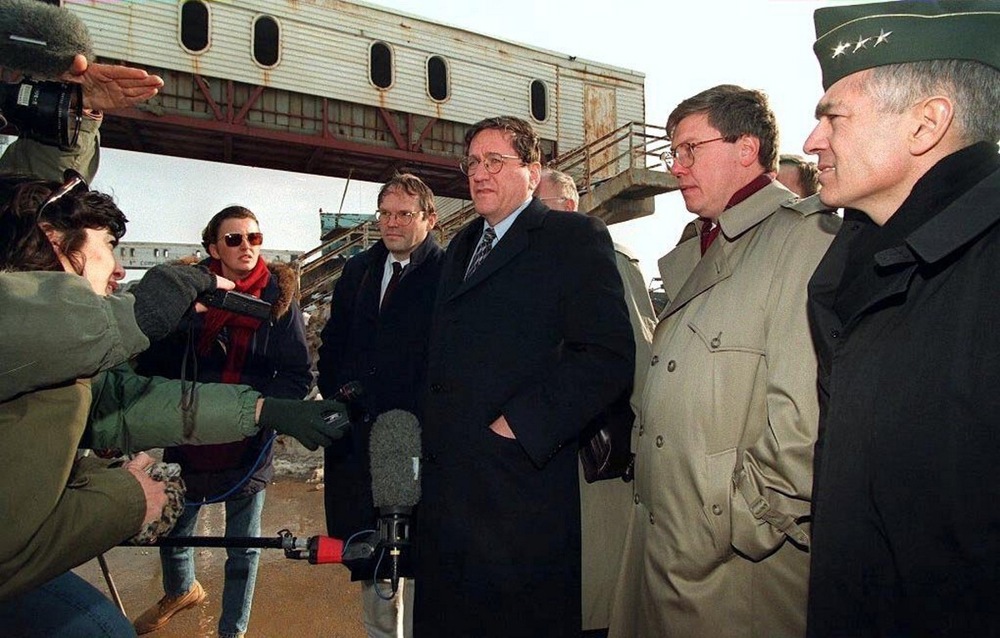
Nelson, the former US ambassador, described the Dayton peace deal as “successful and significant”.
“It is significant because we successfully used our diplomatic and military power to end a war that even led to genocide,” he said. “That is, unfortunately, a rare success and America should remember that while thinking about our role in helping to bring peace to the world. Iraq and Afghanistan were failures by comparison.”
“And I think that in terms of efforts to help your country – we’ve been trying to help it recover for decades. And there have been many different approaches. It’s important to capture a perspective of each ambassador on what has worked and what hasn’t.”
Muhamed Sacirbey witnessed the negotiating of Dayton from the inside, as Bosnia’s ambassador to the United Nations. He went to become foreign minister but now lives in the US. He does not see the deal as a success, but as one that ultimately institutionalised the results of aggression – in ethnic division.
“The key actors, including the mediators, had different agendas, especially self-promotion,” the 76-year-old told BIRN.
“For them, Bosnia and Herzegovina, and therefore Dayton, represented a way to catapult their future political aspirations in many ways,” he said. “The result they wanted was a quick one, which would present them as heroes negotiating among barbarians fighting in religious conflicts that have lasted for millennia.”
“Division, not diversity, was the basis for defining the future.”
The consequences of this approach, according to Sacirbey, have largely defined the future of Bosnia, but are also reflected in Ukraine and other conflicts.
“The war in Ukraine would not have happened if there had not been an ambivalent approach to the aggression of ultranationalism and its consequences, which was rationalised and ratified by the Dayton Agreement,” he said.
Sead Turcalo, dean of the Faculty of Political Sciences in Sarajevo, also saw lessons for Ukraine.
“The Dayton Agreement brought peace, but at the cost of permanent international supervision and a frozen conflict within the state,” he said. “This type of model, if replicated elsewhere, could mean an imposed divided order in Ukraine, which carries the risk of perpetuating instability rather than a lasting solution.”
‘What not to do’