A a secular American, I am not a fan of unsubtle public displays of religion. However, us Americans can find it little disturbing based on our national traditions that a government would ban such a display.
Assyrian_Nation on
Iraq used to have local bans during the war with ISIS
FMSV0 on
Portugal just banned burka, niqab and other forms of face covering
Throwawayhair66392 on
Now do Muslim countries in Central Asia.
fedricohohmannlautar on
“The land of the free”
Signumus on
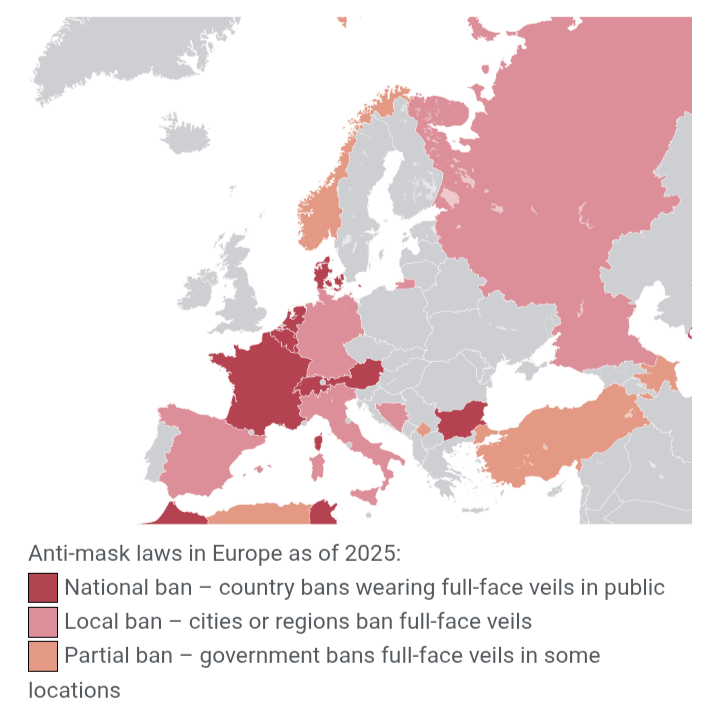
Terrible map. E.g. the Netherlands doesn’t have a general ban face coverings in public, only in specific public areas.
jarvxs on
Is Europe in the room with us
Grzechoooo on
r/PhantomBorders the beacon of religious tolerance that was the Polish-Lithuanian Commonwealth still lives on ❤️
/j <- for that special person who needs it <3
ChewyMurray on
But the square heads gang up on Québec, smh
Conscious_Sail1959 on
Better ban Islam outright than those measures
muck2 on
Germany also has a nationwide ban for all religious symbols in public service (including headscarves).
VertibirdQuexplota on
It’s a really a ridiculous measure. Don’t force anyone to cover themselves, but people who voluntarily want to do it shouldn’t be forbidden from doing so.
Ebi5000 on
What is the source? Germany has a blanket ban on face covering of any type in a wide range of places and scenarios but somehow only a local ban according to the map. Is it simply because of the federal system meaning that each state has its own laws?
[deleted] on
[deleted]
Cultural-Ad-8796 on
Why ban face coverings?
HarrMada on
So much for freedom. Good on the gray countries.
Kandurux on
Not in Denmark if it’s cold.
martinkuehhas181 on
If you don’t like it feel free to migrate to Saudi-Arabia, Afghanistan etc
Bobby-B00Bs on
Zoom put a bit, it’s be a shame to see that more secular countries, like Morocco, which are Muslim majority, also realized that FULL – emphasis on full facial covering ought to be banned.
conqueringLeon on
What are the French or Dutch bikers doing if they are not allowed to Wear a helmet?
pattyboy227 on
So this is the “progressive” and “tolerant” Europe that American leftists idolize so much?
snek99001 on
The grey countries in this map are the ones who are truly free.
LiitoKonis on
For people that don’t get it : before even the religious debate it’s a matter of security and citizenship. Wearing a face covering that doesn’t allow people to recognize you is not something that society tolerates here, you speak to me, I get to know who you are and your religion isn’t up there to debate if you can hide your face
UmaThermos1 on
What’s stopping you from wearing a face mask pretending you’re ill but you actually just wanna hide your face
athe085 on
Look at North Africa and tell me that the ban is Islamophobic
whitepowerranger95 on
Hmmm. I wonder why.
RogueTraderMD on
Italy is completely wrong: local authorities, like cities or regions, have no power to ban veils in public spaces like streets. Multiple court rulings have clarified that veiling is a constitutional right (under the freedom of religion), and, as Italy isn’t a federal state, the laws are the same everywhere.
The most a region or a municipality can do is issue entry rules for public buildings under their authority (a hospital, a townhouse, etc.) under the claim of “security needs”. It usually happens in the North, where the very racist Lega party is stronger, but those entry rules are often at risk of being overruled when appealed in court.
The national law is: people can cover their faces in public only if they have a justified reason to do so. Maybe you’re wearing a balaclava because it’s snowing like there’s no tomorrow, maybe you’re a Muslim woman wearing a niqab: both are perfectly justified reasons for Italian law.
The catch is that, whatever your reason, any public officer can ask you to identify yourself at the officer’s whim. It’s an anti-terrorism rule from the 1970s, and the usual example is people walking while wearing a full biker helmet.
Just like those locally administered buildings, banks or bars usually sport signs with a “no entry with your face covered” warning (still, the issue is masked robbers, not Middle Eastern housewives), but those are private spaces.
So, since other people from other nations are complaining about this map, we can safely assume that this map is terrible overall.
Ricky911_ on
I remember the backlash when Switzerland banned them in 2021. There were outcries about how this was going to affect the Islamic community. Meanwhile, Islamic North Africa already has them banned. Honestly, I remember walking in Ancona, Italy, a city with a huge amount of Muslim migrants. I remember seeing husbands in shorts and shirts walking with women whose bodies were fully covered up to the face. When even other Islamic countries tell you this is barbaric, you need to wake up
GapSea7055 on
What can possibly be the justification on this drastic infringement on freedom?
TheDarwinski on
Wow covid really messed people up
Spac3_C4t on
Outdated, Portugal just passed “burka” laws. Essentially, it forbids covering the whole face in public and does not specifiy the burka itself but it is now a thing.

32 Comments
Are COVID masks included?
A a secular American, I am not a fan of unsubtle public displays of religion. However, us Americans can find it little disturbing based on our national traditions that a government would ban such a display.
Iraq used to have local bans during the war with ISIS
Portugal just banned burka, niqab and other forms of face covering
Now do Muslim countries in Central Asia.
“The land of the free”
Terrible map. E.g. the Netherlands doesn’t have a general ban face coverings in public, only in specific public areas.
Is Europe in the room with us
r/PhantomBorders the beacon of religious tolerance that was the Polish-Lithuanian Commonwealth still lives on ❤️
/j <- for that special person who needs it <3
But the square heads gang up on Québec, smh
Better ban Islam outright than those measures
Germany also has a nationwide ban for all religious symbols in public service (including headscarves).
It’s a really a ridiculous measure. Don’t force anyone to cover themselves, but people who voluntarily want to do it shouldn’t be forbidden from doing so.
What is the source? Germany has a blanket ban on face covering of any type in a wide range of places and scenarios but somehow only a local ban according to the map. Is it simply because of the federal system meaning that each state has its own laws?
[deleted]
Why ban face coverings?
So much for freedom. Good on the gray countries.
Not in Denmark if it’s cold.
If you don’t like it feel free to migrate to Saudi-Arabia, Afghanistan etc
Zoom put a bit, it’s be a shame to see that more secular countries, like Morocco, which are Muslim majority, also realized that FULL – emphasis on full facial covering ought to be banned.
What are the French or Dutch bikers doing if they are not allowed to Wear a helmet?
So this is the “progressive” and “tolerant” Europe that American leftists idolize so much?
The grey countries in this map are the ones who are truly free.
For people that don’t get it : before even the religious debate it’s a matter of security and citizenship. Wearing a face covering that doesn’t allow people to recognize you is not something that society tolerates here, you speak to me, I get to know who you are and your religion isn’t up there to debate if you can hide your face
What’s stopping you from wearing a face mask pretending you’re ill but you actually just wanna hide your face
Look at North Africa and tell me that the ban is Islamophobic
Hmmm. I wonder why.
Italy is completely wrong: local authorities, like cities or regions, have no power to ban veils in public spaces like streets. Multiple court rulings have clarified that veiling is a constitutional right (under the freedom of religion), and, as Italy isn’t a federal state, the laws are the same everywhere.
The most a region or a municipality can do is issue entry rules for public buildings under their authority (a hospital, a townhouse, etc.) under the claim of “security needs”. It usually happens in the North, where the very racist Lega party is stronger, but those entry rules are often at risk of being overruled when appealed in court.
The national law is: people can cover their faces in public only if they have a justified reason to do so. Maybe you’re wearing a balaclava because it’s snowing like there’s no tomorrow, maybe you’re a Muslim woman wearing a niqab: both are perfectly justified reasons for Italian law.
The catch is that, whatever your reason, any public officer can ask you to identify yourself at the officer’s whim. It’s an anti-terrorism rule from the 1970s, and the usual example is people walking while wearing a full biker helmet.
Just like those locally administered buildings, banks or bars usually sport signs with a “no entry with your face covered” warning (still, the issue is masked robbers, not Middle Eastern housewives), but those are private spaces.
So, since other people from other nations are complaining about this map, we can safely assume that this map is terrible overall.
I remember the backlash when Switzerland banned them in 2021. There were outcries about how this was going to affect the Islamic community. Meanwhile, Islamic North Africa already has them banned. Honestly, I remember walking in Ancona, Italy, a city with a huge amount of Muslim migrants. I remember seeing husbands in shorts and shirts walking with women whose bodies were fully covered up to the face. When even other Islamic countries tell you this is barbaric, you need to wake up
What can possibly be the justification on this drastic infringement on freedom?
Wow covid really messed people up
Outdated, Portugal just passed “burka” laws. Essentially, it forbids covering the whole face in public and does not specifiy the burka itself but it is now a thing.